In this guide
- Do you need glass for a bathroom partition? The honest answer
- Bathroom partition options without glass, at a glance
- Shower curtain: the bathroom partition for rentals and small budgets
- Half wall or kerb: the masonry bathroom partition
- Acrylic and polycarbonate sheets: the light bathroom partition
- Glass bathroom partition: what you pay more for, and its drawbacks
- Glass or no glass: which bathroom partition suits your situation
- Plan the bathroom kerb now so a glass partition can come later
- Shower wall ideas other than tile: a short note
- Questions to settle before choosing a bathroom partition
Key takeaways
- A shower curtain is the cheapest and easiest partition. It suits rentals, but water still escapes under it.
- A half wall is permanent and private. It is mason's work, and it takes floor space that glass does not.
- Acrylic and polycarbonate sheets are light and hard to break. They scratch and turn cloudy sooner than glass.
- A kerb alone stops water on the floor, not spray. It works best together with a screen above it.
- Fabrockers fits glass only. The other options are not our trade, and this guide still says where each one wins.
Do you need glass for a bathroom partition? The honest answer
No. A bathroom partition only has to keep shower water on the wet side of the room. Glass does that best over many years, but it is also the costliest option, and it needs a finished bathroom with solid walls. If you rent, or the budget is tight, or the bathroom will be renovated soon, a partition without glass can be the better choice for now.
You should know who is writing this. We make and fit toughened glass partitions. We do not sell or fit curtains, acrylic sheets, PVC doors or masonry walls. So read this as a fair comparison from people who see many bathrooms, not as a list of our services.
Bathroom partition options without glass, at a glance
| Option | Stops spray | Stops floor water | How it ages | Best for |
|---|---|---|---|---|
| Shower curtain | Partly; it moves and leaves gaps | No, unless it hangs inside a kerb | Needs washing; replaced every so often | Rentals, tight budgets, short stays |
| Kerb alone | No | Yes | Lasts as long as the tiles | Bucket baths; a first step before any screen |
| Half wall, tiled | Up to its height | Yes | Permanent; grout lines need cleaning | Privacy beside the WC during a full renovation |
| Acrylic or polycarbonate sheet in a frame | Yes | Mostly, with a bottom seal | Scratches and turns hazy with years | Lower budgets; walls too weak for glass |
| PVC folding door | Mostly | Partly | Folds and track collect scale; hinges wear | Full privacy at low cost |
| Toughened glass | Yes | Yes, with a kerb and seals | Stays clear for years if wiped | An owned home with finished tiles |
Notice the second column and the third. Spray and floor water are two different problems. Most disappointments come from fixing one and forgetting the other. If the floor stays wet whatever you hang, see bathroom floor always wet after a shower.
Shower curtain: the bathroom partition for rentals and small budgets
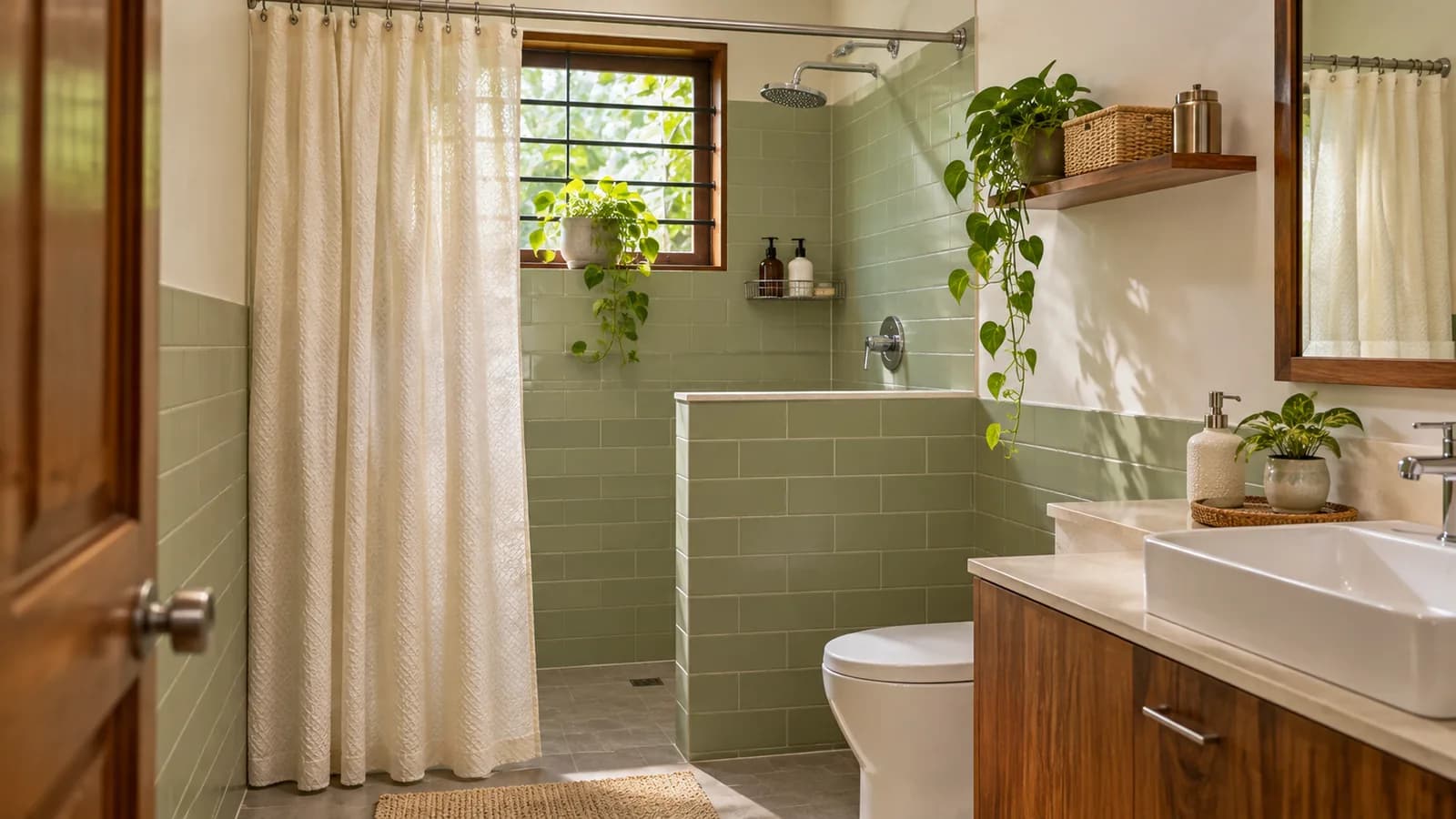
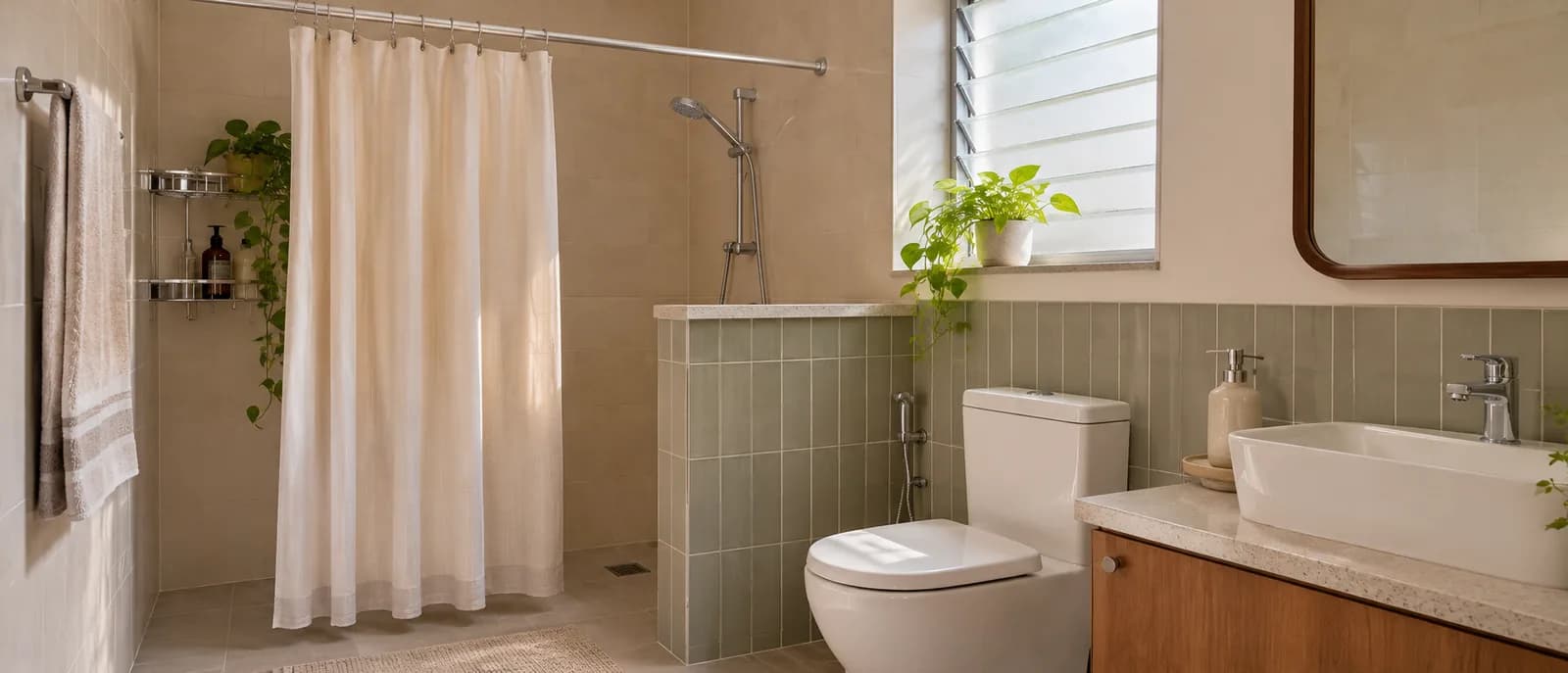
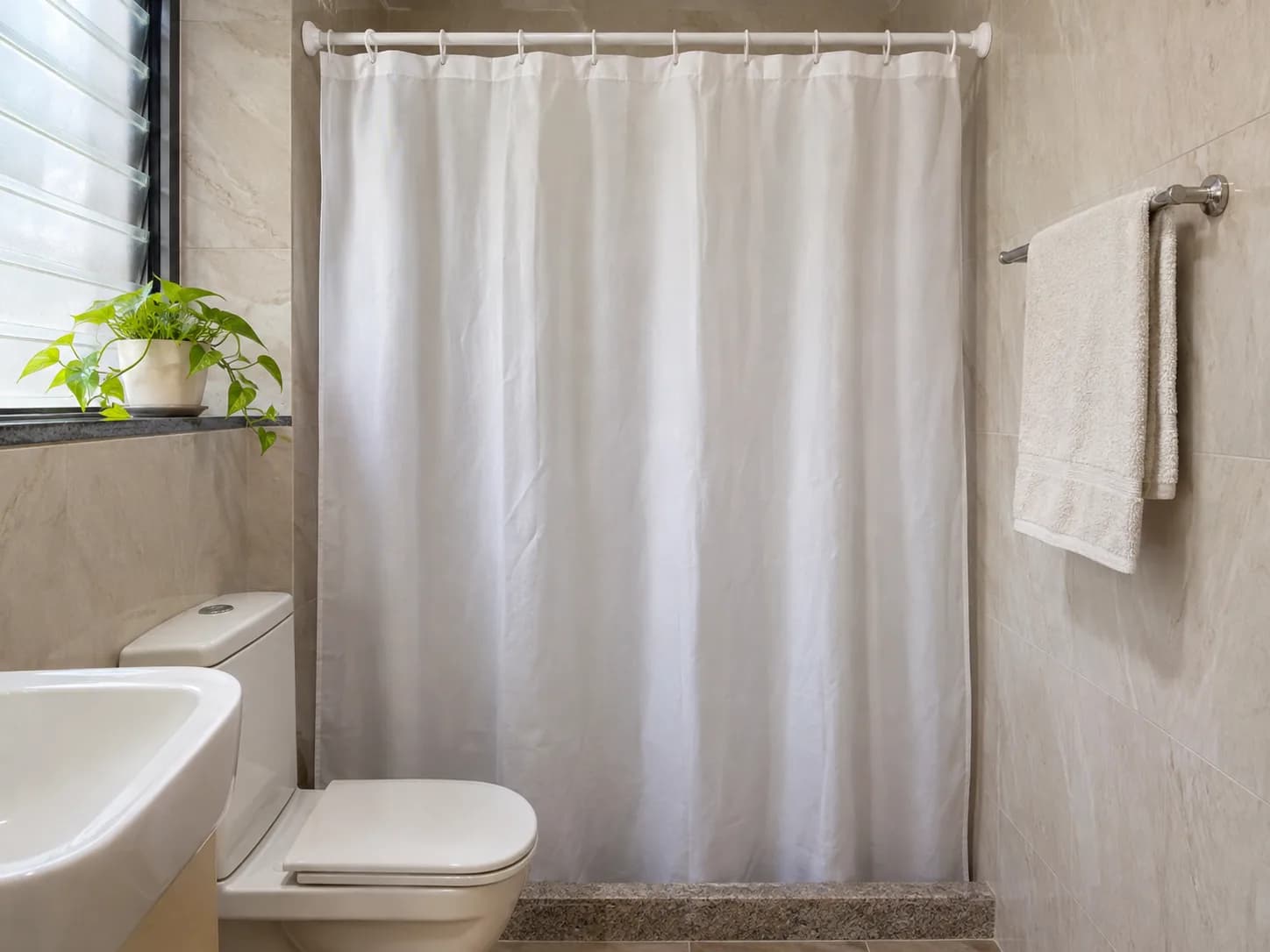
A shower curtain is a waterproof sheet on a rod. It is the cheapest partition, and it goes up in minutes. A tension rod holds itself between two walls by spring pressure, so nothing is drilled. That matters in a rented flat, where holes in the owner's tiles can become an argument.
A curtain is also the only partition that disappears. Slide it aside and the whole floor is yours again. In a very small bathroom, or one where a child is bathed from a bucket, that freedom can matter more than a perfect seal.
Its weakness is the bottom edge. Water runs down the curtain and under it, and air from the shower pulls the sheet inward. The fabric also stays damp, so it needs washing or it grows mould.
- Hang it inside a kerb. The curtain's hem should fall on the shower side of the raised strip.
- Choose a weighted hem. A heavier bottom edge clings less and gaps less.
- Spread it out after the bath. A bunched curtain stays wet in its folds.
- Wash it regularly. Most fabric curtains can go in the washing machine; check the label.
Half wall or kerb: the masonry bathroom partition
A kerb is a low raised strip across the floor, usually stone or tile. It stops water running along the floor into the dry side. It does nothing for spray. For a family that bathes with a bucket and mug, a kerb alone may be all the partition they need.
A half wall, also called a dwarf wall, is a short tiled wall between the shower and the WC. It is commonly built somewhere between waist and chest height. It gives real privacy for the WC side, a ledge for bottles, and a solid surface that nobody worries about breaking.
It has three costs. It is several inches thick once tiled, and a small bathroom feels that. It blocks light and makes the room look like two small boxes. And it is permanent: it is built with the floor, waterproofed with the floor, and removed only by breaking tiles. Spray above its height still crosses over.
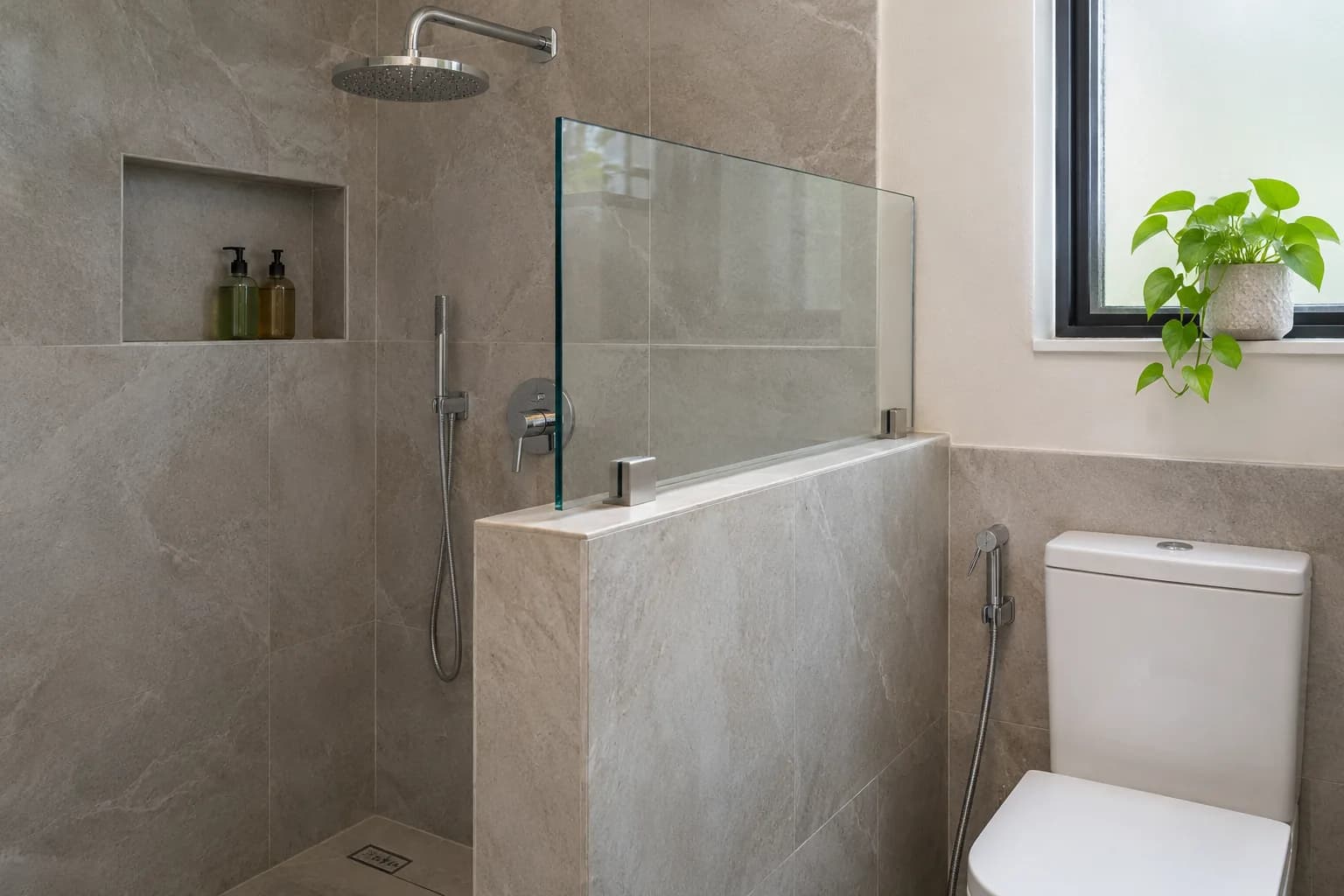
Many homes mix the two ideas: a half wall below and a short glass panel on top. The wall gives privacy and the glass stops the spray without closing the room. The masonry is the mason's work. The glass above it is something we can measure for.
Acrylic and polycarbonate sheets: the light bathroom partition
Acrylic is a clear, rigid plastic that looks like glass and weighs much less. Polycarbonate is a tougher plastic that is very hard to break. Both are sold as shower panels, usually held in an aluminium frame because the sheet bends without one.
Their strengths are real. They are light, so they can go on walls that could not carry glass. They do not shatter. They usually cost less. And they can be cut on site, so a small measuring error is not a disaster.
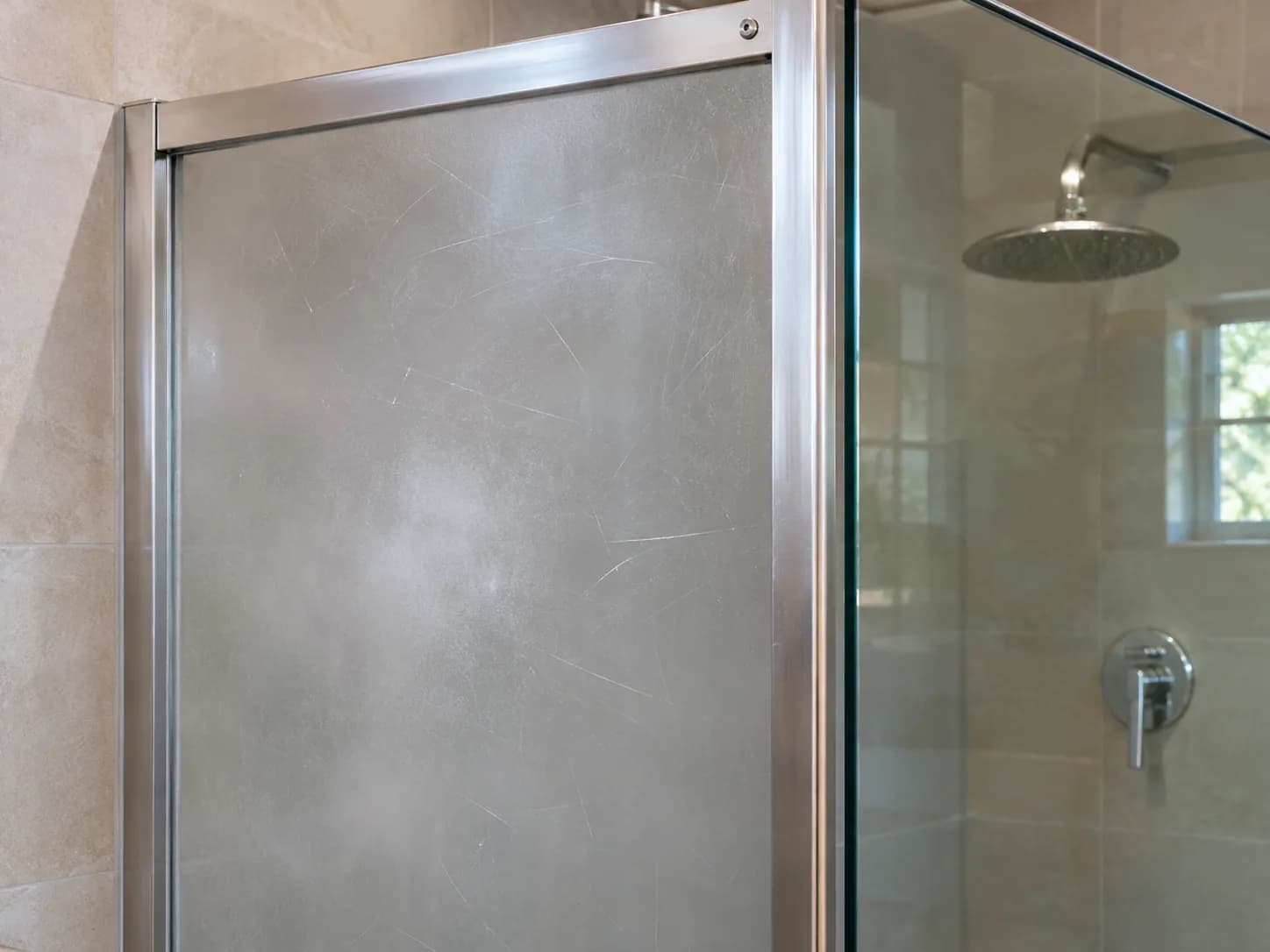
Their weakness is the surface. Plastic is much softer than glass. A rough scrubber leaves fine scratches, and scratches hold soap and scale. Over the years many sheets turn hazy or yellowish, faster with strong cleaners. A panel that looked like glass on day one often does not after a few years.
- Choose plastic when the budget is fixed, the wall is hollow or weak, or the bathroom will be redone soon.
- Clean it only with a soft cloth and mild soap. Never use a scouring pad or a solvent.
- Expect to replace it sooner than you would replace glass.
PVC folding doors as a shower partition
A folding PVC door hangs from a top track and closes like a concertina. It is common on bathroom entrances in India, and some homes use one across the shower. It is cheap and fully opaque, and it folds away to one side. In a wet zone its folds and track collect soap and scale. The bottom edge is not watertight.
Glass bathroom partition: what you pay more for, and its drawbacks
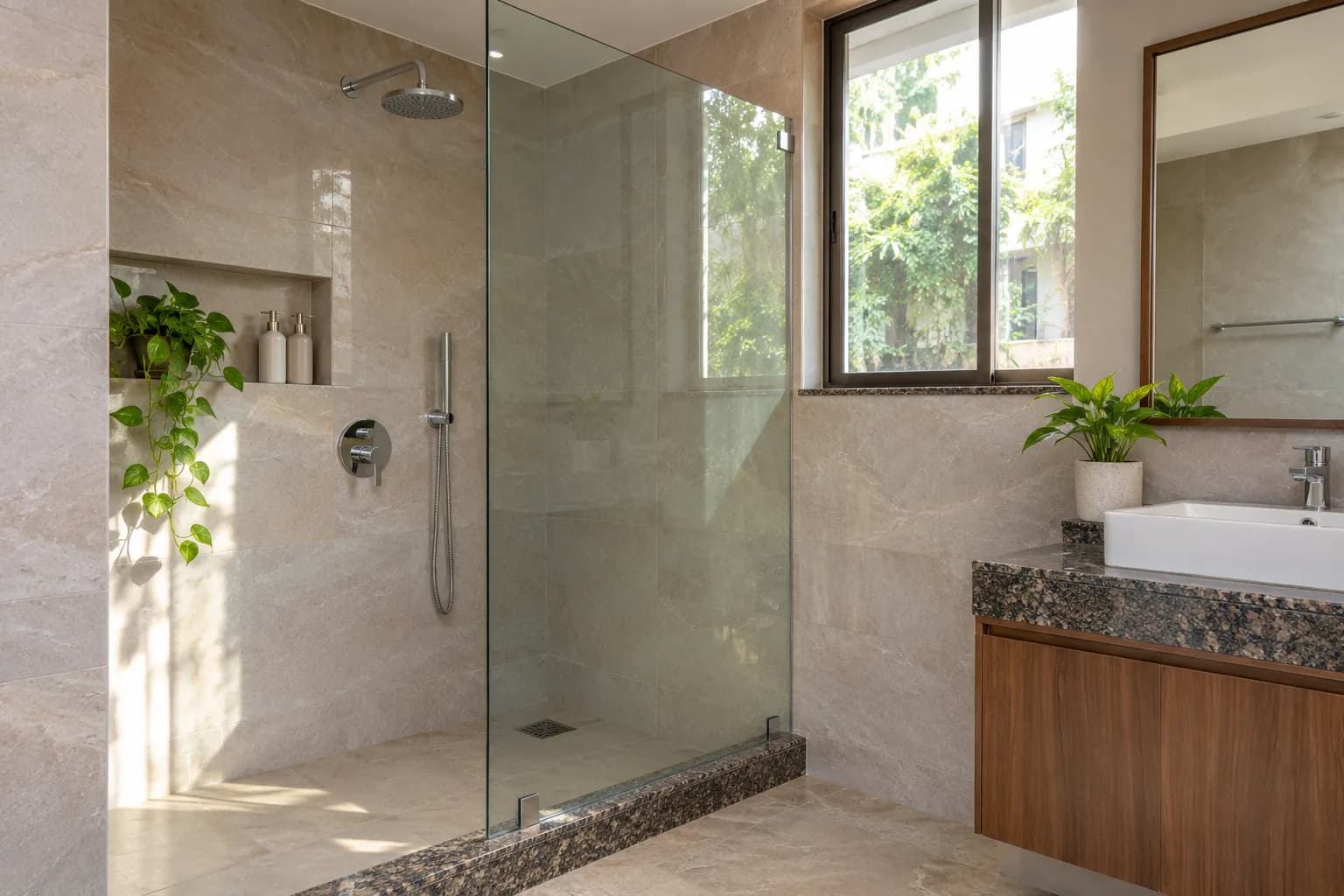
A glass partition is a sheet of toughened glass, a safety glass that is heat-treated for strength. If it ever breaks, it falls into small blunt pieces instead of long sharp ones. It is rigid, so its seals stay where they were set. Its surface is hard, so ordinary cleaning does not scratch it.
That is what the extra money buys: a partition that looks the same after years of daily use. It takes up only the thickness of the glass. It lets light through, so a small bathroom still looks like one room.
It has honest drawbacks too:
- It costs the most of the options in this guide.
- It is heavy. A glass door needs a solid wall behind its hinges.
- It cannot be trimmed. It is measured after tiling and made to that size.
- It is drilled into the tiles. In a rented flat you need the owner's consent.
- It shows hard water marks. A wipe after each bath prevents them; see how to clean shower glass.
The least costly glass option is a walk-in fixed panel, because it has no door and no moving parts. A sliding shower glass door closes the shower fully where there is no room for a door to swing. Every build is on the shower cubicles page, and the shower cubicle cost guide shows the current rates.
Glass or no glass: which bathroom partition suits your situation
| Your situation | Usually the better choice | Why |
|---|---|---|
| Rented flat, short stay | Curtain on a tension rod | No drilling, and it leaves with you |
| Rented flat, long stay, owner agrees | Fixed glass panel, or a framed plastic panel | A small fixed job the owner may welcome |
| Own flat, tight budget this year | Curtain now, with the kerb built properly | Glass can be measured later without breaking anything |
| Own home, full renovation | Glass | The tiles are new and the walls are open to planning |
| Very small bathroom, bucket baths | Kerb with a curtain, or a fixed glass panel | A closed cubicle can feel cramped |
| Hollow or weak wall | Framed plastic panel, a half wall, or a fixed glass panel after a site check | A heavy glass door needs a solid fixing |
| Someone needs help while bathing | Curtain or a wide walk-in opening | A helper can reach in without a door in the way |
If privacy is what pushes you away from glass, look at frosted and fluted glass first. Both hide the person and still pass light. Our guide to frosted or clear glass for a bathroom compares them, and the fluted glass shower enclosure shows the ribbed version.
If glass looks right for your bathroom, book a measuring visit. We check the wall and the floor slope first and tell you what we find.
Plan the bathroom kerb now so a glass partition can come later
Many people start with a curtain and move to glass a year or two later. That works well if the floor is built for it from the start. The kerb and the floor slope decide whether any partition works, so get those right even if the screen above them is a curtain for now.
- Give the shower side its own drain, and slope that floor toward it.
- Build the kerb straight and level along its whole length. Glass is cut straight.
- Make the kerb wide enough for a glass panel and its seal to sit on.
- Finish the wall tiles fully on both sides of the kerb line.
Our guide to wet and dry bathroom design explains the slope, the kerb and where the glass stands. If you are choosing a glass layout for a compact room, see shower partition ideas for small bathrooms.
Shower wall ideas other than tile: a short note
Some people searching for partitions are really asking about the walls inside the shower. That is a different question. The usual alternatives to tile are large stone or quartz slabs, waterproof PVC or acrylic wall panels, and special waterproof plaster finishes. All of them are a tiler's or a waterproofing contractor's work, not ours. Whatever the wall finish, it must be complete before any glass is measured.
Questions to settle before choosing a bathroom partition
- Do you own the flat? If not, ask the owner before anything is drilled.
- How long will this bathroom stay as it is? A temporary bathroom needs only a temporary partition.
- Is it spray or floor water that troubles you? Spray needs a screen. Floor water needs a kerb and a slope.
- Are the walls solid and the tiles finished? Glass needs both.
- How much cleaning will really happen? A curtain needs washing, plastic needs gentle care, and glass needs a daily wipe.
If the answers point to glass, we fit it in Bengaluru and across Delhi NCR. If they point elsewhere, that is a good answer too. A dry floor is the goal, and there is more than one way to reach it.
Common questions
What can I use instead of glass for a bathroom partition?
The common choices are a shower curtain, a tiled half wall, a kerb alone, an acrylic or polycarbonate sheet in a frame, and a folding PVC door. Each stops a different amount of water. A curtain suits rentals, a half wall suits a full renovation, and a plastic sheet suits a lower budget or a weak wall.
Is an acrylic sheet good for a bathroom partition?
It is light, hard to break and usually cheaper than glass, so it suits a tight budget or a wall that cannot carry glass. Its surface is soft. It scratches easily and often turns hazy over the years, so it needs gentle cleaning and may need replacing sooner.
Which is better for a shower, a curtain or a glass partition?
Glass keeps water in better and looks the same for years, but it costs more and is fixed to the tiles. A curtain costs little, needs no drilling and slides away, but water escapes under it and it needs washing. For a rented flat a curtain is often the sensible choice. For an owned, finished bathroom, glass usually is.
What is the cheapest way to separate the wet and dry area in a bathroom?
A low kerb on the floor with a shower curtain above it. The kerb stops water running across the floor, and the curtain stops most of the spray. Build the kerb straight and level, and a glass panel can replace the curtain later.
Can I put a bathroom partition in a rented flat without drilling?
Yes. A shower curtain on a tension rod needs no holes, because the rod presses between two walls. Glass and most framed panels are drilled into the tiles, so they need the owner's consent.
Does Fabrockers fit acrylic, PVC or curtain bathroom partitions?
No. We fit toughened glass partitions and doors, and we repair existing shower doors. Curtains, plastic panels, PVC doors and half walls are not our trade. A hardware shop, a carpenter or a mason is the right person for those.
Have a question this guide did not answer? Call us or send a photo on WhatsApp and we will tell you what it needs.
