In this guide
- How to clean shower glass doors: the short answer
- What is on your shower glass: scale, soap film or etching
- How to clean shower glass with vinegar, step by step
- Cleaning shower glass with baking soda and vinegar
- Removing hard water stains on glass shower doors that are months old
- How to clean shower glass without scratching it
- What damages shower door seals, hinges and handles
- The daily squeegee habit that keeps shower glass clear
- When hard water stains on glass are etched and cleaning will not fix them
- Shower glass cleaning mistakes that cost a new panel
Key takeaways
- Most white marks are mineral scale, and scale cleans off. Plain white vinegar and a soft sponge remove fresh hard water stains.
- Nothing rough should touch the glass. Steel wool, scouring pads, blades and gritty powders leave scratches.
- Strong acids damage what holds the glass. Toilet acid and bleach attack seals, chrome, stainless steel and stone.
- A wiper after every bath prevents most stains. Scale forms only where water is left to dry.
- Etched glass does not clean. If a haze stays after a proper clean, the surface itself is damaged.
How to clean shower glass doors: the short answer
Mix white vinegar and water half and half in a spray bottle. Spray it on dry glass and wait a few minutes. Wipe with a soft sponge, rinse with clean water, and dry the glass with a rubber wiper. Clean shower glass with a mild acid such as vinegar and a soft cloth, never with anything rough, and dry it after every bath.
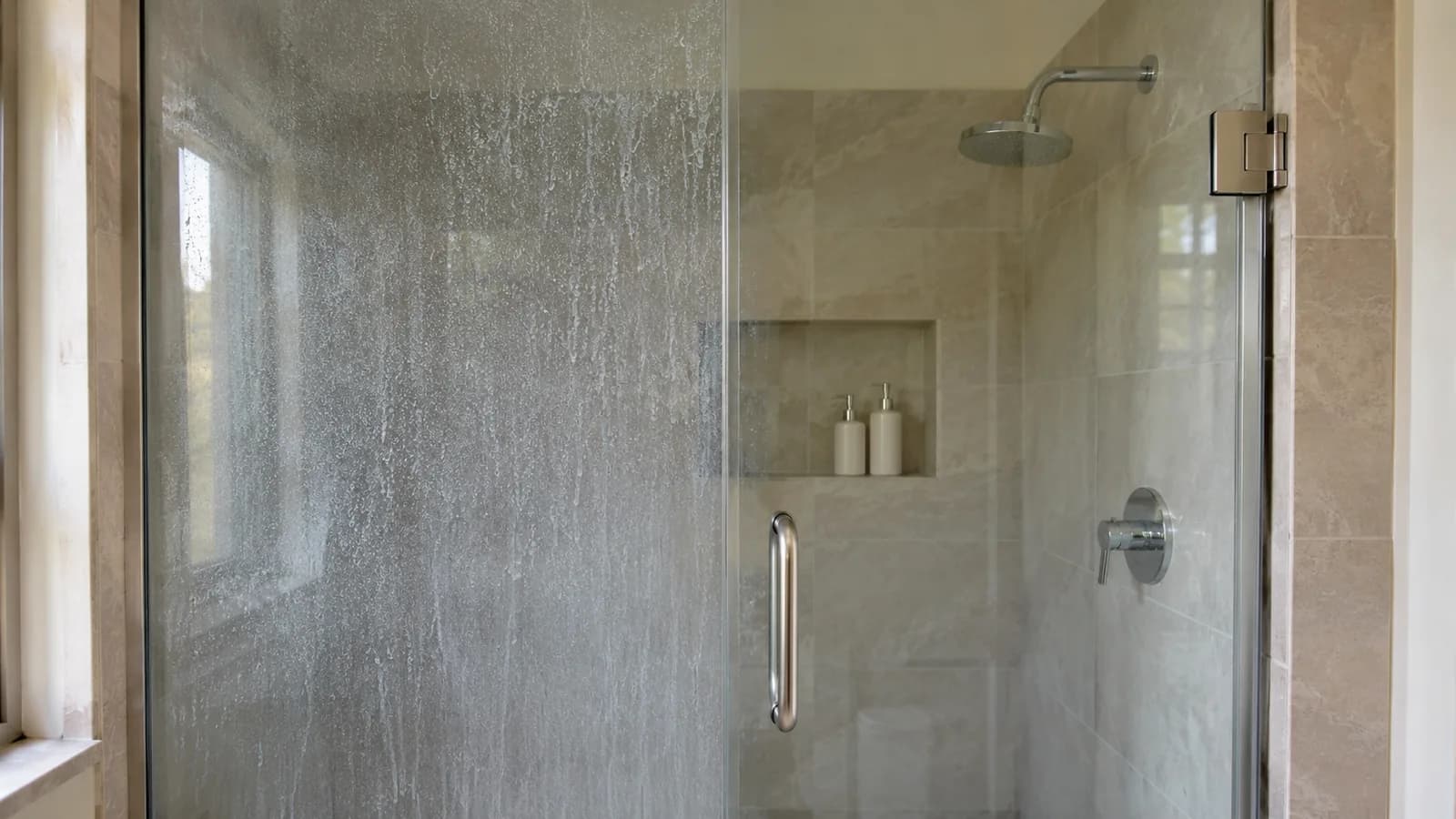
It helps to know what you are cleaning. Hard water is water that carries dissolved minerals, mainly calcium and magnesium. Borewell water in Bengaluru and much of the supply in Delhi NCR is hard. When a drop dries on the glass, the water leaves and the minerals stay. That white deposit is called scale.
What is on your shower glass: scale, soap film or etching
Different marks need different answers. Look closely and run a fingernail across the mark before you choose a method.
| Mark | How it looks and feels | What removes it |
|---|---|---|
| Fresh hard water spots | White dots where drops dried; slightly rough; almost vanish when wet | Diluted vinegar and a soft sponge |
| Old, thick scale | A white crust low on the glass and near the handle; clearly rough | A vinegar soak, repeated |
| Soap film | A dull, greasy layer that smears when rubbed | Baking soda paste or mild dish soap, then vinegar |
| Brown streaks under a hinge or handle | Rust-coloured lines running down from a fitting | They wipe off, but the fitting is rusting; see rust on a shower door |
| Black spots on the clear seals | Dark dots in the strip along the door edge | Surface mould wipes off; mould inside the strip returns, see mould on a shower door seal |
| Etching | A milky or rainbow haze that stays after cleaning; feels smooth | Nothing; the glass surface is damaged |
How to clean shower glass with vinegar, step by step
- Start with dry glass and moving airVinegar works best when shower water has not diluted it. Open the window or switch on the exhaust fan.
- Mix and sprayMix white vinegar and water half and half. For heavy marks use the vinegar undiluted. Spray from the top of the glass down.
- Give it timeLeave it for five to ten minutes. The acid needs time to soften the minerals. Spray again if a patch dries.
- Wipe with something softUse a soft sponge or a microfibre cloth, in small circles. Let the vinegar do the work, not your arm.
- Rinse everything wellRinse the glass, the hinges, the handle, the seals and the floor with clean water. Vinegar should not be left sitting on metal or stone.
- Dry with a wiper, then a clothPull a rubber wiper down the glass in overlapping strokes. Dry the fittings with a cloth.
Lemon juice works the same way, because it is also a mild acid. A shop-bought bathroom descaler works too. Read its label, test a corner first, and keep it off metal fittings and stone unless the label says it is safe there.
Cleaning shower glass with baking soda and vinegar
Baking soda is a fine, soft powder. Mixed into a paste with a little water, it lifts soap film without scratching glass. It is the right tool when the glass feels greasy and vinegar alone only smears it.
Many videos mix baking soda and vinegar together in a bowl. The fizz looks powerful, but the two mostly cancel each other out. Use baking soda and vinegar one after the other: the paste first to loosen soap film, then the vinegar spray to dissolve the minerals.
- Mix about three spoons of baking soda with one spoon of water to make a thick paste.
- Wet the glass, then rub the paste on gently with a soft, wet sponge.
- Spray diluted vinegar over the paste. Let it fizz for a minute.
- Wipe it all off with the sponge and rinse the glass thoroughly.
- Dry the glass with a wiper. Dried baking soda leaves its own white film.
Soap film comes mostly from bar soap, which reacts with the minerals in hard water. Liquid body wash usually leaves less of it. If soap film is your main problem, that small change helps more than any cleaner.
Removing hard water stains on glass shower doors that are months old
Old scale builds in layers, and one spray will not go through all of them. The answer is a longer soak, not a harder scrub.
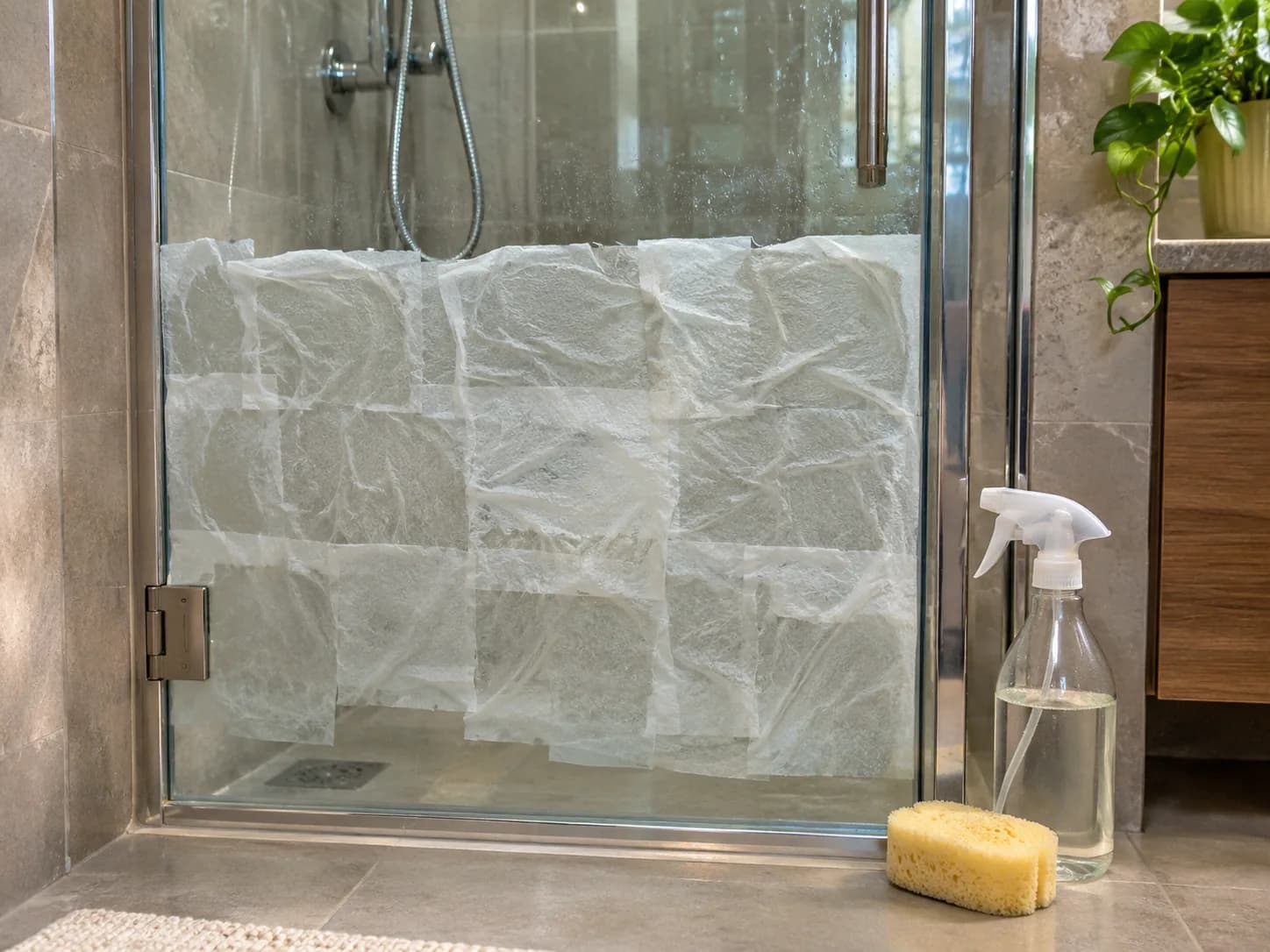
- Soak, do not spray. Wet paper towels or a thin cloth with undiluted vinegar and press them onto the glass. They hold the vinegar against the scale.
- Wait longer. Leave them for twenty to thirty minutes. Wet them again if they start to dry.
- Use warm vinegar. Slightly warm vinegar works faster than cold. Warm is enough; do not boil it.
- Wipe, rinse, look, repeat. Each round removes a layer. Two or three rounds are normal for neglected glass.
If the glass is still hazy after three patient rounds, stop. More force will scratch it. The haze that remains is probably etching, which a later section explains.
How to clean shower glass without scratching it
Glass is hard, but sand, grit and steel are harder. Almost every scratch on shower glass comes from a cleaning tool, not from daily use.
| Safe to use | Do not use |
|---|---|
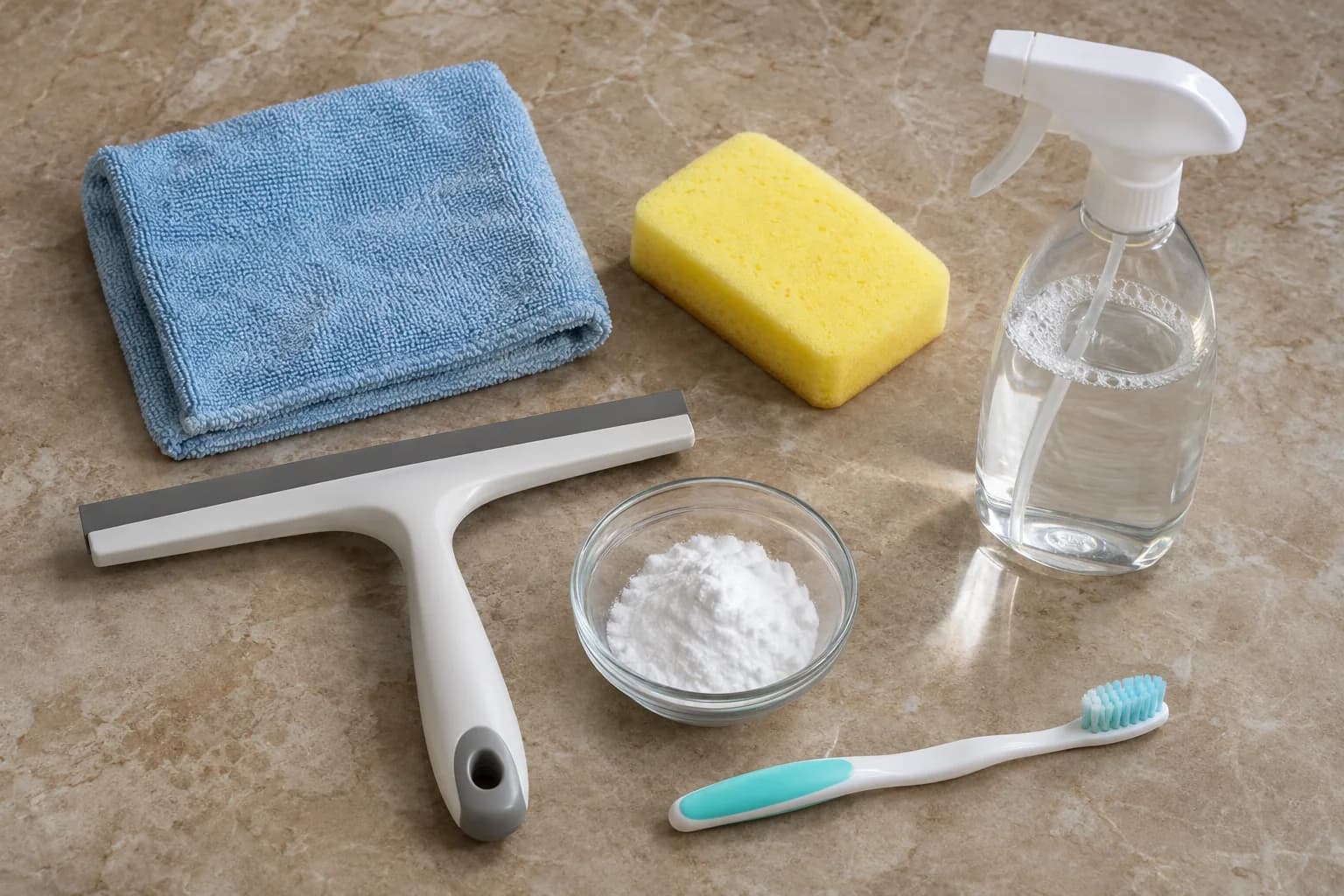
| Microfibre cloth or soft cotton cloth | Steel wool or a steel scrubber |
| Soft sponge, or a pad marked non-scratch | Green scouring pads and other rough pads |
| Rubber wiper | Razor blades and metal scrapers |
| Soft old toothbrush for corners and grooves | Sandpaper or emery paper |
| Baking soda paste, vinegar, lemon, mild dish soap | Gritty scouring powders |
| A clean cloth, rinsed often | A dirty cloth carrying grit, or a dry cloth on dusty glass |
Some guides suggest a razor blade for stubborn scale. On toughened glass a blade can drag tiny hard specks across the surface and leave fine scratches. Do not use one on a shower door.
Three kinds of glass need extra care:
- Coated glass. Some shower glass has a coating that makes water bead and run off. Harsh cleaners and rough pads wear it away. Use mild soap and a soft cloth, or follow the care note that came with it.
- Fluted glass. The ribs hold scale in their grooves. Use a soft brush along the ribs, not across them.
- Frosted glass. The frosted face is slightly rough and holds oily marks. Wash it with mild dish soap. Rubbing it with anything abrasive can leave shiny patches.
What damages shower door seals, hinges and handles
The glass is the toughest part of a shower enclosure. The clear plastic seals, the silicone lines, the plated hinges and handles, and the rollers of a sliding door are all weaker. A cleaner that does no harm to the glass can still ruin them.
- Toilet acid and tile acid. These strong acids pit chrome and stainless steel and make seals brittle. Never use them on or near the enclosure.
- Bleach. It whitens mould for a few days. With repeated use it can turn clear seals yellow and stiff, and it can pit stainless steel.
- Vinegar left to sit. A few minutes is fine. Left for hours it can dull plated fittings, so always rinse.
- Rough pads on metal. They cut through thin chrome plating, and rust starts in the scratches.
- Scale left on a sliding rail. It makes the rollers skid and wear. Wipe the rail whenever you clean the glass.
Worn parts are replaced, not cleaned. A seal that stays black or has gone hard needs shower door seal replacement. Rusting hinges and handles are changed on the glass you have: see shower door hinge replacement and shower door handle replacement. A slider that drags after cleaning has usually worn its wheels, which is shower door roller replacement.
The daily squeegee habit that keeps shower glass clear
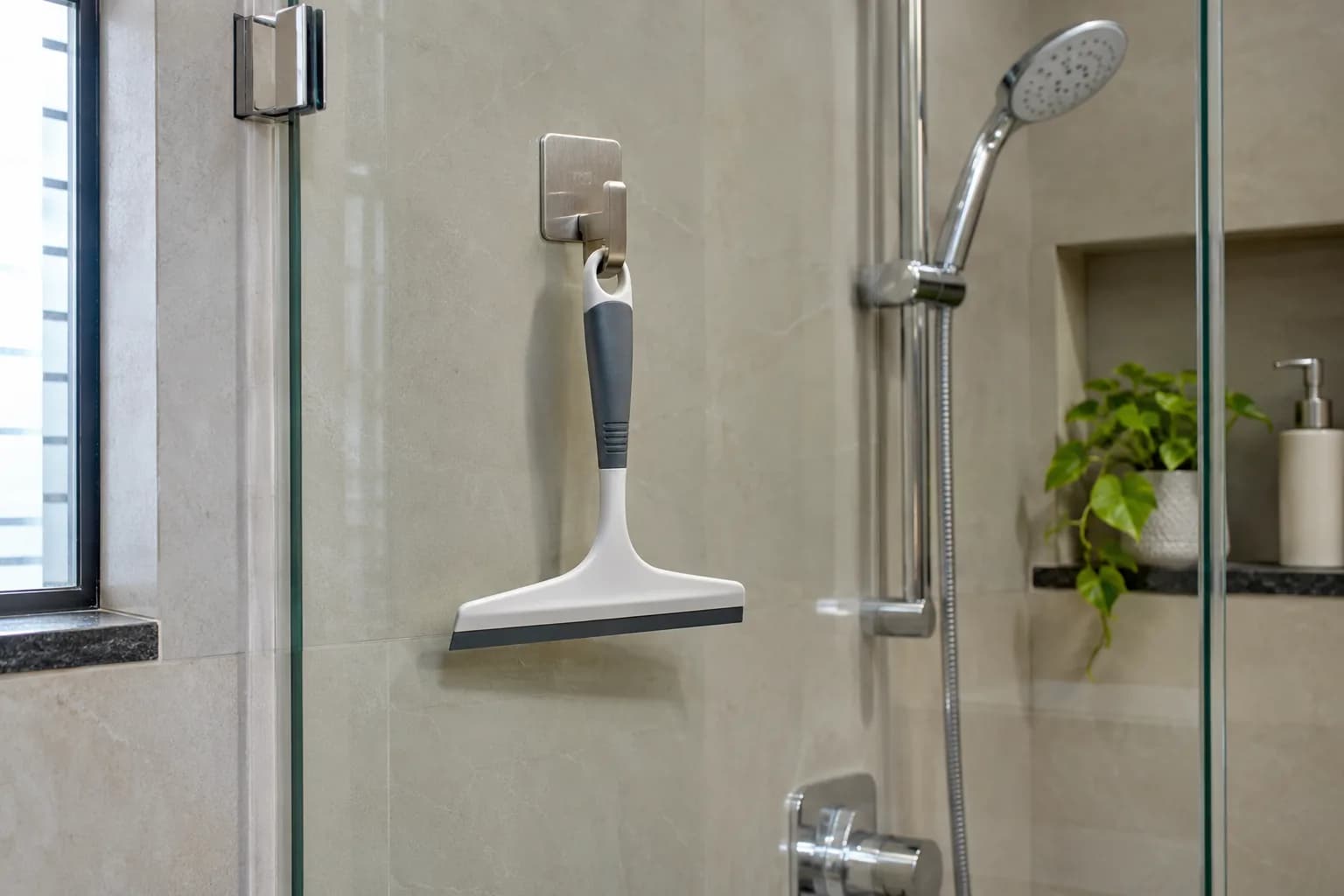
A squeegee is the rubber-bladed wiper most Indian homes already keep for the floor. Buy a small one for the glass and hang it inside the shower. Scale forms only where water dries, so glass that is wiped dry stays clear.
- After the bath, pull the wiper down the glass from top to bottom.
- Overlap each stroke a little, and wipe the blade on a cloth between strokes.
- Run it once along the bottom edge and the kerb.
- Leave the door slightly open, with the window open or the fan on, so the enclosure dries.
| How often | What to do | With what |
|---|---|---|
| After every bath | Wipe the glass dry | Rubber wiper |
| Once a week | Wash off soap film; wipe hinges, handle and rail | Mild dish soap and a soft sponge |
| Every two to four weeks | Remove any white marks before they build | Diluted vinegar |
| Twice a year | Look at the seals, the hinges and the silicone lines | Your eyes; book a repair if a part has failed |
A water softener on the supply reduces scale across the whole bathroom. That is plumbing work, and it is not our trade. A bathroom laid out as wet and dry also keeps splashes in a smaller area; see wet and dry bathroom design.
When hard water stains on glass are etched and cleaning will not fix them
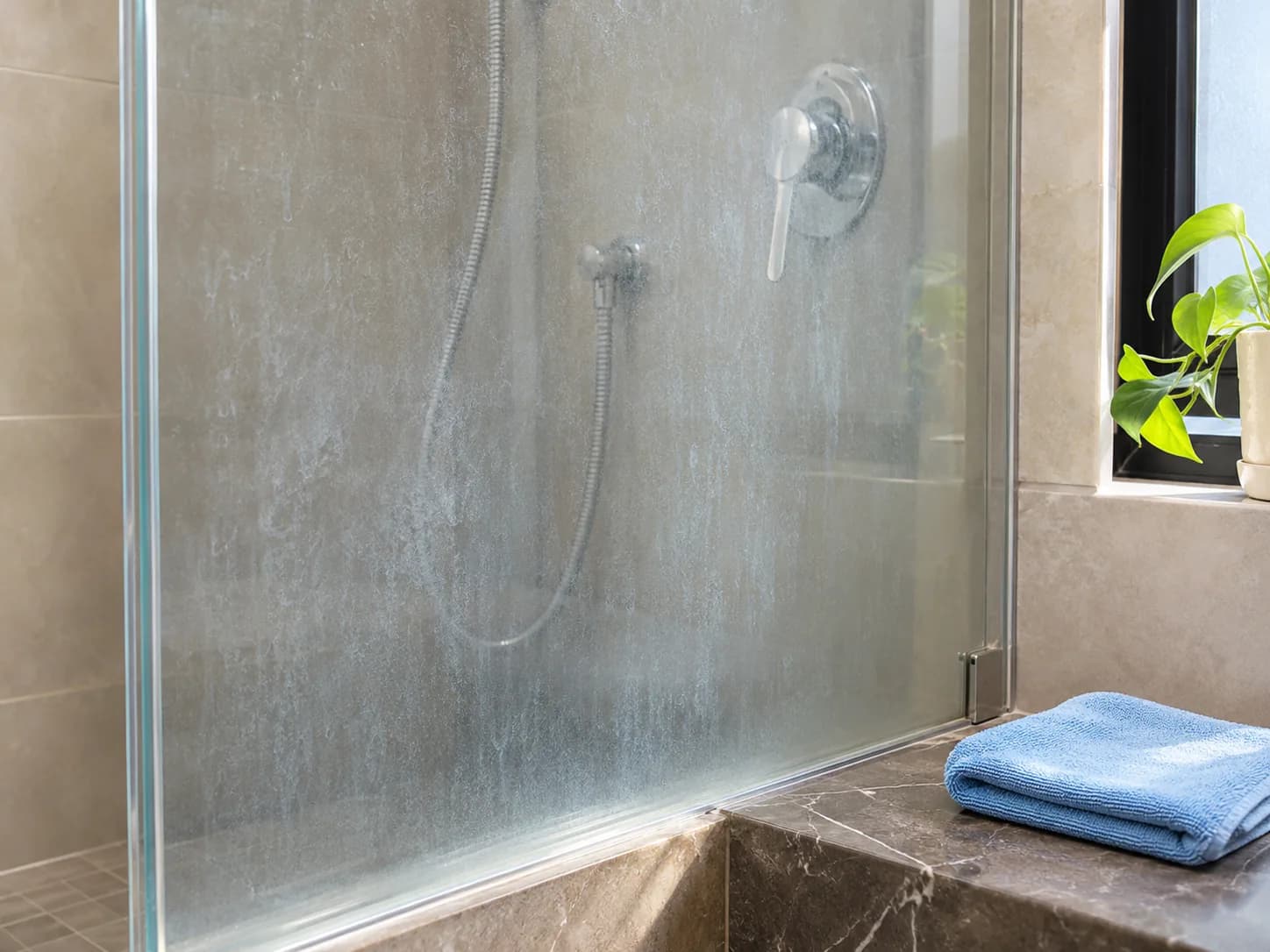
Etching is damage to the glass surface itself. It happens when minerals sit on the glass for a long time and slowly eat into it. If the glass is smooth to a fingernail but still looks milky after a proper clean, the stain is etched in, and no household cleaner will remove it.
Etching usually shows where the shower hits most. Scrubbing harder at this point only adds scratches to the haze.
Glass polishing pastes exist, and they sometimes improve light etching. The results are uneven, and we do not polish glass on site. For a panel that has etched, the lasting fix is a new toughened panel made to the same size, with the old fittings put back if they are sound. Ask about a protective coating on the new glass, which helps water run off.
Our page on hard water stains on shower glass shows how to tell scale from etching. A panel change is handled as a shower cubicle and glass door repair, and the same visit checks the seals and fittings.
If the glass stays cloudy after a proper clean, book a visit. We check the panel, the seals and the fittings together.
Shower glass cleaning mistakes that cost a new panel
- Using toilet acid because it works on tiles. It also works on your hinges and seals.
- Cleaning only when the glass looks bad. By then the lowest layer may already be etching.
- Ignoring a chip at the glass edge. A chipped edge on toughened glass is a safety matter, not a cleaning one. See shower glass broken or cracked.
If you are still choosing glass, the finish changes the cleaning. Our guide to frosted or clear glass for a bathroom compares how each one shows marks.
Common questions
How do I clean shower glass doors without scratching them?
Use a soft sponge or microfibre cloth with diluted white vinegar or mild dish soap, then rinse and dry with a rubber wiper. Never use steel wool, rough scouring pads, blades or gritty powders. Rinse your cloth often, because trapped grit scratches too.
Does vinegar remove hard water stains from shower glass?
Yes, when the stains are mineral scale sitting on the surface. Spray white vinegar mixed half and half with water, wait five to ten minutes, wipe with a soft sponge and rinse. Old, thick scale needs a longer soak with vinegar-wet paper towels, repeated two or three times.
Can I use baking soda and vinegar together on shower glass?
Use them one after the other, not mixed in a bowl. Mixed, they fizz and mostly cancel each other out. Rub a baking soda paste on first to loosen soap film, spray vinegar over it, then wipe and rinse well.
Why does my shower glass stay cloudy even after cleaning?
The glass has probably etched. Minerals left on it for a long time have damaged the surface, so the haze is in the glass and not on it. It feels smooth to a fingernail and does not change with vinegar. Only a new panel brings back clear glass.
Can I use toilet cleaner acid on a glass shower partition?
No. Strong acid may clear the scale, but it pits chrome and stainless steel fittings, makes the seals brittle and can damage stone and grout. Use vinegar or a bathroom descaler that is labelled safe for glass and metal.
Does Fabrockers clean shower glass or remove hard water stains?
No, cleaning is not a service we sell. This guide is for doing it yourself. We replace panels that have etched, and we change worn seals, hinges, handles and rollers on the glass you have.
Have a question this guide did not answer? Call us or send a photo on WhatsApp and we will tell you what it needs.
