In this guide
- Terrace covering ideas: choose by what you want the terrace for
- Open terrace covering ideas: shade without a full roof
- Terrace cover ideas for rain: a sloped roof and a gutter
- Pergola design on a terrace: posts, frame and where it fixes
- Pergola with roof: polycarbonate or toughened glass
- A terrace shed: the plain roof that covers the most area
- Terrace covering ideas on a budget in India
- Will covering the terrace cool the room below?
- Wind, fixing and where DIY stops on a terrace
- Permission for a terrace covering in a flat or a house
- What a terrace cover will not fix: leaks and waterproofing
- Planning a terrace cover in five steps
- What moves the cost of a terrace covering
- Mistakes people make when covering a terrace
Key takeaways
- Decide what the terrace is for. Shade to sit in, a dry space in the rains, a cooler room below and car parking each point to a different cover.
- Only a sloped, solid roof keeps out rain. Shade nets, open pergolas and fabric sails give shade and little else.
- A pergola is the roof you sit under; a shed is the roof that covers the most area for the money. Both use a steel or aluminium frame.
- On a budget, cover less and cover it properly. A small, well-fixed roof beats a large, weak one.
- A terrace is windy. Anything permanent must be anchored into sound structure by a professional.
Terrace covering ideas: choose by what you want the terrace for
An open terrace is the largest unused space in many Indian homes. It is too hot through the day and too wet in the monsoon. Covering it fixes both, but the right cover depends on the use. Pick the terrace covering by its job first: shade, rain cover, a cooler room below or parking. Pick the look second.
The choices fall into two groups. Shade covers cut the sun and let rain through: shade nets, fabric sails, bamboo and open slatted pergolas. Roofs stop both sun and rain: a pergola with a polycarbonate or glass roof, and a terrace shed with a sheet roof. This guide compares them all. It says which ones we fit and which belong to another trade.
| Covering | Rain | Sun and heat | Good to know |
|---|---|---|---|
| Shade net | No | Cuts part of the sun | Lowest cost; lasts a few seasons; not our trade |
| Fabric shade sail or tensile cover | Light rain only, if sloped | Good shade | Needs strong anchor points; a specialist's work, not ours |
| Bamboo or thatch roof | Partly | Good shade, cool feel | Needs regular renewal; not our trade |
| Retractable awning | Light rain | Good shade when open | Folds away; must be closed in high wind; not our trade |
| Open slatted pergola | No | Partial shade | A look more than a cover; ours are built with a roof |
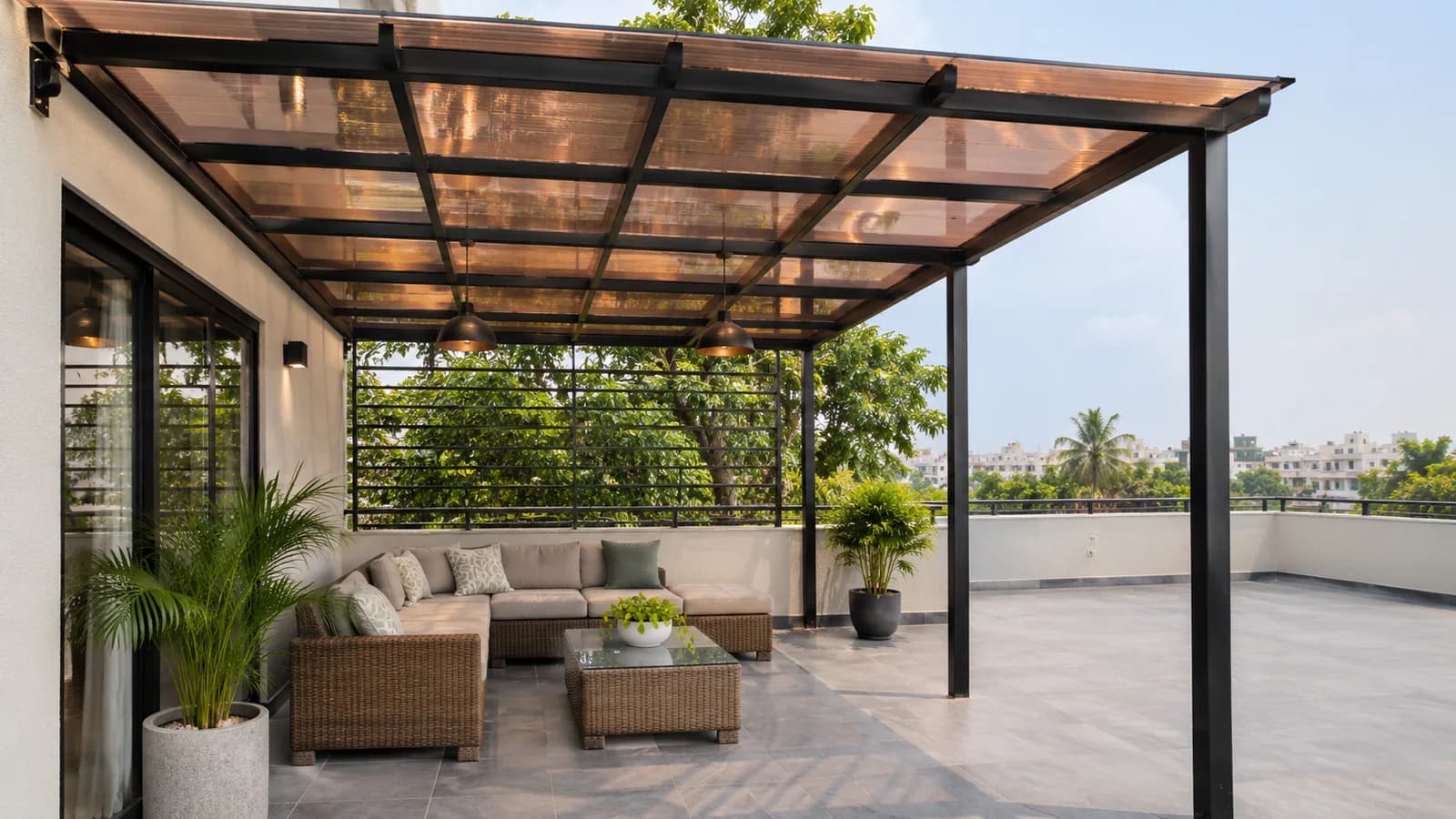
| Pergola with polycarbonate roof | Yes | Tinted sheet cuts much of the heat, lets light in | We fit these in every city we work in |
| Pergola with toughened glass roof | Yes | Clear glass lets heat in; tinted or frosted helps | Heavier and costlier; stays clear for years |
| Terrace shed with sheet roof | Yes | Full shade | Lowest-cost fitted roof; plain sheet is noisy in rain |
Open terrace covering ideas: shade without a full roof
If you only want shade for a winter afternoon or a summer evening, you may not need a roof at all. Shade covers are lighter, cheaper and easier to remove. None of them is our trade.
- Shade net. The green or beige knitted net used over nurseries. It is tied to poles or hooks and cuts part of the sunlight. It lets rain and wind pass through. Sun wears it out in a few seasons.
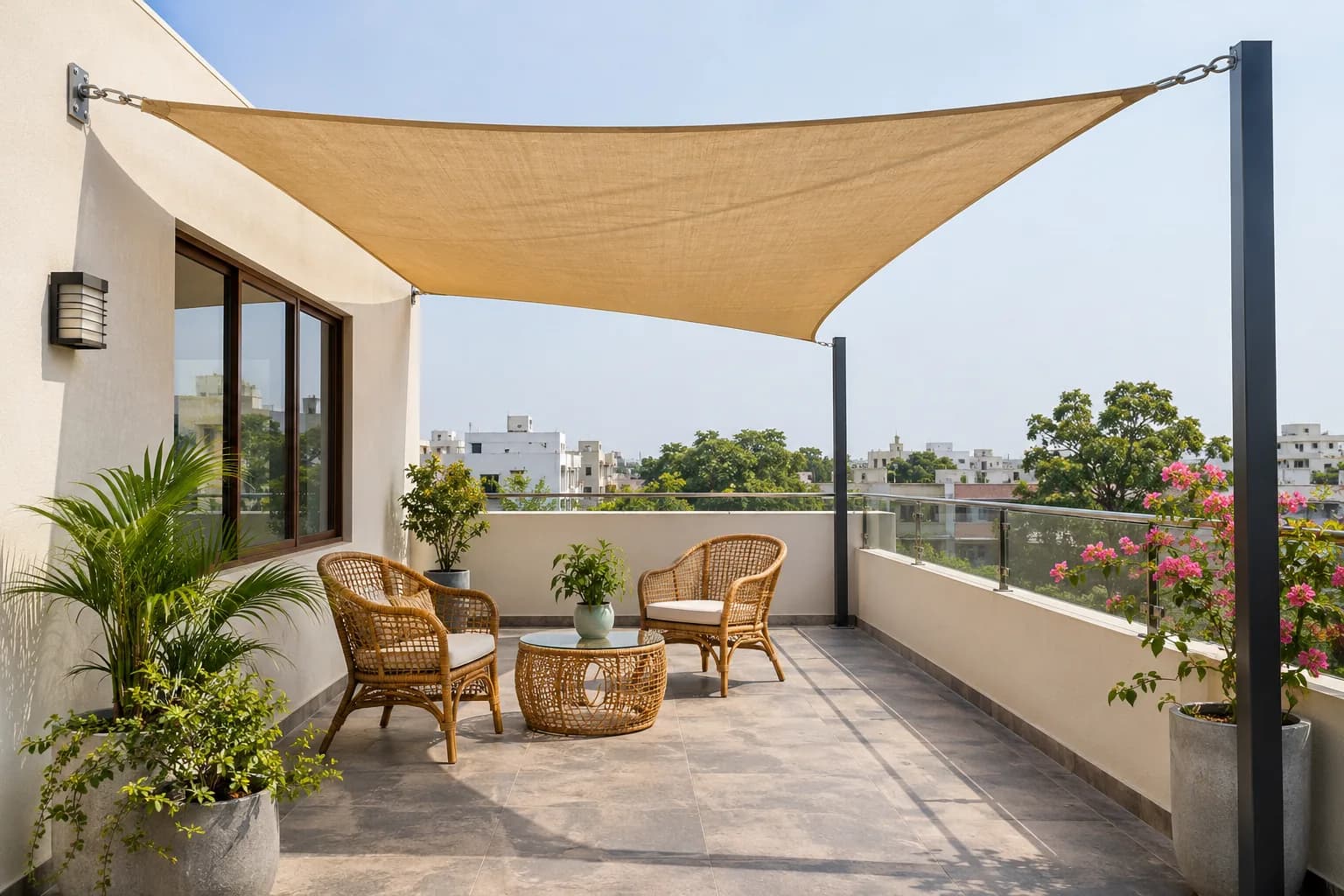
- Shade sail. A stretched piece of outdoor fabric, usually a triangle or a square, fixed at its corners. Its corners pull hard in wind, so the anchor points must be strong.
- Bamboo or thatch. A traditional roof that feels cool underneath. It needs treating and renewing, and it can shelter insects and birds.
- Open slatted pergola. A frame with spaced beams and no sheet. It gives striped, partial shade and carries climbers well. A carpenter or a fabricator builds these.
The honest limit of all four is rain. If you want to sit out during a shower, or keep furniture outside, you need a roof.
Terrace cover ideas for rain: a sloped roof and a gutter
A terrace rain cover has three parts that matter more than the sheet itself. The first is slope. The roof must tilt so water runs off and does not pool. The second is a gutter on the low edge, with a pipe down to the floor drain. Without it, the roof drops a sheet of water onto one strip of floor. The third is the joint with the wall. Where the roof meets the building, it is covered with a metal strip called a flashing and sealed.
Rain on a terrace also comes sideways. A roof keeps the middle dry in most showers. In driving rain the edges get wet. A side panel of polycarbonate or glass on the weather side closes that gap. The problem page on not being able to use the terrace in rain explains what to expect.
The terrace's own drain still has to work, because a roof sends all its rain down one pipe. Drains and plumbing are not work we do. If rain pools inside the terrace door itself, that is a door water leakage repair.
Pergola design on a terrace: posts, frame and where it fixes
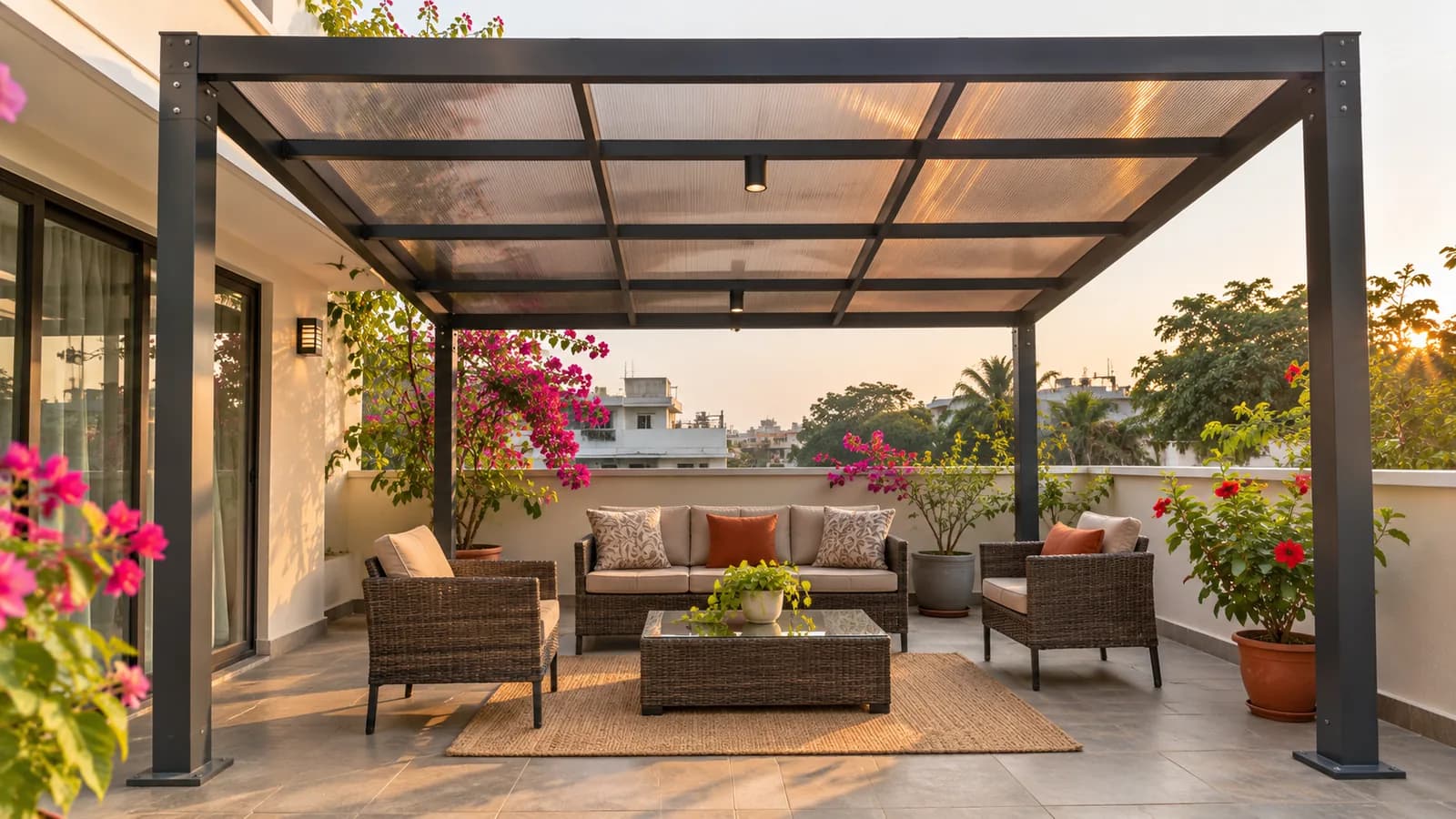
A pergola is a frame with a roof over one part of an outdoor space. On a terrace it usually covers the sitting area beside the staircase room or along one wall. Good pergola design on a terrace starts with the structure, not the colour.
- Wall-fixed or free-standing. Where one side can fix to a sound wall, the pergola needs posts only on the outer side. A free-standing one needs posts at every corner.
- Steel or aluminium. Powder-coated steel spans wide with slim sections, so it suits a large terrace. Aluminium is lighter and does not rust, so it suits a balcony or a very wet spot.
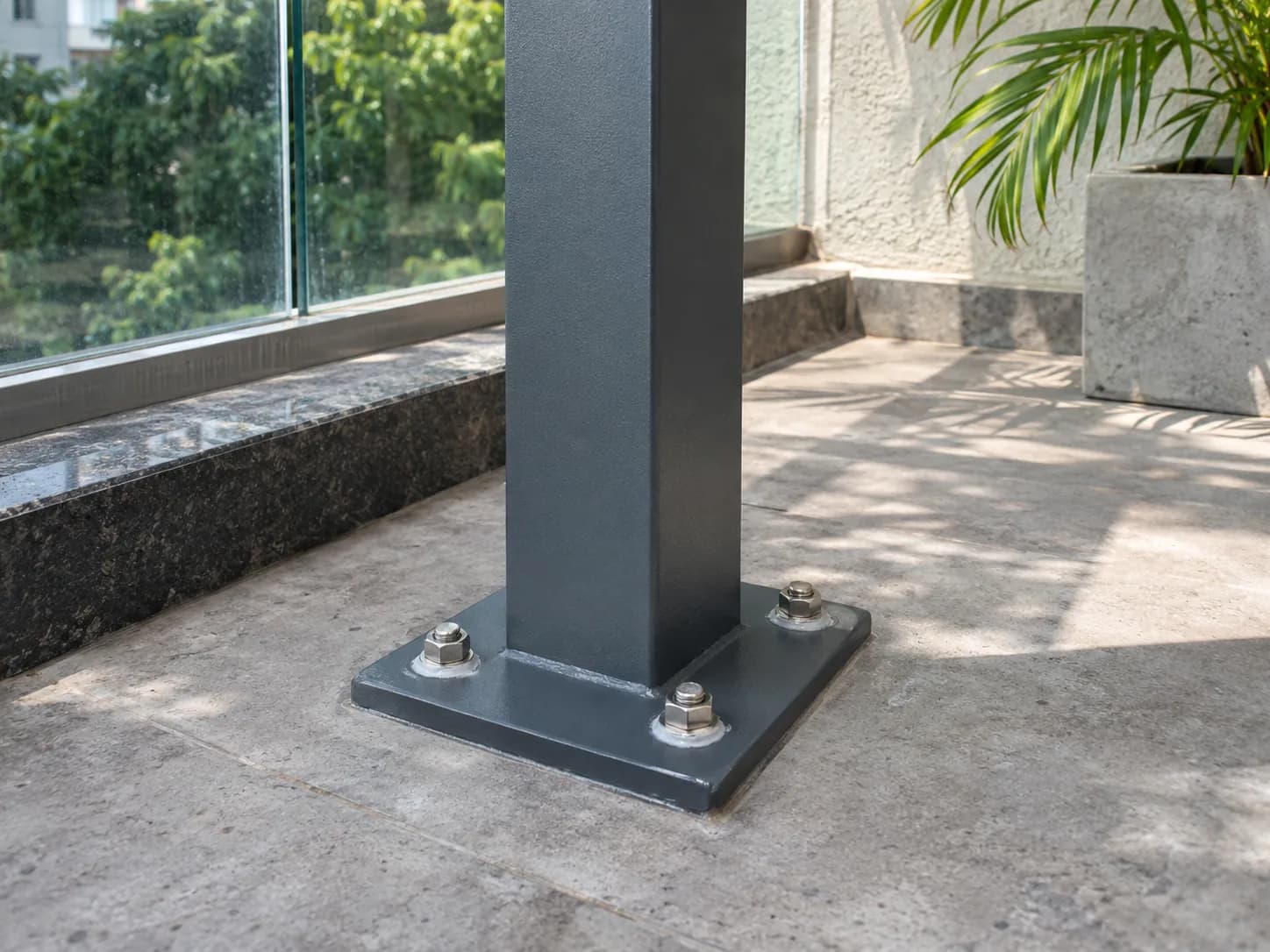
- The post positions. Posts stand on base plates bolted into the slab or the parapet. Each anchor is sealed, so water cannot reach the steel inside the concrete.
- The colour. Black, grey, white and wood-look finishes are the common choices. Match the window frames or the railing.
- The sides. Leave them open for air. Close only the side the wind and rain come from.
- The edge. A terrace you sit on needs a sound parapet or railing. We build glass railings for terraces in Bengaluru and across Delhi NCR.
Size it to the furniture. Mark the table and chairs on the floor with chalk, then add walking space around them. That rectangle is your roof. Our pergola installation page shows how the frame is fixed and what we check at the measuring visit.
Pergola with roof: polycarbonate or toughened glass
Both roofs sit on the same kind of frame. The choice is about light, heat, looks and budget.
| What matters | Polycarbonate roof | Toughened glass roof |
|---|---|---|
| Weight | Light | Heavy; the frame is sized for it |
| Light underneath | Bright; tinted shades are softer | Bright and clear |
| Heat | Tinted and bronze shades cut much of it | Clear glass lets it in; tinted or frosted helps |
| Noise in rain | Quieter than plain steel sheet | Generally quiet |
| Ageing | Scratches more easily; dulls slowly over many years of sun | Stays clear; cleans with a wipe |
| Cost level | Lower | Higher |
| Best for | Terraces and parking where shade and rain cover are the point | A sit-out or porch that should look like part of the house |
Toughened glass is safety glass. It is much stronger than ordinary glass and breaks into small blunt pieces. Overhead, the frame and the anchors are sized for its weight and for the wind. For a west-facing terrace, choose a tinted roof or add a side panel on the afternoon side.
A terrace shed: the plain roof that covers the most area
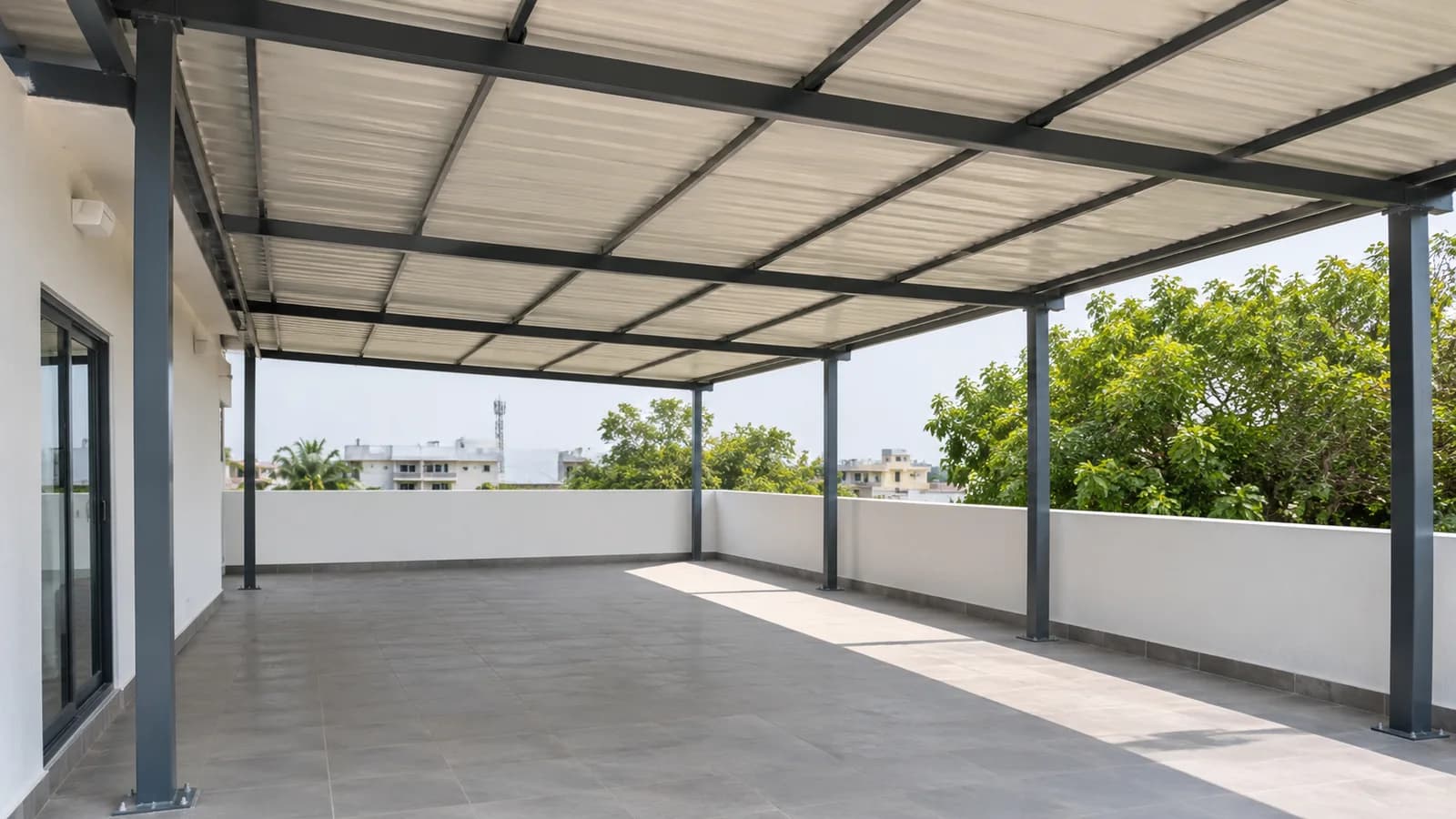
A terrace shed is a steel frame with a sloped sheet roof. It suits a whole terrace, a washing and drying area, a water tank corner or a car parking spot.
- Colour-coated steel sheet. Blocks the sun fully and is the lowest-cost roof we fit. A plain sheet drums in heavy rain.
- Insulated sandwich sheet. Two skins with insulation between. It is much quieter and keeps the space below cooler, at a higher rate.
- Polycarbonate sheet. Lets daylight through. Use it where a steel sheet would darken the windows beside it.
See terrace shed installation for how the frame is built. For a car, the same build goes over the parking spot. The page on a car getting wet in open parking covers the sizes. We fit pergolas and sheds in Bengaluru and across Delhi NCR. See where we work.
Terrace covering ideas on a budget in India
A tight budget means choosing carefully. The cheapest good terrace cover is a small one: roof only the part you will really use, and fix it properly.
- Know the order of cost. From lowest to highest it usually runs: shade net, steel sheet roof, polycarbonate or insulated sheet, toughened glass roof.
- Cover the sitting area, not the terrace. Roof cost follows area, so a smaller roof costs less.
- Use a wall. A roof that fixes to a sound wall on one side needs fewer posts.
- Keep the shape simple. A plain rectangle with one slope costs less than curves, steps and two levels.
- Choose stock colours and standard sheets. Special finishes add to the rate.
- Do not save on anchors, the gutter or the coating. These are what keep a roof standing and dry in year five.
A shade net is the true low-cost answer if you need only shade for a season or two. Just be clear that it is temporary and gives no rain cover. Very small roofs are usually quoted as a job. The posts, anchors, gutter and fitting day cost about the same on a small roof as on a large one.
Will covering the terrace cool the room below?
Usually, yes. The room under a terrace is heated by the slab above it. The slab takes in sun all day and gives the heat back for hours after sunset. A roof over the slab keeps it in shade, so it stores far less heat.
A small pergola cools the sitting area and not much more. A shed over most of the terrace helps the room below far more. An insulated sheet, or a roof with an air gap under it, helps most. See terrace too hot to use. Heat-reflective paints and cool-roof tiles are another route. They are a waterproofing or painting contractor's work, not ours.
Wind, fixing and where DIY stops on a terrace
A terrace is usually the windiest part of a building. Any roof up there catches the wind. That load goes into the anchors, and from the anchors into the slab, the parapet or the wall. This is why we check what the frame will fix to before we quote. We do not fix a roof to a parapet that is not sound.
Permission for a terrace covering in a flat or a house
A terrace roof is visible from outside, so ask before you spend. In an apartment building the main terrace is usually common property, even for the top-floor flat. The society decides what can be built there.
In a house on its own plot it is usually your call. Local building rules can treat a permanent roof as added construction, so check with your association or the local authority if you are unsure. A frame that is bolted, not built in, can be taken down later. We can give you a drawing of what we plan to fit. For committees planning shared spaces, our society upgrades guide covers terraces and parking.
What a terrace cover will not fix: leaks and waterproofing
A roof over a terrace reduces the rain that lands on the slab. It does not repair a slab that already leaks. If the ceiling below has damp patches, get the waterproofing done first, and let it cure. Then fit the cover.
We do not do slab waterproofing, flooring, electrical wiring or civil work. Have the electrician run the wiring for lights or a fan before the roof goes on. If your real question is a balcony and not a terrace, start with our balcony cover ideas guide. For a top-floor balcony with no slab above, see how to cover a balcony from rain.
Planning a terrace cover in five steps
- Name the useSitting, drying clothes, parking or cooling the room below. One sentence is enough.
- Mark the areaChalk the rectangle on the floor. Note which side the afternoon sun and the rain come from.
- Ask for permissionSpeak to the society or association. Ask for the answer in writing.
- Send photos and rough sizesA photo with the length and width is enough to start. The measuring visit checks the slab, the walls and the drain.
- Compare two roofs in writingAsk for the same frame priced with two roof materials. Then you choose with both figures side by side.
Book a measuring visit. We check what the frame can fix to and how the water will drain, and quote both roof options in writing.
What moves the cost of a terrace covering
Five things move the figure. Roof area comes first, because pergolas and sheds are priced by the square foot of roof. Then the roof material, the frame metal and span, any side panels, and access for long steel up to the terrace.
We print no figures in guides. The current starting rates are on the pergola and terrace shed pages. The written quote lists the frame, the roof and the gutter on separate lines.
Mistakes people make when covering a terrace
- A flat roof. Water pools, the sheet sags and the joints leak. Always ask what the slope is.
- No gutter. The roof then pours onto one strip of floor, or onto the neighbour's side.
- A clear roof facing west. It lets in light and heat together. Choose a tinted sheet there.
- Fixing to a weak parapet. A thin or cracked parapet cannot hold a roof in wind.
- Covering a leaking slab. The leak stays. Waterproof first.
Common questions
What is the cheapest way to cover a terrace in India?
A shade net is the lowest-cost cover, but it gives only shade and lasts a few seasons. The lowest-cost proper roof is usually a steel frame with a colour-coated sheet. Covering only the part you use keeps the cost down further.
Which terrace roof is best for heavy rain?
Any solid roof works if it has enough slope, a gutter on the low edge and a sealed joint at the wall. Steel sheet, polycarbonate and toughened glass all keep rain out. Add a side panel on the weather side if rain blows in under the roof.
Is it hot under a pergola with a polycarbonate roof?
It depends on the sheet. A clear sheet lets most of the sun through, so the space warms. Tinted and bronze sheets cut much of the heat and still let daylight in, which is why they are the usual choice for a terrace.
Do I need permission to cover my terrace?
In an apartment, almost always, because the roof shows from outside and the terrace is often common property. In a house on its own plot it is usually your decision, though local rules can apply to a permanent roof. Ask first and get the answer in writing.
What is the difference between a pergola and a terrace shed?
Both are a frame with a sloped roof. A pergola covers a sitting area and is built to look good, with a polycarbonate or glass roof. A terrace shed is the plainer working roof, usually in steel sheet, and covers a larger area for less money.
Can I cover an open terrace without drilling into the slab?
Not with a permanent roof. A roof must be anchored against wind, and the anchors go into the slab, the parapet or a wall and are then sealed. Only light, temporary shade such as a weighted umbrella avoids drilling, and it must come down in wind.
Have a question this guide did not answer? Call us or send a photo on WhatsApp and we will tell you what it needs.
