In this guide
- Why people close an open kitchen with glass
- Kitchen glass partition designs compared
- The kitchen glass partition door: sliding, hinged or folding
- Framed aluminium or frameless glass for a kitchen partition wall
- Clear, fluted or frosted: simple kitchen partition glass designs
- Grease, steam and cleaning a kitchen glass partition
- Kitchen glass partition safety near the hob and the gas
- A kitchen partition and the living room AC
- How a kitchen glass partition is measured and fitted
- What decides the price of a kitchen glass partition
- Kitchen glass partition mistakes to avoid
Key takeaways
- The usual design is a fixed glass panel with a sliding door. It is closed while you cook and open the rest of the day.
- A slim aluminium frame seals better than frameless glass. Choose it when smoke and smell are the main reason.
- Fluted glass hides a busy counter. Keep its smooth face towards the hob, because the ribs hold grease.
- Glass is not a heat shield. Keep it away from the burner, and keep the chimney and a window working.
- Measure after the counter, tiles and ceiling are done. Toughened glass cannot be cut on site.
Why people close an open kitchen with glass
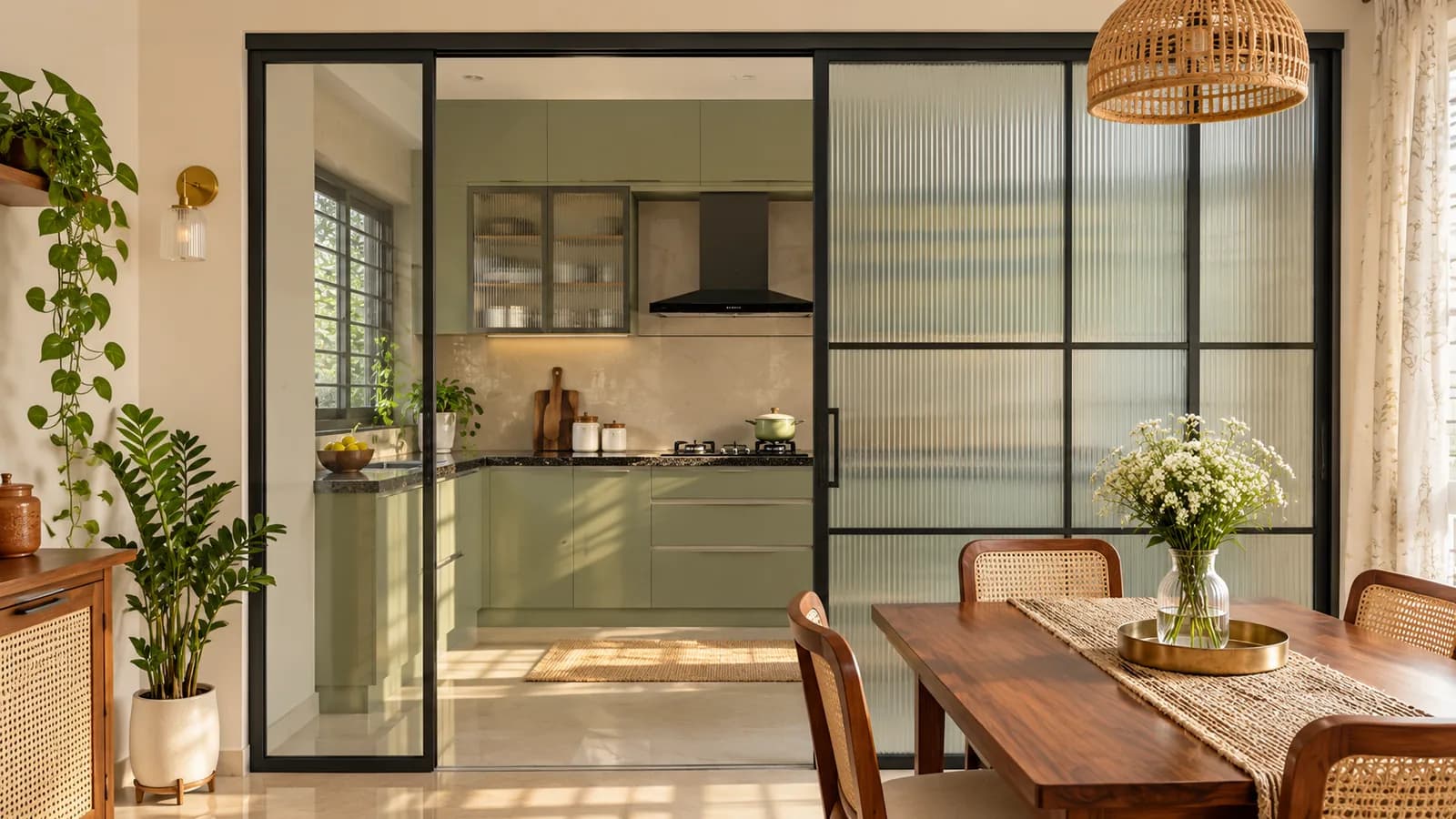
An open kitchen looks good in a brochure. Then the first tadka goes on. The smoke reaches the sofa, and the curtains hold the smell of fried fish. The AC in the living room cools the kitchen too. A kitchen glass partition keeps smoke, smell and cool air on their own sides, and still lets daylight through.
A brick wall would do the same job and leave a dark kitchen. Most flat kitchens borrow their light from the living room, or lend theirs to the dining area. Glass keeps that. The cook can also see the children and the television. That is why many families wanted an open kitchen in the first place.
One honest limit comes first. No indoor glass partition is airtight. It holds most of the smoke and smell while the chimney carries them out. It does not replace the chimney.
Kitchen glass partition designs compared
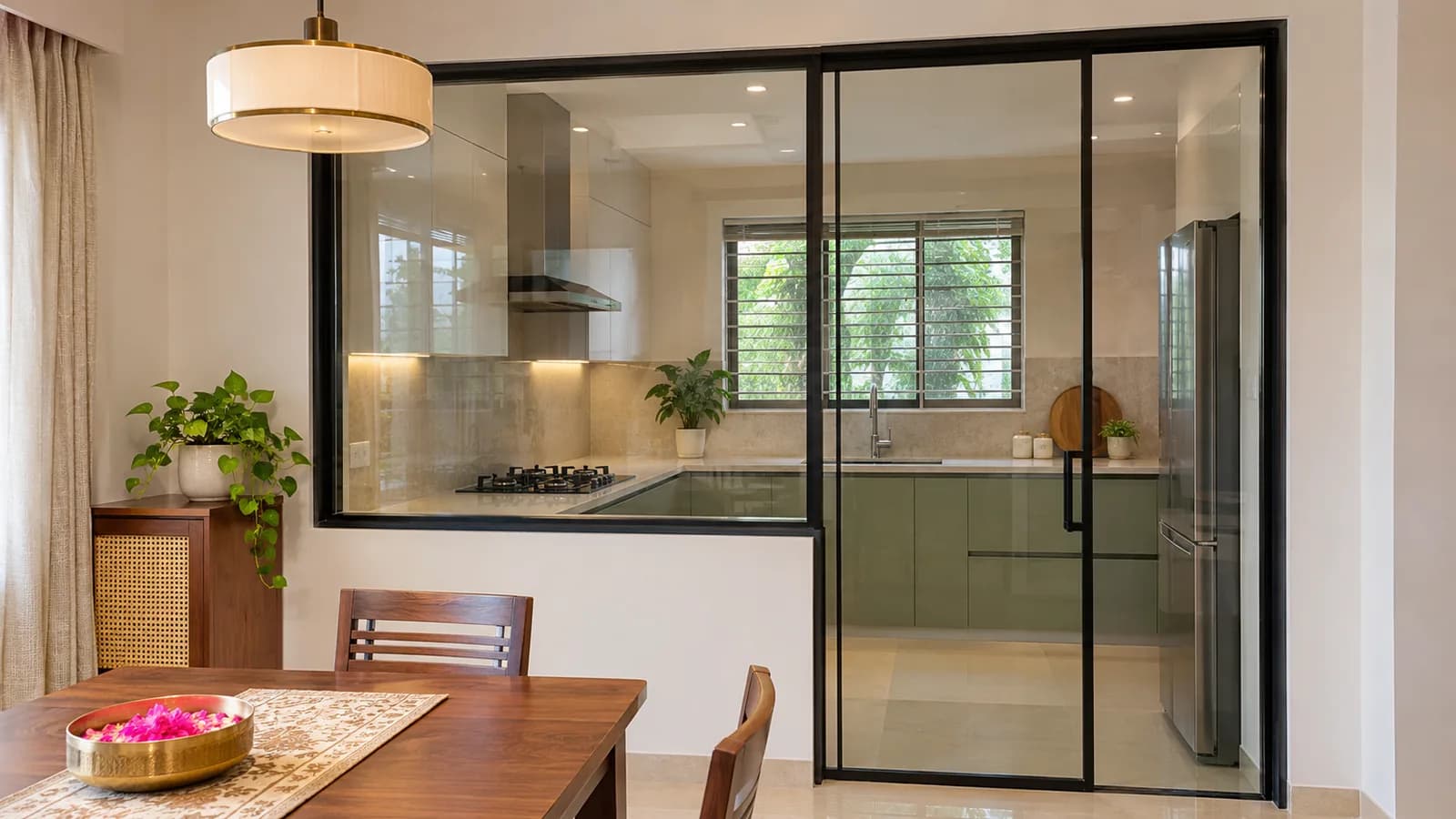
Almost every kitchen partition is one of five designs. The opening you have usually decides which.
| Design | How it opens | Fits best | Watch for |
|---|---|---|---|
| Fixed panel with one sliding door | The door slides across the fixed panel | Most flat kitchens, openings of about 5 ft and wider | Half the opening is always glass, so plan which half you walk through |
| Two or three sliding panels | Panels stack to one side | Wide openings where you want most of it open on a normal day | More tracks to keep clean; panels overlap with small gaps |
| Fixed panel with a hinged door | The door swings on hinges or a floor spring | Narrow openings, and where the best seal is wanted | The swing needs clear floor on one side |
| Glass above a counter or half wall | Fixed, or with a small sliding hatch | A breakfast counter or serving ledge you want to keep | The glass sits on the counter, so the counter must be finished and level |
| Folding glass doors | Panels fold like a screen to one side | Openings you want fully clear | More hinges and rollers to maintain, and frames at every fold |
For a simple design, choose the first row. One fixed panel, one sliding door, clear glass, a slim frame. It suits most kitchens and has the fewest parts to go wrong.
The kitchen glass partition door: sliding, hinged or folding
The door is the part you touch twenty times a day, often with wet or full hands. Choose it before anything else.
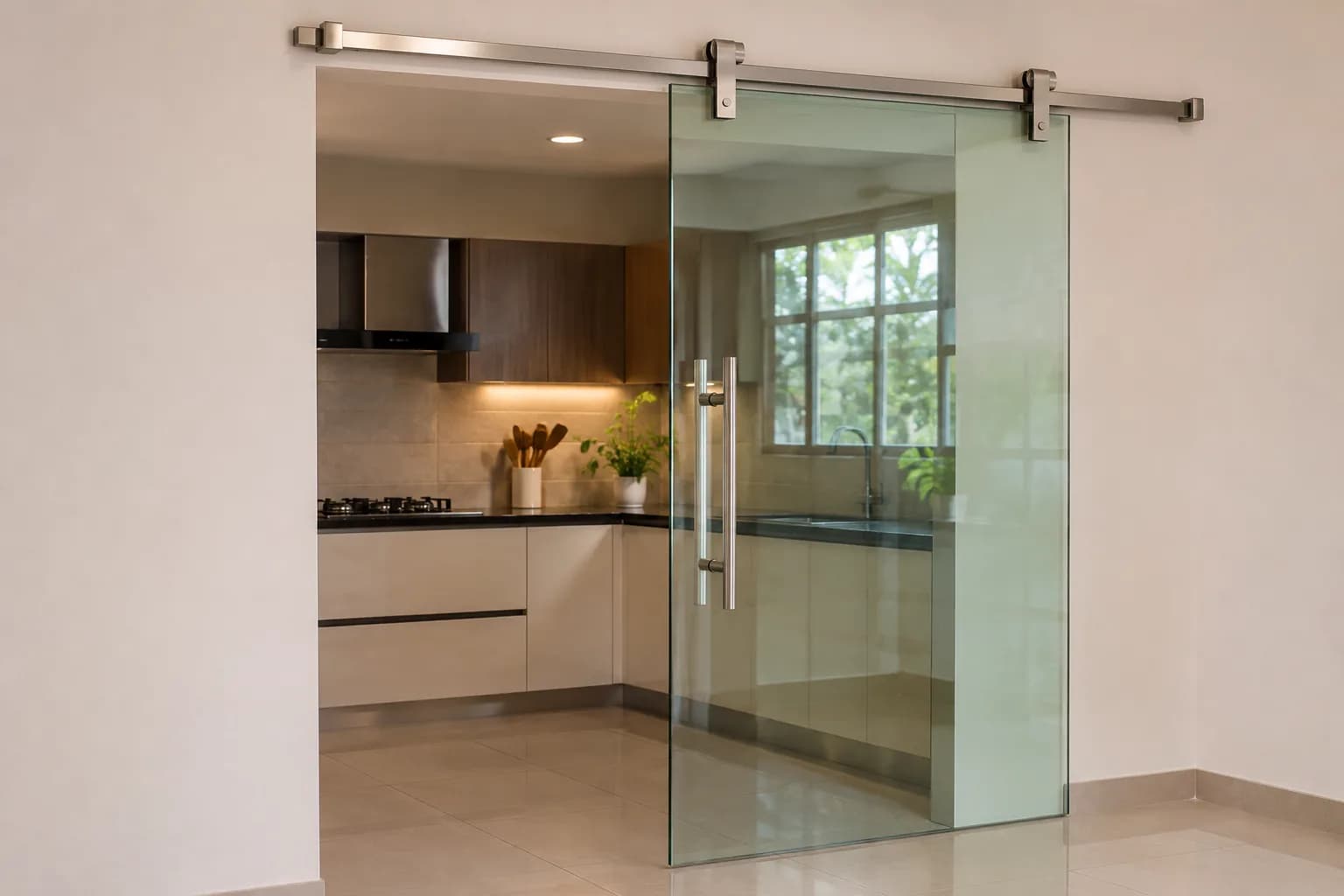
- Sliding takes no floor space, which matters beside a dining table. A top-hung slider hangs from a rail above and has no bottom track. That keeps the kitchen floor easy to mop. A bottom-rolling slider runs on a floor track, which collects crumbs and needs cleaning.
- Hinged closes onto a seal, so it holds smoke and smell best. It needs room to swing. Check that it will not hit the fridge door or a dining chair.
- Folding opens the whole width. It has the most moving parts, so it needs the most care in a greasy room.
Think about the widest thing that must pass. A fridge, a washing machine or a gas cylinder has to come through this door one day. Tell us the size of your largest appliance, and we plan the clear opening around it.
Framed aluminium or frameless glass for a kitchen partition wall
A frameless partition is toughened glass held by slim channels and small fittings. It looks lightest. But a frameless door has small open gaps on every side, and smell passes through gaps. A framed partition sets the glass in a slim aluminium frame, usually matte black. The frame carries rubber and brush seals, so the door closes against something.
| What matters in a kitchen | Slim aluminium frame | Frameless |
|---|---|---|
| Holding smoke and smell | Better; the frame carries the seals | Fair; small gaps stay around the door |
| Look | A drawn black or bronze line; suits a grid design | Almost invisible |
| Walls and beams that are not straight | The frame takes up the difference | Needs a more exact fit |
| Cleaning | Glass wipes clean; the frame edges collect a little grease | One flat surface, fewer edges |
| Sliding door | Fits naturally in the frame's own track | Needs its own rail and fittings |
If smoke and smell are the reason for the partition, a slim aluminium frame is usually the better choice. If you only want a light divider and cook mild food, frameless is fine. See the aluminium glass partition and the frameless glass partition with a door for how each is built. They are office systems, and the same builds are used in homes.
Clear, fluted or frosted: simple kitchen partition glass designs
- Clear glass passes the most light and keeps the cook in the conversation. It also shows every splash and every unwashed pan.
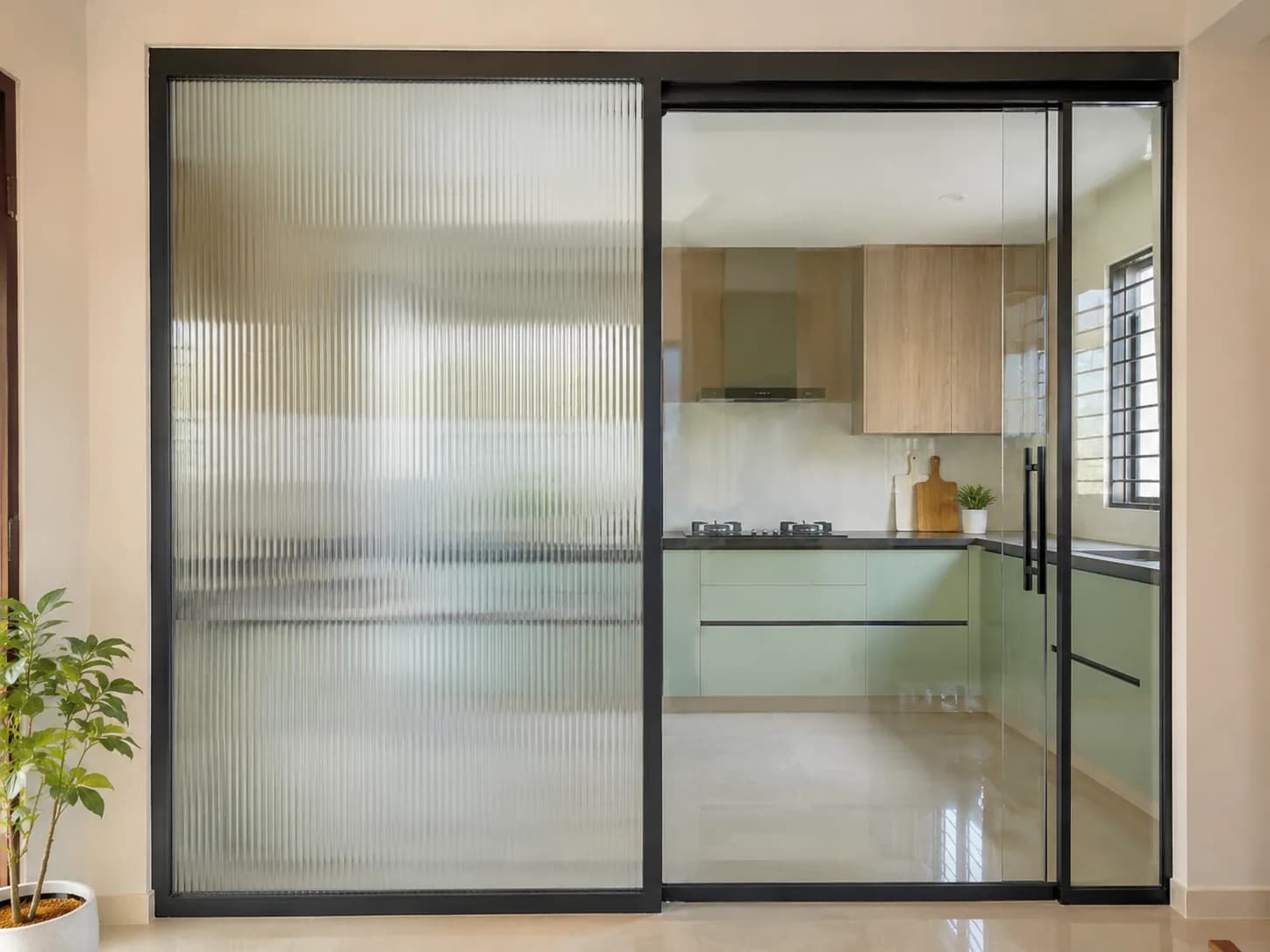
- Fluted glass is ribbed glass that blurs what is behind it. It hides a busy counter from guests. Our fluted glass guide shows where it works.
- Frosted glass hides more and looks flatter. A frosted band at counter height hides the mess and leaves clear glass above.
- A black grid is clear glass divided by slim bars. It gives the industrial look, and the bars add edges to wipe.
A popular mix is fluted glass on the fixed panel and clear glass on the door. Whatever you choose, it should be toughened. Our guide on toughened and normal glass explains why that matters in a room where people carry hot pans.
Grease, steam and cleaning a kitchen glass partition
Indian cooking puts oil in the air. It settles on the nearest cool surface, and glass is one. That is not a reason to avoid glass. Glass is the easiest kitchen surface to clean, far easier than a jali or a painted wall.
- Wipe weekly, not yearly. Fresh grease comes off with warm water and a little dish soap on a soft cloth. Old grease needs real work.
- Dry it after. In hard water areas, drops leave white marks. A dry microfibre cloth or a rubber wiper stops that.
- No steel scrubbers and no powder cleaners. They scratch glass and dull a powder-coated frame.
- Turn fluted glass the right way. Fluted glass has one ribbed face and one smoother face. Ask for the smoother face on the kitchen side.
- Clean the track. Brush or vacuum a bottom track before you wipe it. Grit in the track wears the rollers.
A slider that turns stiff after a year or two has usually collected grease and grit. That is a small repair. See sliding door hard to slide, or book sliding door roller replacement or sliding door track repair.
Kitchen glass partition safety near the hob and the gas
Toughened glass handles heat and knocks much better than ordinary glass. It is still not a heat shield. A few plain rules keep it safe.
- Keep the glass away from the burner. The partition should not stand right beside an open flame or a hot kadai. The site visit checks the distance for your counter.
- Keep the gas reachable. The cylinder, the regulator and any pipeline valve must stay easy to reach and easy to shut. A fixed panel must not box them in.
- Keep the air moving. A closed kitchen with a gas stove needs the chimney or exhaust fan working, and a window that opens.
- Protect the edges. Toughened glass is weakest at its edges and corners. A frame or a channel covers them. Do not bang trolleys or cylinders into a bare glass edge.
The chimney, the exhaust fan, the gas line, the tiles and the cabinets are other trades. We fit the glass and its frame. If the kitchen window stays open more now, a window mosquito mesh keeps flies and mosquitoes out.
A kitchen partition and the living room AC
A closed kitchen helps the AC twice. The cool air stays in the living room, and the heat from the stove stays in the kitchen. For this to work, the partition must reach the ceiling, and the door must be shut while the AC runs. A partition that stops at door height leaves an open band above, and the air mixes over it. Our room partition ideas guide has a full section on partitions for AC.
How a kitchen glass partition is measured and fitted
We have no separate service page named for kitchens. The work is measured and quoted as a custom glass partition. Start at custom glass installation, which also covers a glass splashback behind the counter. A plain glass wall with no door is the fixed glass partition.
- Finish the kitchen firstThe counter, the wall tiles, the floor and any false ceiling should be complete. Glass is measured to finished surfaces.
- Send photos and rough sizesA photo of the opening, its width and its height are enough to start. Mention beams, pipes and switchboards near it.
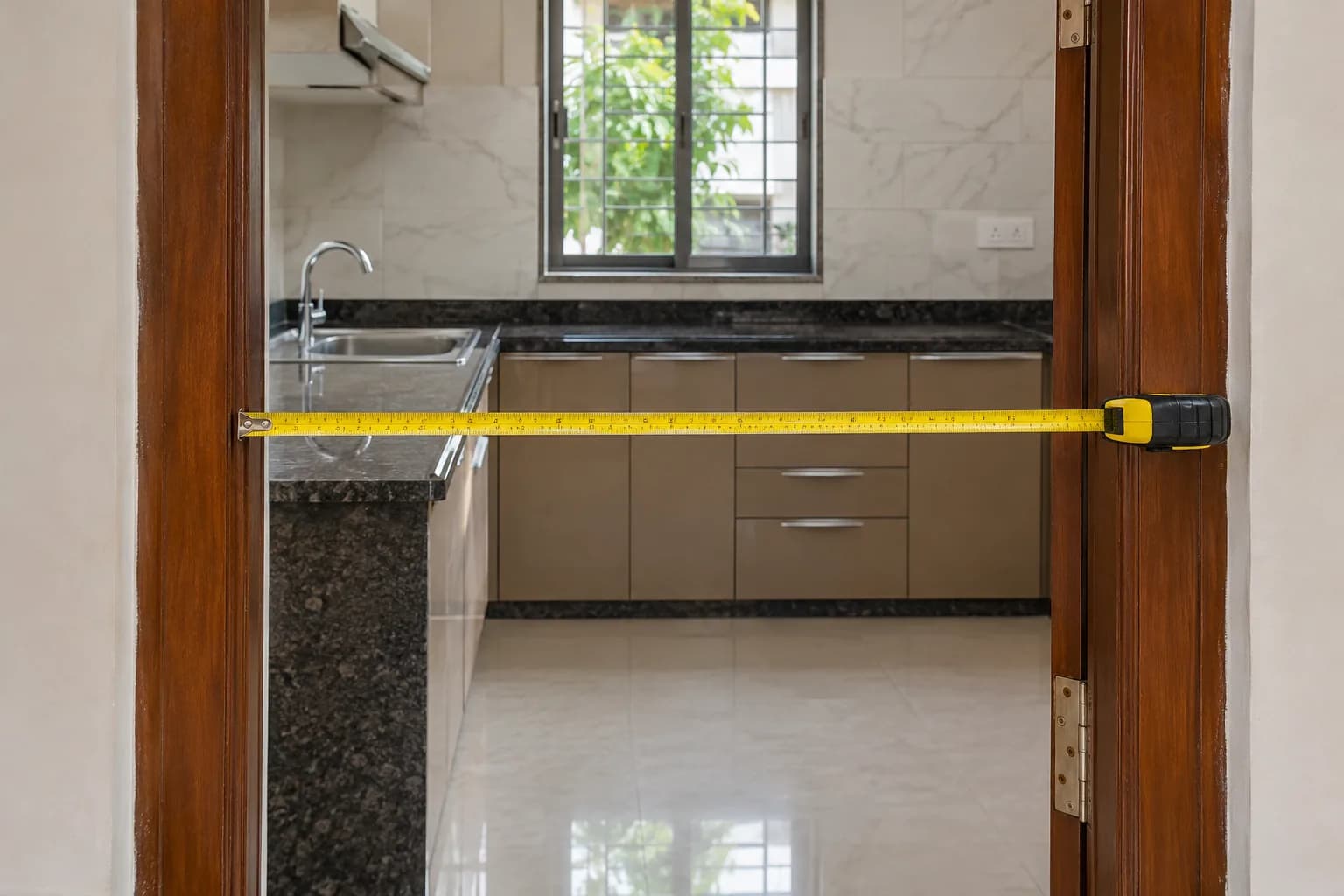
- Site measurementWe measure the opening at several points, because walls and beams are rarely straight. We check what the top rail will fix into.
- Glass is made to sizeToughened glass is cut first and toughened after. It cannot be trimmed on site, so nothing is made before the measurement.
- Fitting dayThe frame or channels go in, then the glass, then the door and its seals. Sealant needs time to cure, so follow the crew's advice before you clean near it.
In Bengaluru we also fit new aluminium sliding doors. They suit a kitchen doorway that opens to a utility area or a balcony. If your kitchen has an ordinary door and you only want to hold the smell, door gap sealing is the smaller job.
Send the opening's size and a photo. We measure on site and quote in writing.
What decides the price of a kitchen glass partition
Guides do not carry rates, because rates change. Four things decide the number: the area of glass, the kind of glass, the door and its fittings, and the frame. Fluted glass costs more than clear. A sliding set costs more than plain hinges. The live rates are on glass partition cost per sq ft and aluminium glass partition price.
Kitchen glass partition mistakes to avoid
- Ordering before the counter is built. A change of 10mm in the counter changes the glass.
- Stopping at door height. The gap above lets smoke and cool air straight through.
- Fixing the top rail to a false ceiling. A sliding door's weight needs a beam, the slab or a steel member above.
- Forgetting the fridge. The clear opening must pass your largest appliance.
- Choosing frameless for heavy frying. The gaps around the door will let the smell out.
- Boxing in the gas valve. Keep every valve and regulator in easy reach.
Common questions
Which glass is best for a kitchen partition?
Toughened glass, in clear or fluted. Clear passes the most light. Fluted hides the counter from the living room. The thickness depends on the height of the panel and the door, so it is decided at the site visit.
Does a kitchen glass partition stop cooking smell completely?
No partition stops all of it. A framed partition with seals, closed while you cook, holds most of the smoke and smell in the kitchen. The chimney or exhaust fan still has to carry it out.
Is a sliding or a hinged glass door better for a kitchen?
A sliding door saves floor space and suits most flats. A hinged door closes onto a seal and holds smell a little better. Choose sliding if a swinging door would hit the dining table or the fridge.
Is glass safe near a gas stove?
Toughened glass handles kitchen heat well, but it should not stand right next to the burner. Keep the gas cylinder, regulator and valve easy to reach. Keep the chimney and a window working in a closed kitchen.
How do I clean grease off a kitchen glass partition?
Use warm water with a little dish soap and a soft cloth, then wipe the glass dry. Do it weekly so the grease does not harden. Avoid steel scrubbers and powder cleaners, which scratch.
Can a glass partition be fitted on top of a kitchen counter?
Yes. Glass above a breakfast counter or a half wall is a common design. The counter must be finished, level and strong where the glass sits. The glass is measured only after that.
Have a question this guide did not answer? Call us or send a photo on WhatsApp and we will tell you what it needs.
