In this guide
- Toughened glass vs normal glass: the short answer
- What is toughened glass, and how is it made?
- Toughened glass vs normal glass difference, point by point
- Toughened glass vs tempered glass: two names, one product
- What toughened glass is used for in homes, shops and offices
- Where normal glass is still fine, and where it is not
- Toughened glass vs laminated glass: strong, or stays in place
- Toughened glass vs acrylic sheet: glass or plastic
- Why toughened glass costs more than normal glass
- How to tell if your glass is toughened or normal
- Limits of toughened glass that sellers rarely mention
- Toughened or normal glass: a decision list for your job
Key takeaways
- Toughened glass is normal glass after heat treatment. It is commonly four to five times stronger at the same thickness.
- The bigger difference is how it breaks. Normal glass breaks into long sharp pieces; toughened glass breaks into small blunt ones.
- Toughened and tempered glass are the same product. Only the word changes from one country to another.
- Laminated glass does a different job. It stays in place when broken, which matters overhead and at height.
- Toughened glass costs more because it is made to order. It is cut, drilled and finished first, then cannot be changed.
Toughened glass vs normal glass: the short answer
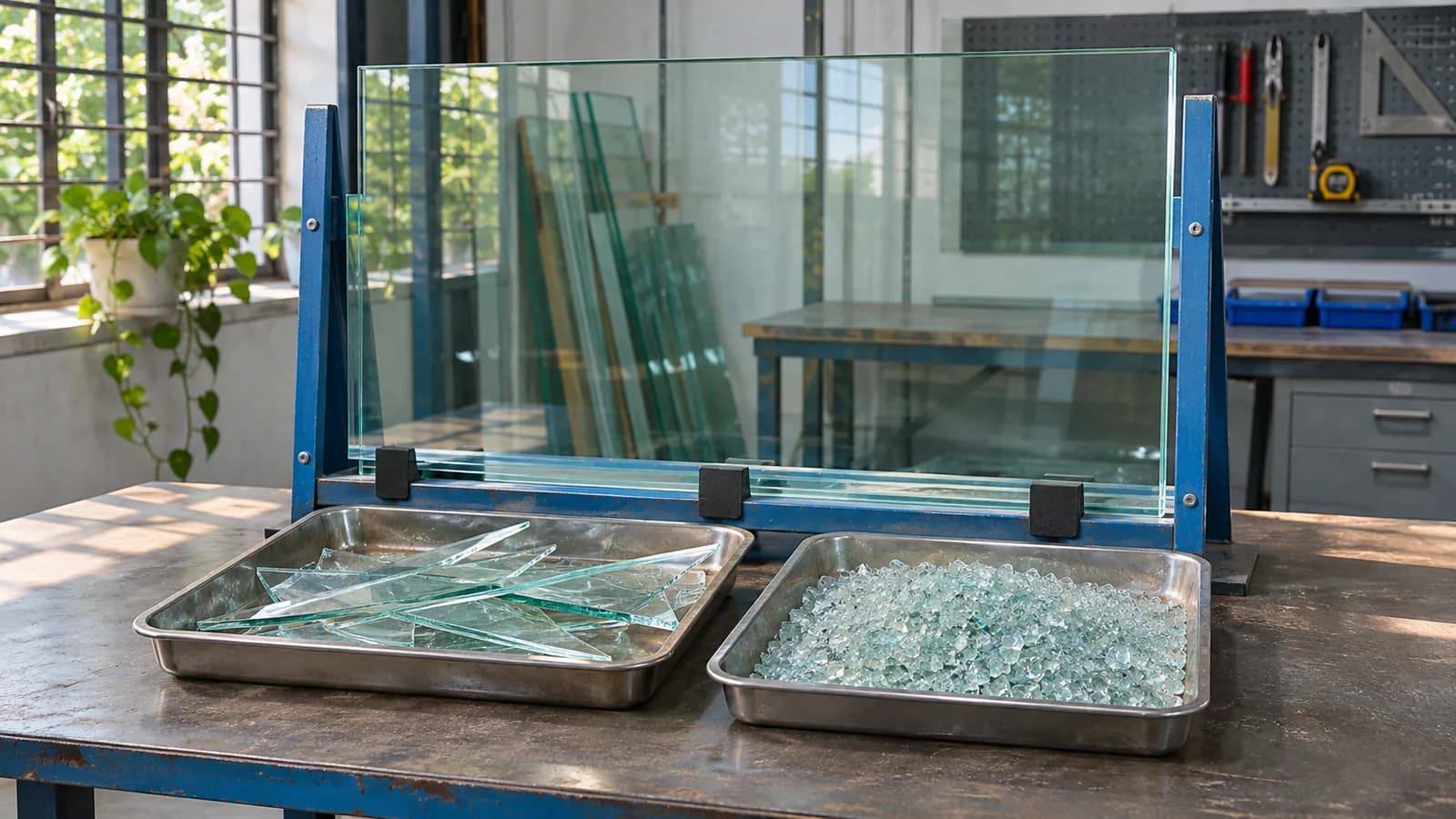
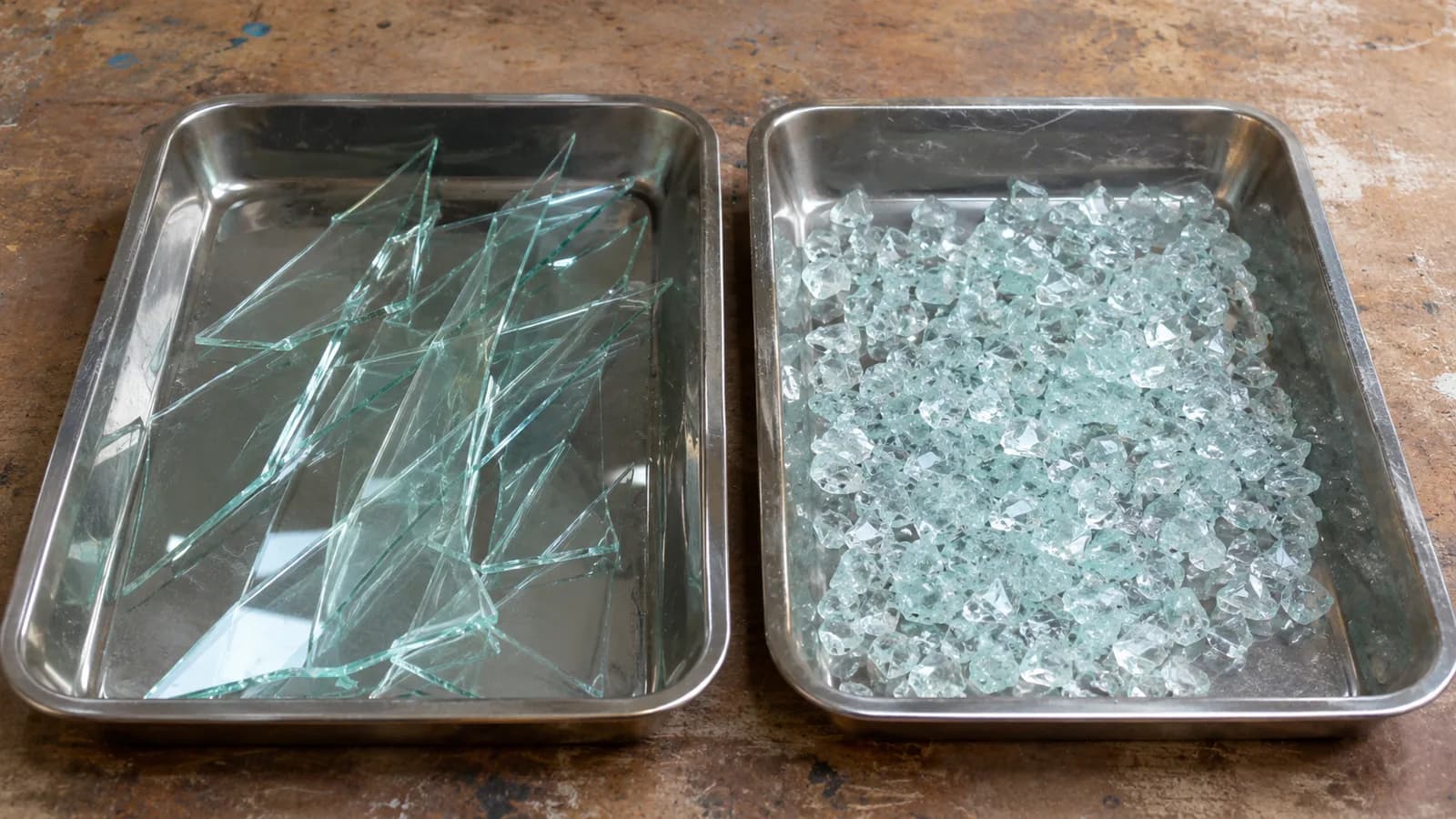
Both begin as the same clear sheet. Normal glass is that sheet as it comes: flat, clear and easy to cut. The trade calls it float glass or annealed glass. Toughened glass is the same sheet after it has been heated and cooled very fast. Toughened glass is commonly four to five times stronger than normal glass of the same thickness. It also breaks into small blunt pieces instead of long sharp ones.
That second point matters more than the first. Strength decides how often glass breaks. The way it breaks decides whether anybody is badly hurt when it does. This is why toughened glass is called safety glass, and why it is the usual choice wherever a person can fall against the panel.
This guide explains how toughened glass is made, compares it with normal glass, laminated glass and acrylic sheet, and says where each one belongs. It is one part of our wider guide to the types of glass for homes.
What is toughened glass, and how is it made?
Toughening is a heat process, not a coating or a different material. The outer skin of the glass is left squeezed tight, and the inside is left pulling against it. A knock has to beat that squeeze before a crack can start. The steps below are the same for a shower door, a table top or a shop front.
- The sheet is cut to the final sizeNormal glass is cut to the exact size measured at your site. Shaped corners and curves are cut now.
- Edges are finished and holes are drilledThe edges are ground smooth or polished. Holes for hinges and handles, and notches for clamps, are made at this stage.
- The glass is heated in a furnaceThe finished piece is heated until it is close to softening.
- Air cools it very fastJets of air cool both faces quickly. The surface sets first, and the inside sets a moment later. That locks the squeeze into the skin.
- The panel is checked and markedThe glass is checked for flatness and size. Many toughened panels carry a small etched stamp in one corner.
Toughened glass vs normal glass difference, point by point
| What matters | Normal (float) glass | Toughened glass |
|---|---|---|
| Strength against a knock or bending | The baseline | Commonly four to five times stronger at the same thickness |
| How it breaks | Long, sharp pieces | Small, blunt, cube-like pieces |
| Heat and sudden temperature change | Can crack near a hob or in strong uneven sun | Handles heat and temperature change much better |
| Cutting or drilling later | Can be cut on site | Cannot be cut or drilled at all |
| Weak point | The whole sheet | The edges and corners |
| Scratch resistance | Scratches with grit or steel wool | About the same; toughening does not make it scratch-proof |
| Weight and clarity | Same | Same; a slight ripple may show in reflections |
| Getting it | Often cut from stock the same day | Made to order after measuring |
| Cost | Lower | Higher, for the reasons below |
Notice what does not change. Toughened glass weighs the same as normal glass. It is no clearer and no better at blocking sound. It scratches just as easily, so never clean it with an abrasive pad or powder. What you are paying for is strength and a safe way of breaking.
Toughened glass vs tempered glass: two names, one product
There is no difference. Tempered glass is the word used in America, and toughened glass is the word used in India and Britain. In local shops you may also hear tuffen glass or toughen glass. All of these mean the same heat-treated safety glass.
One product does sit between normal and toughened. Heat-strengthened glass is heated the same way but cooled more slowly. It is stronger than normal glass, yet it breaks into larger pieces, so it is not a safety glass on its own. You will mostly meet it as one layer inside laminated glass on large building fronts. For a home, the choice is nearly always between normal, toughened and laminated.
What toughened glass is used for in homes, shops and offices
The simple rule is this. Use toughened glass wherever a person, a door or a hard object can hit the glass. In practice that covers most glass you can touch.
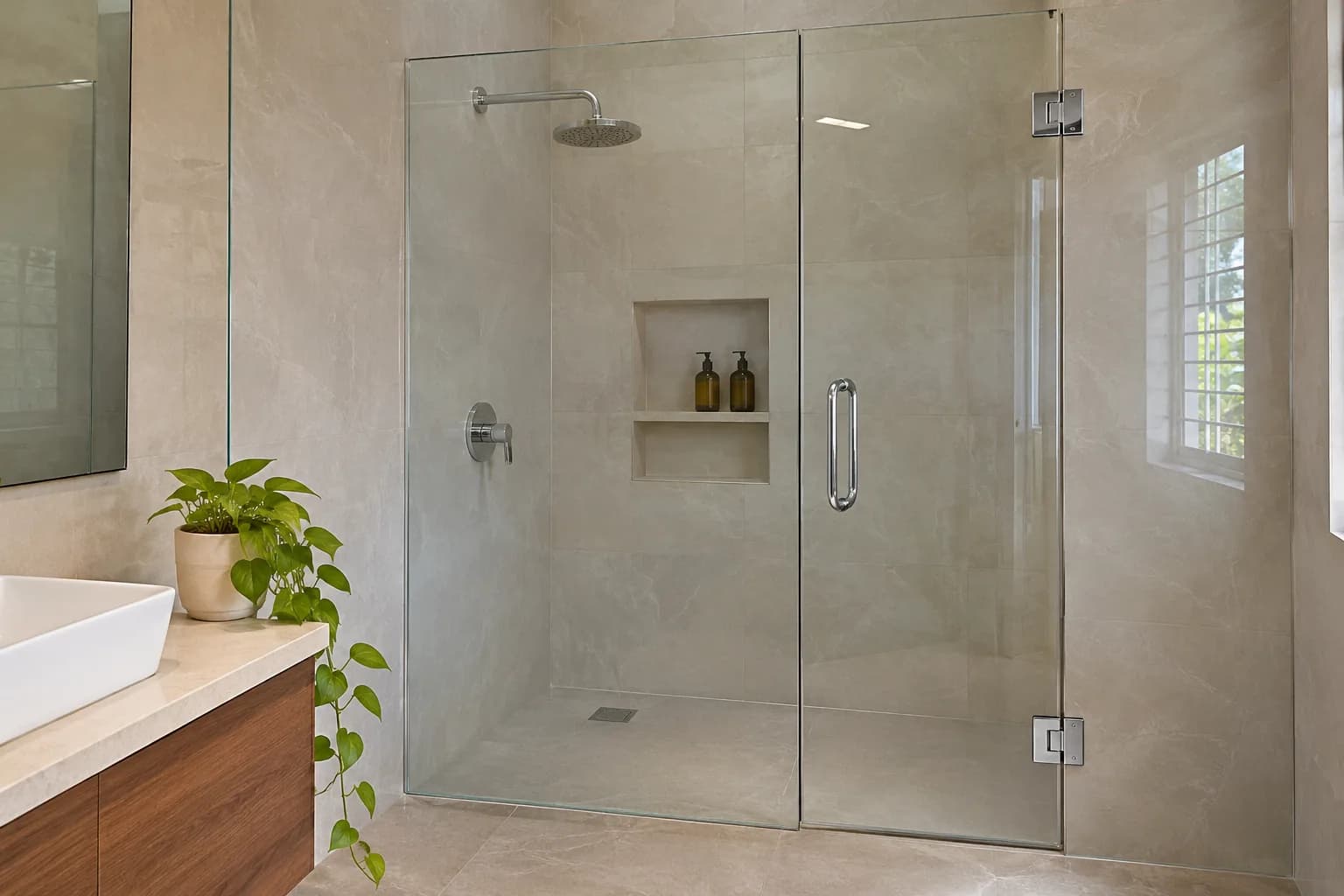
- Shower partitions and doors. Bathrooms are wet and people slip. Every build on our shower cubicles page uses toughened glass.
- Glass doors. Hinged, pivot and sliding doors all take daily knocks. See bathroom glass doors for the door types.
- Office cabins and room dividers. A glass office partition is full-height glass beside a walkway.
- Shop fronts. A toughened glass shop front faces the street and a busy door.
- Balcony and stair railings. The glass is a barrier at height. We build new balcony glass railings in Bengaluru and across Delhi NCR.
- Table tops, shelves and splashbacks. These take knocks at the edge and heat from dishes or a hob. See mirror and custom glass installation.
- Large or low windows. Any pane a child can reach, or a pane big enough to fall through.
Where normal glass is still fine, and where it is not
Normal glass is not bad glass. It is the right, cheaper choice where nobody can fall against it and nothing swings into it. Small window panes held in a frame on all four sides are the common example. So are picture frames, small cabinet panes and the glass over a framed photograph. Most mirrors are also normal glass with a reflective backing.
Normal glass is the wrong choice in a door, a floor-to-ceiling panel, a bathroom, a table top, a shelf, a railing or anything overhead. It is also a poor choice directly behind a hob, where heat can crack it. If you have old plain glass in one of these places, plan to change it rather than wait for it to break.
Toughened glass vs laminated glass: strong, or stays in place
These two are often compared as rivals. They solve different problems. Toughened glass resists breaking and breaks safely, but once broken it falls out of its place. Laminated glass is two sheets bonded with a plastic layer. It may crack more easily if the sheets are normal glass, but the pieces stay stuck together and the panel stays where it is.
| Question | Toughened | Laminated | Laminated toughened |
|---|---|---|---|
| Does it resist knocks? | Yes, strongly | Like the sheets it is made from | Yes, strongly |
| What happens when it breaks? | Falls away in small blunt pieces | Cracks but stays as one sheet | Cracks into small pieces that stay in place |
| Where it is the usual choice | Showers, doors, partitions, table tops | Windows wanting security or less noise | Roofs, skylights, railings wanting extra margin |
| Extra benefit | Lowest cost of the safety glasses | Blocks more sound; hard to get through | Both strength and staying power |
Choose toughened glass where the risk is a person hitting the glass. Choose laminated glass where the risk is broken glass falling or leaving a gap. A shower door is the first case. A glass roof is the second. A balcony railing can be either, which is why many newer buildings ask for laminated toughened glass there. Our thickness guide gives the common build-ups.
Toughened glass vs acrylic sheet: glass or plastic
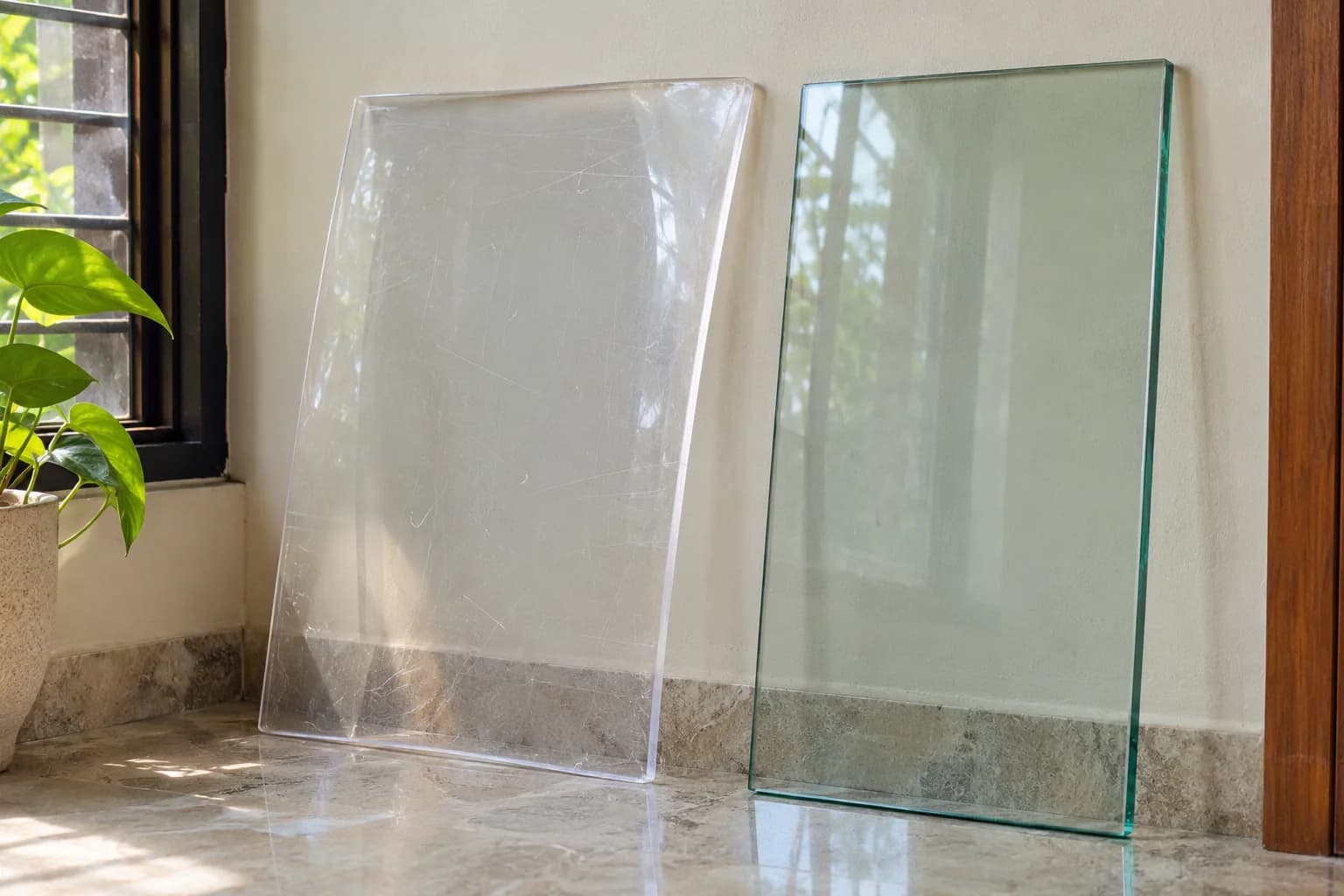
Acrylic sheet is a clear, rigid plastic. It looks like glass from a distance. It weighs about half as much, it does not shatter into pieces, and it can be cut and drilled with ordinary tools. Those are real advantages for small covers, display boxes, signs and temporary screens.
Its limits show with daily use. Acrylic scratches far more easily than glass, so a wiped surface turns hazy over time. Some grades yellow in strong sun. It bends under load, softens with heat and can burn. So it is a poor choice for a shower door, a partition with a door, a railing or a panel near a hob.
We do not sell or fit acrylic sheet, so take this as a fair comparison and not a sales line. For a panel you touch, clean and rely on for years, glass is usually the better material. A different plastic, polycarbonate, is much tougher and is used for roofs. We fit it as the roof sheet on a terrace shed or a pergola.
Why toughened glass costs more than normal glass
People search for the price difference between the two. We print no figure here, because rates move and depend on thickness. The reasons for the gap do not move, and they are worth knowing before you compare quotes.
- An extra factory process. Every toughened piece goes through a furnace after it is cut and finished.
- All the hand work comes first. Edges, holes and notches must be perfect before heating, so more time goes into each piece.
- Made for one opening. The panel fits your site and no other. A wrong measurement means a new panel.
- Thicker glass is common. Doors, partitions and railings use thicker sheets than a small window pane.
- Transport and handling. A finished panel cannot be trimmed, so it is packed and carried with more care.
Live starting rates are on four pages. See door, window and glass repair cost for replacement glass and glass partition cost for cabins and dividers. See shower cubicle cost for bathrooms and glass door installation cost for a single door.
How to tell if your glass is toughened or normal
- Look for a stamp. Many toughened panels carry a small etched mark in one corner. A missing stamp does not prove the glass is normal, but a stamp is a good sign.
- Look at the edges. Toughened glass has smooth, finished edges because they were ground before heating. A raw, sharp cut edge suggests normal glass.
- Look through polarised sunglasses. In daylight, toughened glass often shows faint dark bands or spots. This is a hint, not a proof.
- Check the paperwork. A proper quotation or bill names the glass type and thickness for each panel.
- Ask at the next visit. A fitter who handles both every day can usually tell from the edge and the fittings.
Never test glass by hitting it. If the type matters for safety, such as a door a child uses, treat doubtful glass as normal glass and plan the change.
Limits of toughened glass that sellers rarely mention
Toughened glass is strong on its face and weak at its edges. A sharp knock on a corner can break a panel. So can metal pressing on the edge. The same panel would take a hard push in the middle. This is why good fittings hold the glass through gaskets, and why a hinge or clamp must never be over-tightened.
Very rarely, a toughened panel breaks with nobody near it. The usual causes are an old edge chip, a fitting that presses on the glass, or a tiny impurity inside the sheet. Our page on toughened glass that broke by itself explains each cause. It is uncommon, and the glass still breaks into blunt pieces, but it is a reason to use laminated toughened glass overhead.
Finally, toughened does not mean unbreakable or burglar-proof. A pointed tool at the edge will break it. Where security is the worry, laminated glass or a window grill does more than toughening.
Book a visit. We check what glass you have, measure the opening and quote the right type in writing.
Toughened or normal glass: a decision list for your job
- Door, shower, partition or railing: toughened, always.
- Table top, shelf or splashback: toughened.
- Glass overhead: laminated toughened is the usual choice.
- Large window, low window or a child's room: toughened.
- Small framed pane out of reach: normal glass is acceptable.
- Picture frame or small cabinet pane: normal glass is fine.
- Light cover, sign or temporary screen: acrylic can do the job.
Still choosing between glass finishes? Go back to the pillar guide for frosted, fluted, tinted and lacquered glass. If a panel has already cracked, see glass door cracked or window glass cracked for what to do today.
Common questions
Is toughened glass the same as tempered glass?
Yes. Tempered is the American word and toughened is the word used in India and Britain. Both mean glass that has been heated and cooled fast so it is stronger and breaks into small blunt pieces.
Can toughened glass be cut or drilled after it is made?
No. Cutting or drilling releases the stress locked into the glass, and the whole panel breaks. Every hole, notch and size is fixed before toughening. That is why the glass is measured on site and made to order.
Is toughened glass unbreakable?
No. It is much stronger than normal glass on its face, but a hard knock on an edge or corner can break it. When it breaks, it falls into small blunt pieces, which is what makes it a safety glass.
Which is better, toughened glass or laminated glass?
They do different jobs. Toughened glass resists knocks and breaks safely, so it suits showers, doors and partitions. Laminated glass stays in place when broken, so it suits roofs and skylights. Laminated toughened glass combines both, and is common on railings at height.
Is an acrylic sheet stronger than toughened glass?
Acrylic does not shatter, so it survives some knocks that break glass. But it scratches easily, bends under load and softens with heat. For a shower, a door, a railing or a kitchen panel, toughened glass is usually the better choice.
Why is toughened glass more expensive than normal glass?
It goes through an extra furnace process, and all cutting, edging and drilling must be finished first. Each panel is made for one opening and cannot be altered or reused. Thicker glass is also common for doors and partitions. Live rates are on our pricing pages.
How can I check whether my glass door is toughened?
Look for a small etched stamp in a corner and for smooth, finished edges. Through polarised sunglasses, toughened glass often shows faint dark bands in daylight. None of these is proof, so ask a fitter if safety depends on it. Never test glass by hitting it.
Have a question this guide did not answer? Call us or send a photo on WhatsApp and we will tell you what it needs.
