In this guide
- Mirror sizes at a glance: bathroom, bedroom and full body
- Mirror size for a wash basin and a bathroom vanity
- What height to hang a bathroom mirror at
- Mirror size for full body: the half-your-height rule
- Mirror size for a bedroom, a dressing table and a dresser
- Wardrobe door mirrors: size, weight and safety
- Gym and dance wall mirrors: panel sizes and joints
- Mirror thickness in mm: when a thicker mirror is used
- Mirror edge finishes: polished, bevelled or framed
- How a mirror is fixed to a wall: adhesive, clips or a frame
- Mirror sizes in inches, feet, mm and cm
- How to measure and order a mirror cut to size
- Mirror size mistakes to avoid before you order
Key takeaways
- A wash basin mirror is usually as wide as the basin, or a little narrower. About 2 to 4 in (50 to 100 mm) narrower is common.
- Hang it for the eyes that use it. The centre usually sits about 57 to 65 in (1450 to 1650 mm) above the floor.
- A full-length mirror must be at least half your height. That is plain optics. In practice, people choose 48 to 72 in (1200 to 1800 mm).
- Most home mirrors are 4 mm to 6 mm thick. A big frameless mirror usually needs the thicker glass to stay flat.
- Measure the wall, not the old mirror. Write the width first, then the height, in mm.
Mirror sizes at a glance: bathroom, bedroom and full body
There is no official mirror size for a home. A mirror is cut to suit the wall and the furniture below it. A mirror over a wash basin is usually as wide as the basin, or a little narrower. A full-length mirror must be at least half your height. The table below gives the commonly used ranges for each place.
| Where | Width | Height | Common thickness |
|---|---|---|---|
| Wash basin, single | 18 to 24 in (450 to 600 mm) | 24 to 36 in (600 to 900 mm) | 4 or 5 mm |
| Bathroom vanity counter | 30 to 48 in (750 to 1200 mm) | 30 to 42 in (750 to 1050 mm) | 5 or 6 mm |
| Full-length wall mirror | 12 to 24 in (300 to 600 mm) | 48 to 72 in (1200 to 1800 mm) | 5 or 6 mm |
| Dressing table, used seated | 20 to 36 in (500 to 900 mm) | 24 to 36 in (600 to 900 mm) | 4 or 5 mm |
| Dresser, used standing | 24 to 40 in (600 to 1000 mm) | 30 to 42 in (750 to 1050 mm) | 4 or 5 mm |
| Wardrobe door | The shutter width, less a small margin | Up to the shutter height | Usually 4 mm |
| Gym or dance wall, each panel | 36 to 48 in (900 to 1200 mm) | 72 to 84 in (1800 to 2100 mm) | 5 or 6 mm |
Every size here is rounded to the figures glass shops use. One inch is 25.4 mm, so 24 in is really 610 mm. The trade rounds it to 600 mm. That small difference matters when a mirror must fill an exact space.
Mirror size for a wash basin and a bathroom vanity
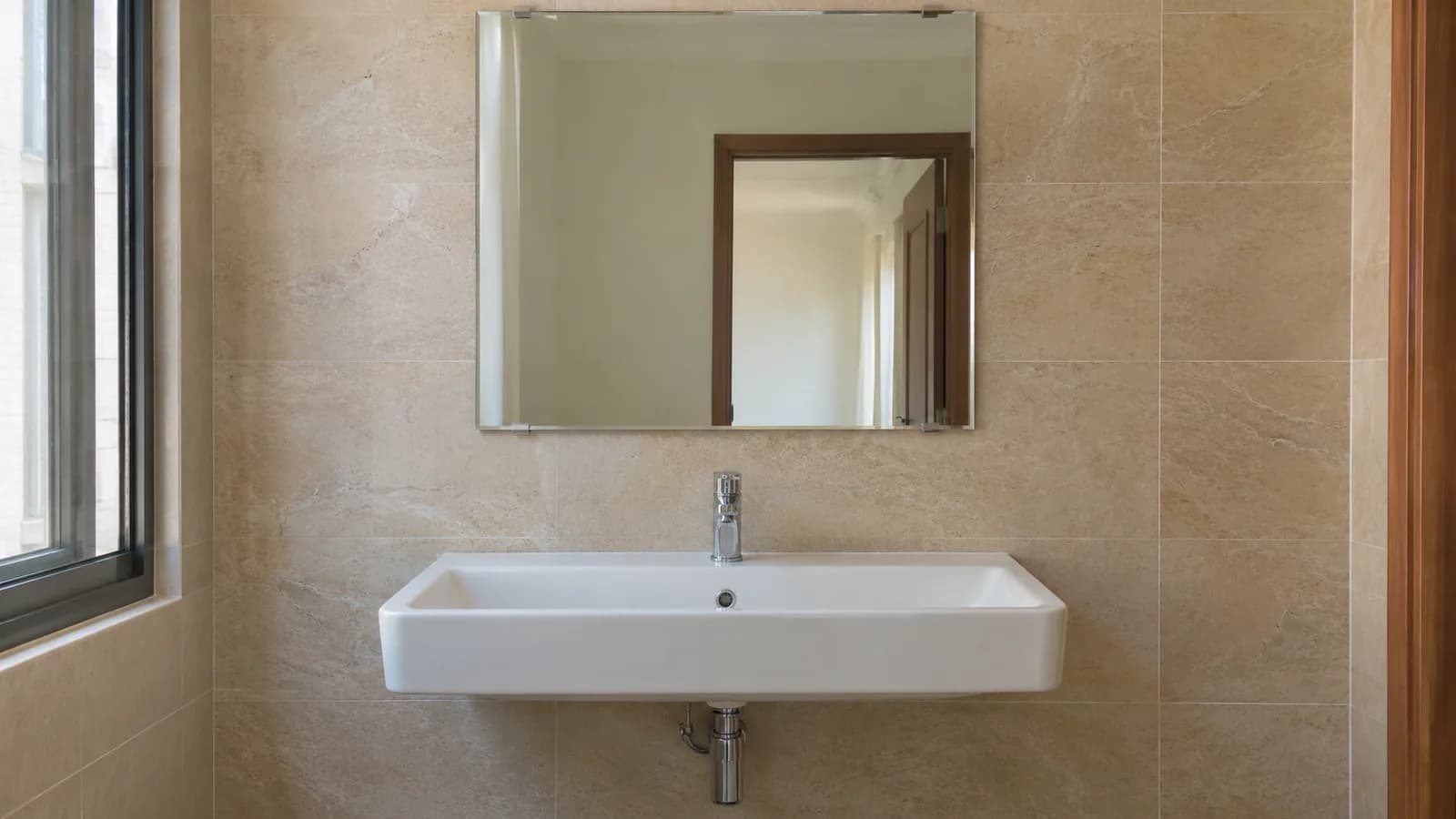
Start with the width of the basin or the counter below. The mirror should not be wider than that. Most people keep it equal, or about 2 to 4 in (50 to 100 mm) narrower. A narrower mirror leaves a little wall on each side, and it looks centred.
Mirror size for a wash basin fixed on the wall
A wall-hung or pedestal basin is usually about 18 to 24 in (450 to 600 mm) wide. A mirror of about 18 x 24 in (450 x 600 mm) suits a small basin. A mirror of about 24 x 36 in (600 x 900 mm) suits a larger one. Hang it upright, with the longer side vertical. That shows more of you in a narrow space.
Mirror size for a bathroom vanity counter
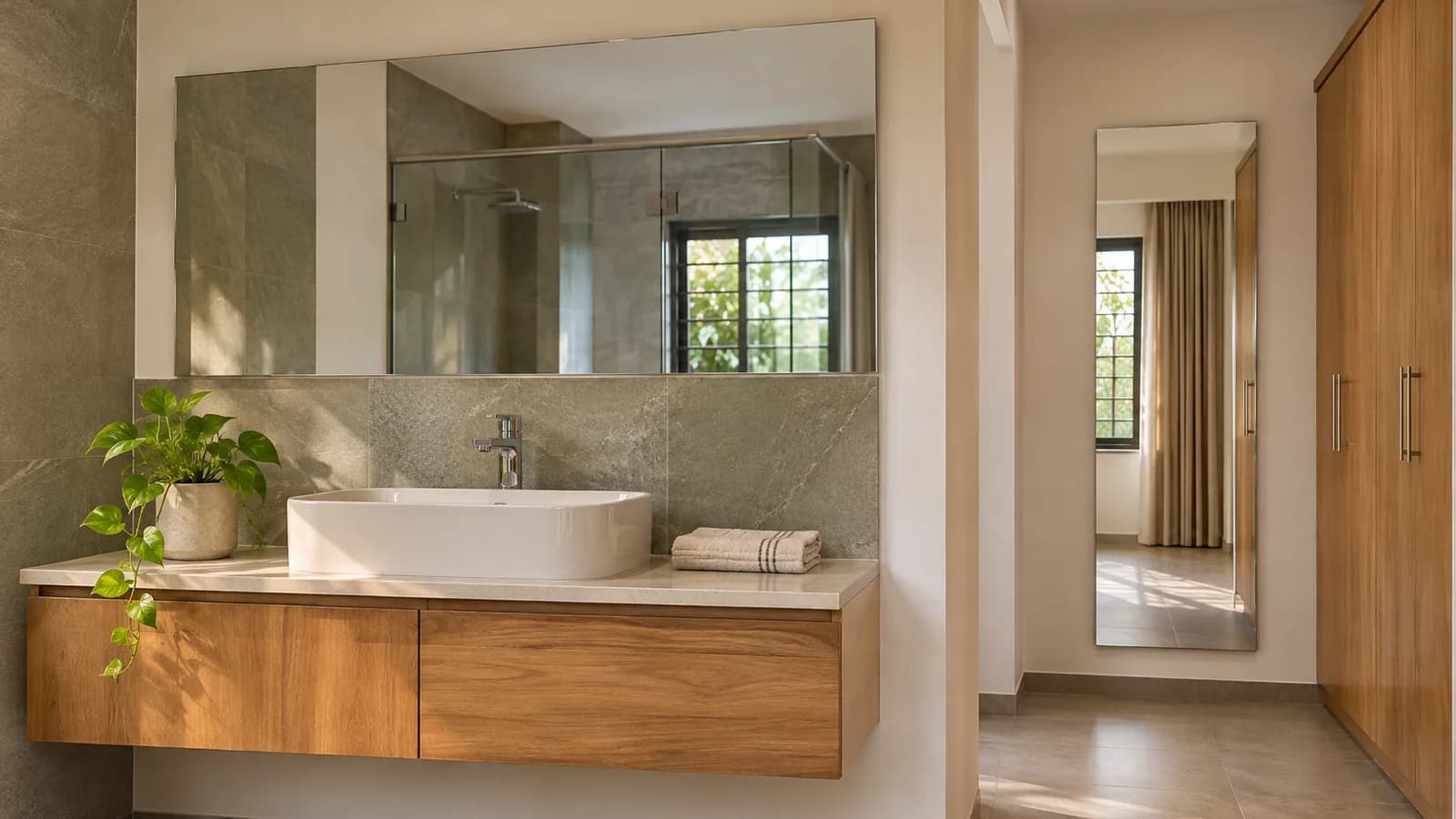
A vanity is a counter with the basin set in it, often with storage below. Counters commonly run from 30 to 48 in (750 to 1200 mm) wide. Here the mirror usually follows the counter, not the basin. One wide mirror makes a small bathroom look bigger. With two basins, you can use one long mirror, or one mirror over each basin.
| Basin or counter width | Mirror width | Mirror height |
|---|---|---|
| 18 in (450 mm), small basin | 16 to 18 in (400 to 450 mm) | 24 to 30 in (600 to 750 mm) |
| 24 in (600 mm), common basin | 20 to 24 in (500 to 600 mm) | 24 to 36 in (600 to 900 mm) |
| 30 in (750 mm), small counter | 26 to 30 in (650 to 750 mm) | 30 to 36 in (750 to 900 mm) |
| 36 in (900 mm), counter | 32 to 36 in (800 to 900 mm) | 30 to 36 in (750 to 900 mm) |
| 48 in (1200 mm), wide counter | 44 to 48 in (1100 to 1200 mm) | 30 to 42 in (750 to 1050 mm) |
| 60 in (1500 mm), two basins | One mirror of 56 to 60 in (1400 to 1500 mm), or two of 20 to 24 in (500 to 600 mm) | 30 to 42 in (750 to 1050 mm) |
Three things can change these figures. A tap fixed on the wall needs space below the mirror. A light above the mirror limits its height. A wall cabinet or a window beside the basin limits its width. Where the wall is tiled, try to end the mirror on a tile joint. It looks planned, and a small error hides in the joint.
Is your basin right beside the shower? Then splashes and steam reach the mirror every day. Our guide on wet and dry bathroom design shows how to keep the basin side dry.
What height to hang a bathroom mirror at
Hang the mirror for the eyes of the people who use it. The centre of a wash basin mirror usually sits about 57 to 65 in (1450 to 1650 mm) above the floor. That is the eye level of most standing adults. Then check the top edge and the bottom edge.
| What | In inches | In mm | Why |
|---|---|---|---|
| Rim of the basin | About 32 to 34 in | About 800 to 850 mm | The usual basin height in homes |
| Bottom edge of the mirror | About 38 to 42 in | About 950 to 1050 mm | It sits 6 to 8 in (150 to 200 mm) above the rim, clear of the tap |
| Centre of the mirror | About 57 to 65 in | About 1450 to 1650 mm | Standing eye level for most adults |
| Top edge of the mirror | About 72 to 78 in | About 1800 to 1950 mm | It should be above the head of the tallest user |
Take a mirror of 24 x 30 in (600 x 750 mm) over a common basin. Put its bottom edge 42 in (1050 mm) above the floor. Its top edge is then at 72 in (1800 mm). Most adults see their face and shoulders in it. A shorter mirror must hang higher, so its top still clears the tallest person.
A home with children or a wheelchair user needs the mirror to reach lower. A taller mirror usually solves this better than a lower one. It serves the short user and the tall user together.
Mirror size for full body: the half-your-height rule
A full-length mirror shows you from your head to your shoes. To show your whole body, a flat wall mirror must be at least half your height. This is plain optics, and standing further back does not change it. So a person of 5 ft 8 in (173 cm) needs about 34 in (86 cm) of mirror.
Here is why. Light from your shoes reaches your eyes by bouncing off the mirror. It bounces at a point halfway between your shoes and your eyes. Light from the top of your head bounces halfway between your head and your eyes. You use only the glass between those two points. That strip of glass is half your height.
| Your height | Least mirror height | Bottom edge above the floor |
|---|---|---|
| 5 ft 0 in (152 cm) | 30 in (76 cm) | About 28 in (70 cm) |
| 5 ft 4 in (163 cm) | 32 in (81 cm) | About 30 in (76 cm) |
| 5 ft 8 in (173 cm) | 34 in (86 cm) | About 32 in (81 cm) |
| 6 ft 0 in (183 cm) | 36 in (91 cm) | About 34 in (86 cm) |
The bottom edge in the table sits at half your eye height. The table shows the least size, and the least size is hard to live with. It works at one exact height on the wall. It suits one person, not a family. It leaves no room for heels, a hairstyle or raised arms. So we suggest you go taller.
Full-length mirror sizes people actually order
Most full-length mirrors are 48 to 72 in (1200 to 1800 mm) tall. Widths run from 12 to 24 in (300 to 600 mm). A width of 16 to 18 in (400 to 450 mm) shows one person well. Choose 24 in (600 mm) if you want to see an outfit with your arms out.
- 48 in (1200 mm) tall. Enough for adults, if the bottom edge sits about 24 in (600 mm) above the floor.
- 60 in (1500 mm) tall. A common family size. Hang it with the bottom edge about 12 in (300 mm) above the floor.
- 72 in (1800 mm) tall. It runs almost from the floor to head height. It suits children and tall adults together.
A child needs the bottom edge lower than an adult does. For a child of 3 ft 6 in (107 cm), keep it within about 18 in (450 mm) of the floor. Some people lean a tall mirror against the wall instead of hanging it. A leaning mirror must still be tied to the wall at the top. Otherwise it can slide, or tip onto a child.
Mirror size for a bedroom, a dressing table and a dresser
Mirror size for a bedroom wall or door
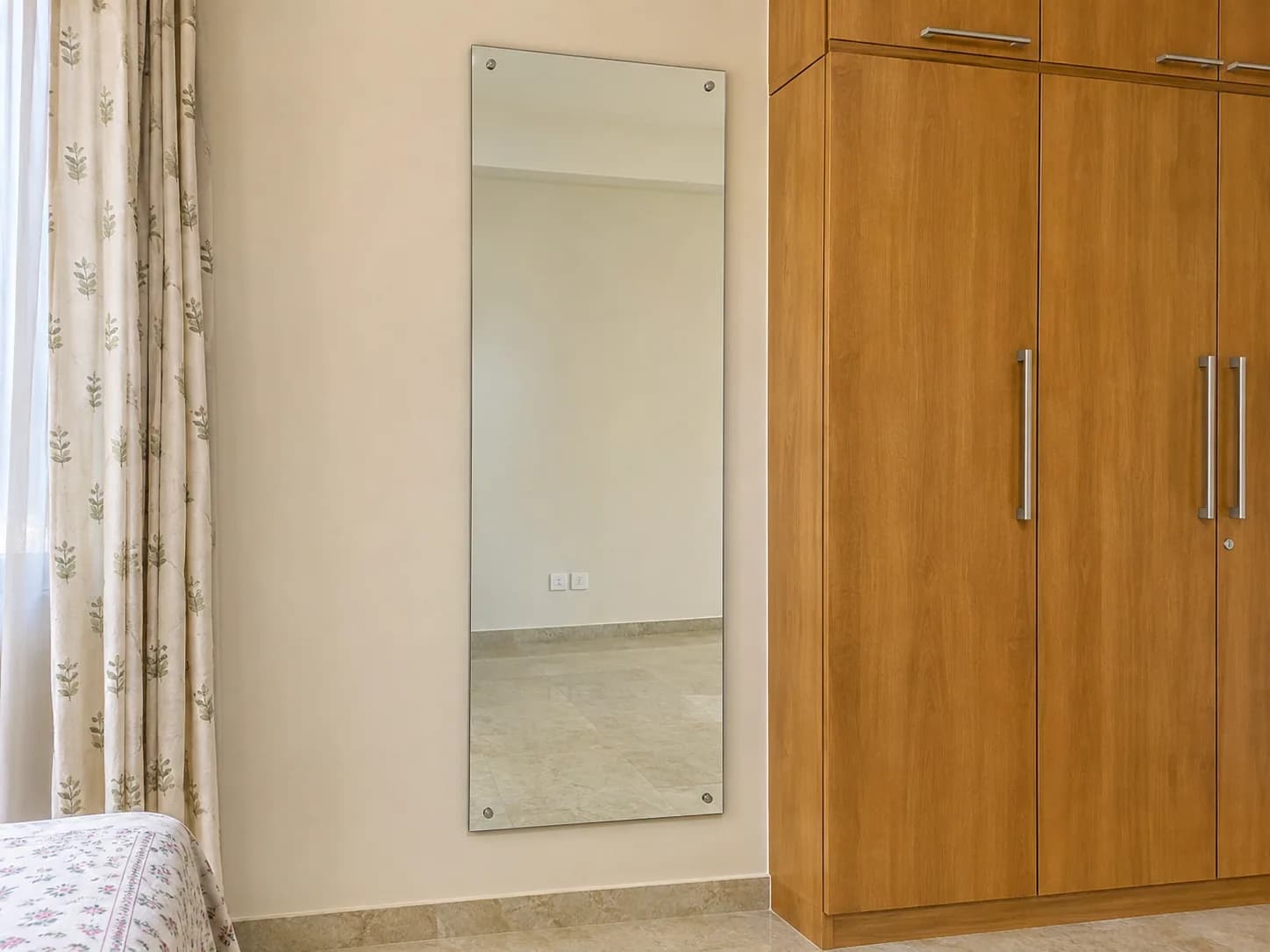
A bedroom usually needs one full-length mirror. Use the sizes in the section above. Good places are the wall beside the wardrobe, or the back of the bedroom door. A door mirror is usually narrow. About 12 to 16 in (300 to 400 mm) wide and 48 to 60 in (1200 to 1500 mm) tall is common. Keep it clear of the handle and the hinges. Keep it light too, because the hinges carry it every day.
Think about what the mirror will reflect. A mirror that faces a window reflects daylight into the room. A mirror that faces a strong lamp gives glare. Leave about 3 ft (900 mm) of clear floor in front, so you can step back and turn.
Mirror size for a dressing table
You usually sit at a dressing table. So the mirror is sized for a seated face and shoulders. Dressing tables are commonly 30 to 48 in (750 to 1200 mm) wide. The mirror is usually about two thirds of that width, or the full width. That gives 20 to 36 in (500 to 900 mm). A height of 24 to 36 in (600 to 900 mm) is common.
Seated eye level is about 44 to 48 in (1100 to 1200 mm) above the floor. Start the mirror just above the table top, about 4 to 6 in (100 to 150 mm) up. Your face then sits near the middle of the glass. If you also stand at the table, choose a taller mirror instead.
Mirror size for a dresser
A dresser is a low chest of drawers, and you stand in front of it. Dressers are commonly 36 to 60 in (900 to 1500 mm) wide and 30 to 36 in (750 to 900 mm) high. A mirror of about two thirds of the dresser's width looks balanced. That is 24 to 40 in (600 to 1000 mm) wide. Because you stand, the top edge should reach about 72 in (1800 mm) above the floor.
Wardrobe door mirrors: size, weight and safety
A mirror on a wardrobe shutter saves wall space in a small bedroom. A shutter is the door of the wardrobe. The mirror can cover the whole shutter, or run as a strip down the middle. A full shutter is usually about 78 to 84 in (1950 to 2100 mm) tall. That is far more than half your height, so it works as a full-length mirror.
- Size. On a hinged shutter, keep the mirror about 1 to 2 in (25 to 50 mm) inside each edge. That clears the hinges, the handle and the closing gap. A centre strip is usually 12 to 18 in (300 to 450 mm) wide.
- Weight. Glass weighs about 2.5 kg per square metre for each mm of thickness. A 4 mm mirror of 600 x 2100 mm (about 2 x 7 ft) weighs about 12.6 kg. The hinges or rollers must carry the shutter and that weight together.
- Thickness. Wardrobe mirrors are usually 4 mm, to keep the shutter light. The board behind supports the glass across its whole back.
- Safety. A shutter moves every day, and children play near it. Ask for a safety backing. It is a film on the back that holds the pieces if the mirror breaks.
A sliding wardrobe often holds its mirror in a slim aluminium frame instead. Has a mirrored shutter cracked, or come off its track? See bathroom or wardrobe mirror broken and wardrobe sliding door repair.
Gym and dance wall mirrors: panel sizes and joints
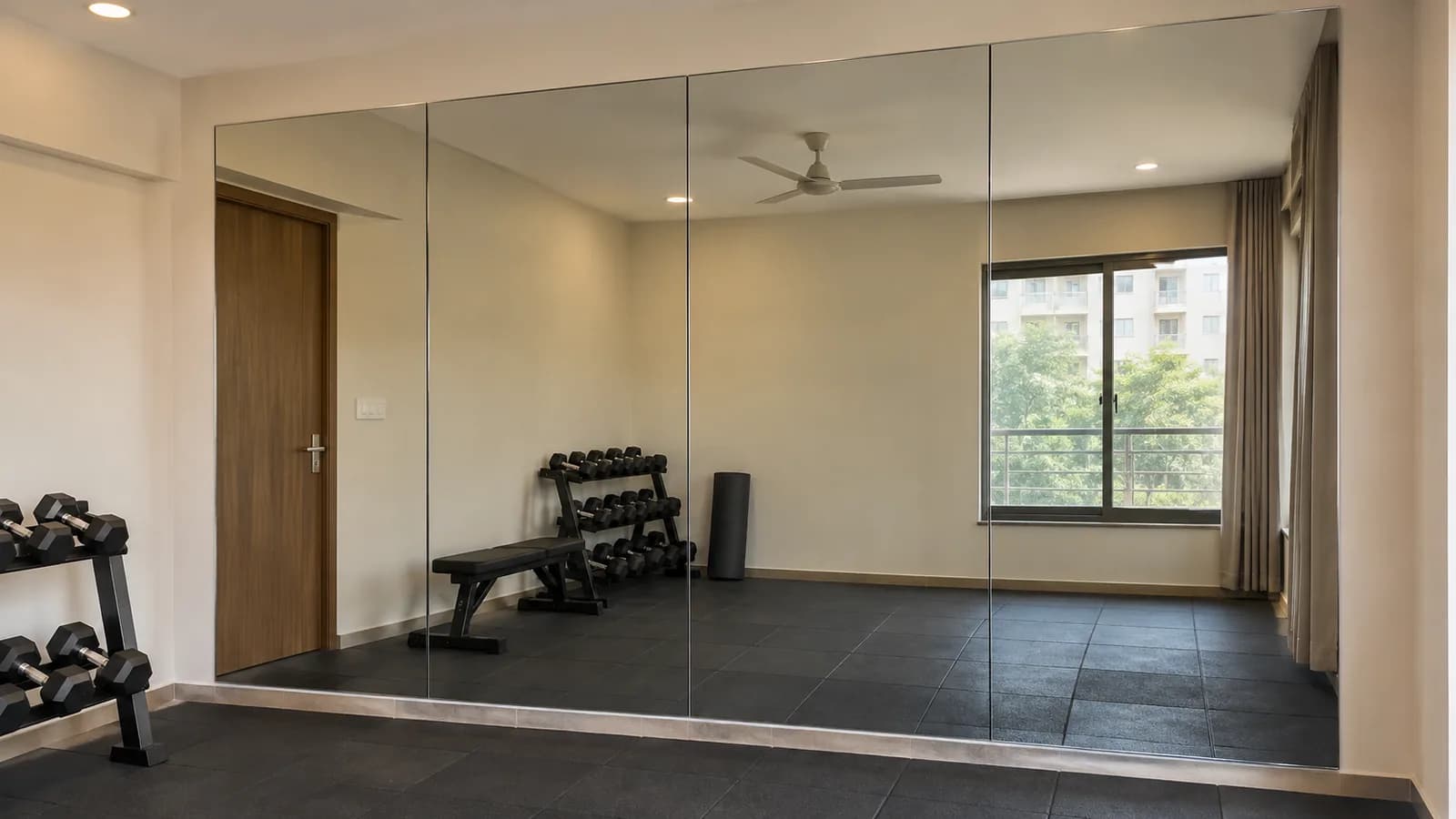
A gym or dance mirror covers a whole wall. No single sheet does that. A big sheet is heavy, and it must fit the lift and the stairs. So the wall is made of several panels set side by side.
- Panel width. Panels are commonly about 3 to 4 ft (900 to 1200 mm) wide. Equal panels look best, so the wall length is divided evenly.
- Panel height. About 6 to 7 ft (1800 to 2100 mm) is common. The top should clear the tallest user with arms raised, where the ceiling allows.
- Bottom edge in a gym. It often starts 12 to 18 in (300 to 450 mm) above the floor. That keeps weights lying on the floor away from the glass.
- Bottom edge in a dance or yoga room. It starts close to the floor, about 4 to 6 in (100 to 150 mm) up. People work sitting and lying down, and low eyes need a low mirror.
- Thickness. Usually 5 or 6 mm. A thin panel bends slightly on an uneven wall, and the reflection bends with it.
- Joints. Panels meet edge to edge, with polished edges and a very thin gap. The wall must be flat, or the reflection breaks at every joint.
A panel of 4 x 6 ft (1200 x 1800 mm) in 6 mm glass weighs about 32 kg. So the weight usually rests on a metal channel along the bottom. Adhesive and clips at the top then hold the panel flat. The exact fixing always depends on the wall.
We fit full-wall mirrors for gyms. Each panel is made to the size of your wall. If one panel cracks later, only that panel is replaced.
Mirror thickness in mm: when a thicker mirror is used
Mirror thickness is given in mm. Most home mirrors are 4 mm or 5 mm thick. A large frameless mirror usually goes to 6 mm, so that it stays flat. The right figure depends on the size, the wall and the fixing.
| Thickness | Weight of each square metre | Commonly used for |
|---|---|---|
| 3 mm | About 7.5 kg | Small mirrors held in a frame, and mirrors inside cabinet doors |
| 4 mm | About 10 kg | Wash basin mirrors, wardrobe shutters and framed wall mirrors |
| 5 mm | About 12.5 kg | Larger frameless bathroom mirrors, full-length mirrors and bevelled edges |
| 6 mm | About 15 kg | Large frameless wall mirrors, gym and dance walls, and wide bevels |
A thicker mirror is used for three reasons. First, a large mirror must stay flat, and thin glass bends. A bent mirror gives a stretched, wavy reflection. Second, a frameless mirror on clips is held at only a few points. Third, a bevelled edge is ground into the glass, so the glass needs enough thickness.
Thicker is not always better. Each extra mm adds weight to the wall, the adhesive and the hinges. A 4 mm mirror glued fully to a flat board stays flat and works well. We suggest a thickness at the measuring visit, when we can see the wall.
A mirror is usually ordinary glass with a reflective coating on the back. It is usually not toughened glass. That is why it can be cut to almost any size. Doors, railings and showers follow different rules. Our toughened glass thickness guide covers those.
Mirror edge finishes: polished, bevelled or framed
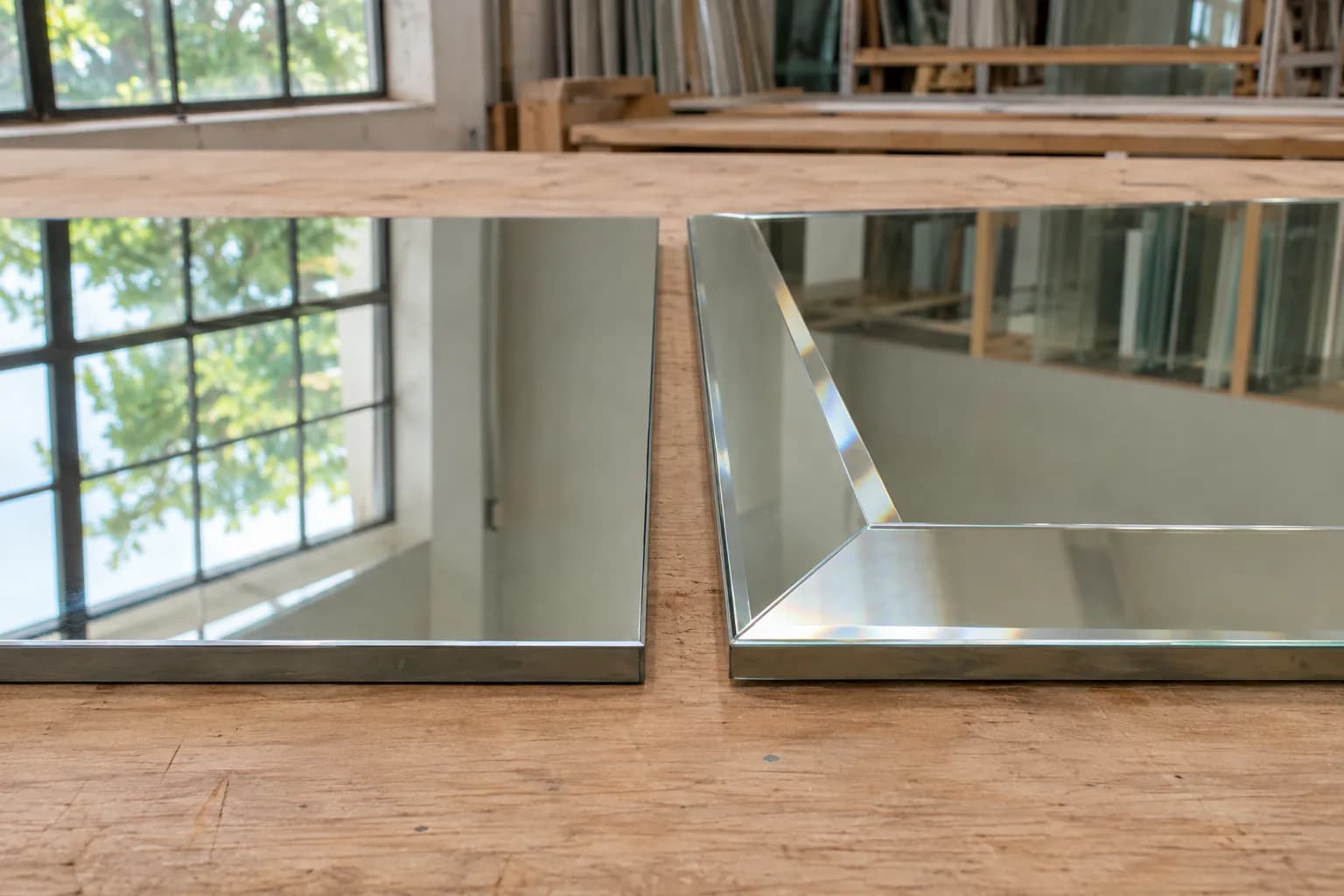
A freshly cut mirror has a sharp edge. The edge finish makes it safe to touch. It also decides how the mirror looks on the wall.
- Raw or seamed edge. Only the sharpness is sanded off. Use it only where a frame or a channel hides the whole edge.
- Flat polished edge. The edge is ground flat and polished smooth. It is the usual finish for a frameless mirror.
- Pencil polished edge. The edge is rounded, like the side of a pencil. It feels soft, and it suits mirrors that people walk close to.
- Bevelled edge. A sloping band is ground around the face of the mirror. The band is commonly 0.5 to 1 in (12 to 25 mm) wide. It catches the light like a frame made of glass.
A bevelled edge costs more than a polished one, because it takes more work. It also suits thicker glass. On a wall of several panels, plain polished edges usually meet more neatly than bevels. Any edge you can touch should be polished or bevelled.
Corners are a separate choice. A small rounded corner is safer in a small bathroom. Round, oval and arched mirrors are cut from a template. A curve costs more to make than a rectangle, and it usually takes longer.
How a mirror is fixed to a wall: adhesive, clips or a frame
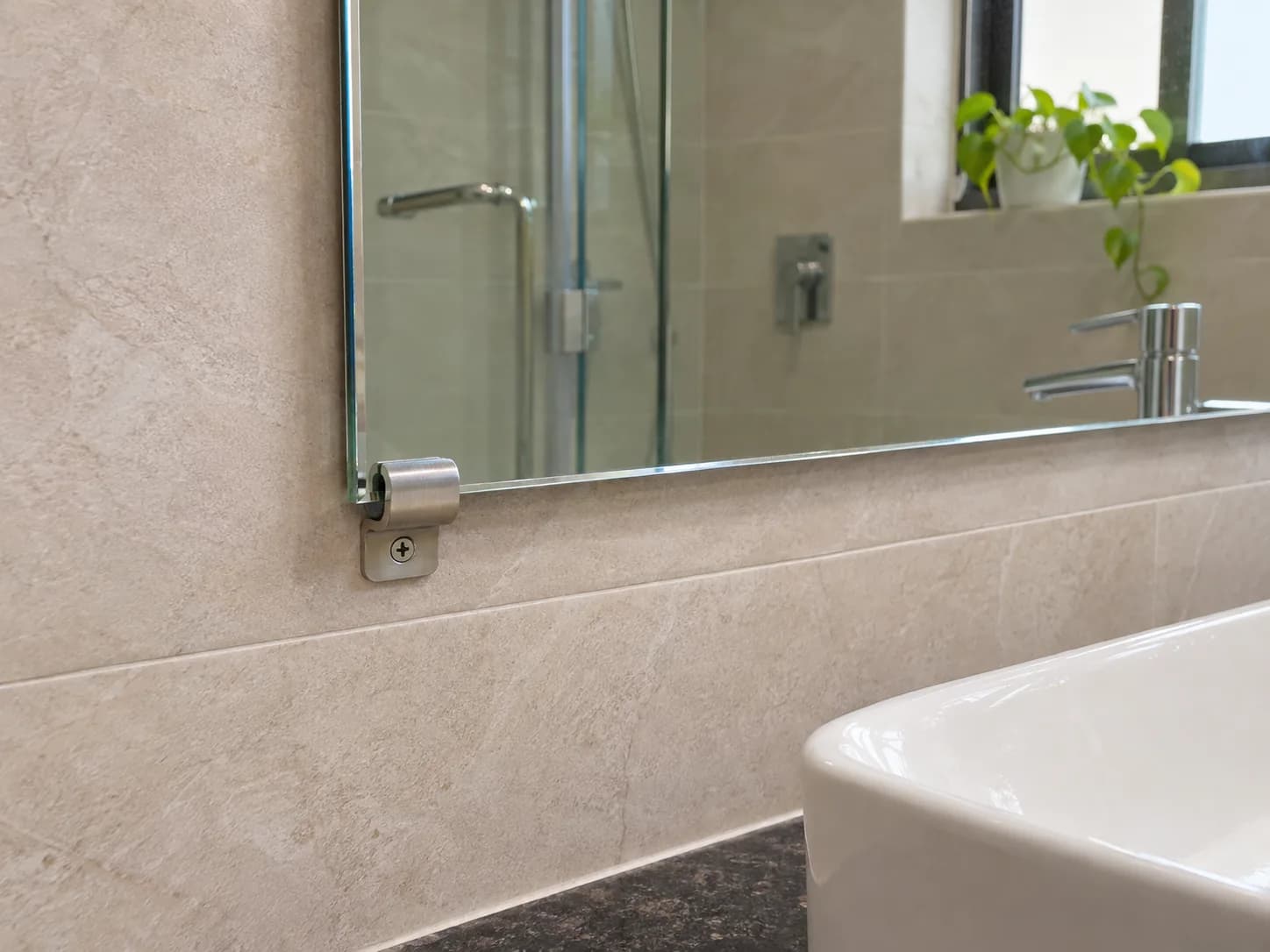
The fixing depends on the wall and on the weight of the mirror. There are five common ways. Two of them are often used together.
| Method | How it holds | Where it suits | What to watch |
|---|---|---|---|
| Mirror adhesive | A neutral-cure silicone or mirror adhesive bonds the back to the wall | Flat, dry, sound walls and boards, for a clean frameless look | The wrong glue can damage the silver backing |
| Clips or brackets | Small clips screwed to the wall hold the edges and carry the weight | Bathrooms, tiled walls and heavier mirrors | The clips show, and the drill holes must miss pipes and wires |
| Bottom channel | A metal channel carries the weight along the bottom edge | Tall mirrors and gym walls | It needs a level line, and it is usually used with adhesive |
| Mirror screws | Screws with caps pass through holes drilled in the mirror | Walls where glue cannot be trusted | The holes are drilled at the workshop, so their places are fixed early |
| Frame | The mirror sits in a frame, and the frame hangs on the wall | Any wall that takes a screw, and mirrors you may move later | The frame adds width, so the glass must be sized smaller |
Adhesive alone is a risk for a large or heavy mirror. Clips, brackets or a channel should carry the weight, and the adhesive should only keep the mirror flat. If the glue weakens one day, the mirror still stays up.
Why a wet bathroom wall matters for a mirror
A bathroom is the hardest room for a mirror. Three things go wrong there.
- Steam weakens many glues and tapes. A mirror held by tape alone can let go after some years of hot showers.
- A damp wall holds nothing. Glue does not bond to wet plaster, and screws work loose in soft plaster. The wall must be dry and sound first.
- Moisture attacks the backing. Water that reaches the silver coating turns the edges black. A copper-free mirror with sealed edges resists this much better.
Adhesive grips only the top layer of a wall. On a painted wall, the mirror hangs from the paint. On loose tiles, it hangs from those tiles. So we look at the wall before we choose the fixing. Damp or crumbling plaster needs a mason or a waterproofing contractor first. That repair is not our work.
Mirror sizes in inches, feet, mm and cm
Glass is usually sold by the square foot and cut by the mm. That mix causes mistakes. The table shows the exact figure and the figure the trade rounds to.
| Inches | Feet | Exact mm | Trade size in mm | Trade size in cm |
|---|---|---|---|---|
| 12 in | 1 ft | 305 mm | 300 mm | 30 cm |
| 18 in | 1.5 ft | 457 mm | 450 mm | 45 cm |
| 24 in | 2 ft | 610 mm | 600 mm | 60 cm |
| 30 in | 2.5 ft | 762 mm | 750 mm | 75 cm |
| 36 in | 3 ft | 914 mm | 900 mm | 90 cm |
| 48 in | 4 ft | 1219 mm | 1200 mm | 120 cm |
| 60 in | 5 ft | 1524 mm | 1500 mm | 150 cm |
| 72 in | 6 ft | 1829 mm | 1800 mm | 180 cm |
A mirror ordered as 24 x 36 in may arrive as 600 x 900 mm or as 610 x 914 mm. On an open wall, that does not matter. Between two walls or two tile borders, it does. If the mirror must fill an exact space, give the size in mm only.
How to measure and order a mirror cut to size
People search for mirror cutting, mirror fixing and mirror installation near them. All three jobs start with the same thing, a correct size. Follow these steps before you call anyone.
- Measure the wall, not the old mirrorMeasure the clear space the mirror can use. Note the taps, switches, lights, shelves and tile borders around it.
- Measure in three placesTake the width at the top, the middle and the bottom. Take the height at the left, the centre and the right. Walls and alcoves are rarely square, so use the smallest figure.
- Leave a clearanceBetween two walls, take off about 3 to 6 mm (up to a quarter inch) on each side. A mirror cut to the exact gap will not go in.
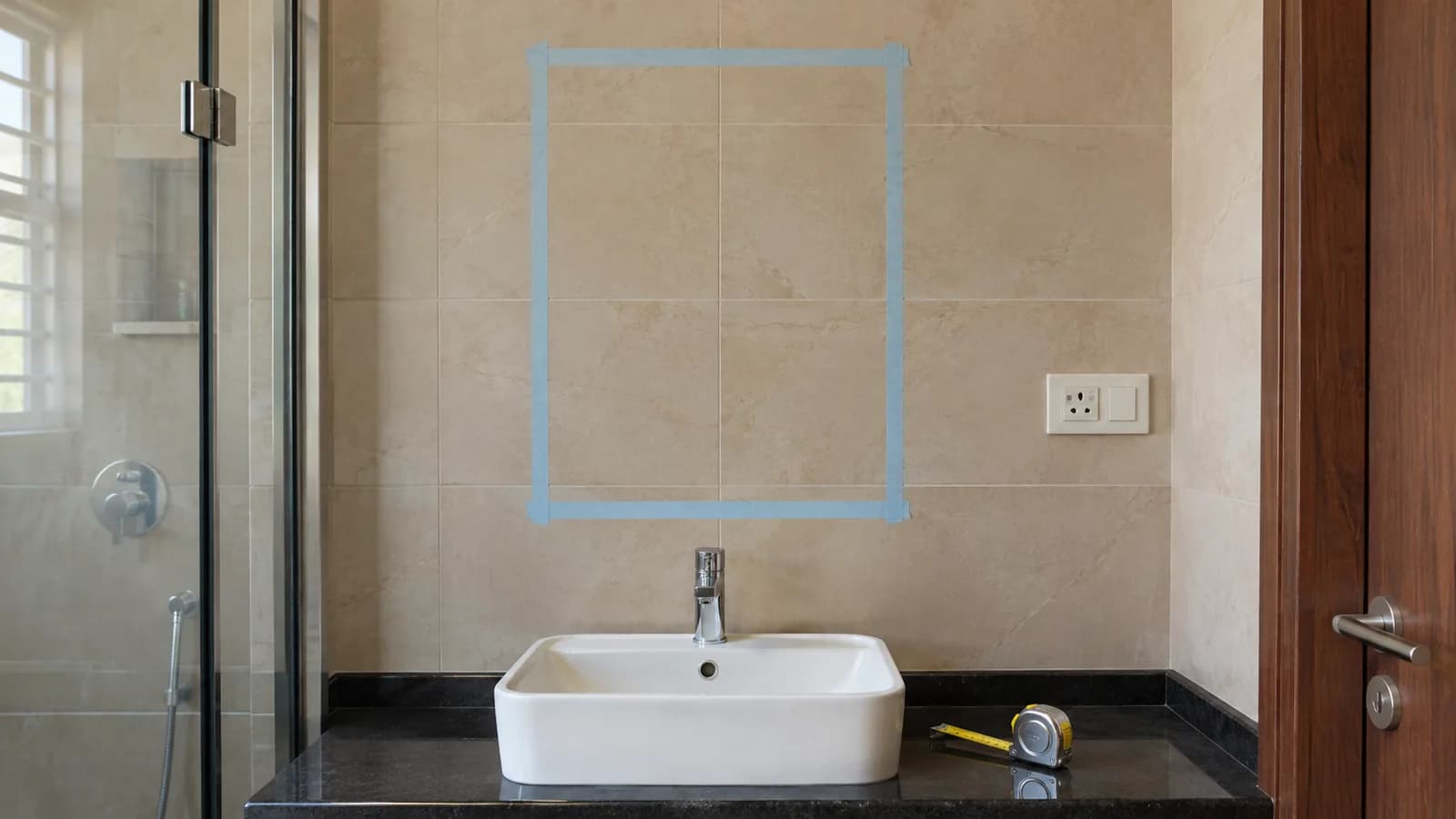
- Tape the outline on the wallMark the size with masking tape and stand in front of it. Check that the shortest user and the tallest user both see their face.
- Choose the thickness, the edge and the fixingDecide these together with the size. Mark any hole or cut-out for a switch or a light, because those are made at the workshop.
- Write it down clearlyWrite the width first, then the height, in mm. Add the thickness, the edge finish and the room. Take one photo of the wall from the front and one from the side.
- Check the way inA tall mirror must fit the lift, the stairs and the room door. Tell the fitter your floor and the size of the lift.
For a simple rectangle on an open wall, this is enough to ask for a price. For an alcove or an odd shape, we make a template on site instead of trusting figures. We cut and fit mirrors and custom glass across Bengaluru, Mumbai, Pune and Delhi NCR, with our own team. We measure on site. You get a written price that covers the glass, the edge finish, the fixings and the fitting. Making the piece usually takes about four to seven working days.
The live starting rate is on our mirror and custom glass installation page.
Send a photo of the wall and your rough size. We measure on site and give you the price in writing.
Mirror size mistakes to avoid before you order
- Copying the old mirror's size. The old one may have been wrong for the wall too.
- A mirror wider than the basin. It looks too heavy for the basin, and its corners stick out past the counter.
- Hanging a short mirror too low. A tall user then sees a chin, not a face.
- Choosing the least full-length size. Half your height is correct in theory, but hard to use on a real wall.
- Thin glass for a big frameless mirror. It bends on the wall, and the reflection turns wavy.
- Glue alone on a bathroom wall. Steam weakens it. Let clips or a channel carry the weight.
- A normal mirror in a steamy bathroom. Ask for a copper-free mirror with sealed edges.
- Forgetting the lift. A 6 ft (1800 mm) mirror is wasted if it cannot reach your floor.
A mirror is one kind of made-to-measure glass. For the other kinds, read types of glass for homes. For openings, see standard window and door sizes in India. We work across Bengaluru, Mumbai, Pune and Delhi NCR, and where we work lists the areas.
Common questions
What size mirror should go above a wash basin?
Usually as wide as the basin, or about 2 to 4 in (50 to 100 mm) narrower. For a 24 in (600 mm) basin, a mirror of 20 to 24 in wide and 24 to 36 in tall is common. That is 500 to 600 mm by 600 to 900 mm. It is a rule of thumb, not a standard.
At what height should a bathroom mirror be fixed from the floor?
The centre usually sits about 57 to 65 in (1450 to 1650 mm) above the floor. The bottom edge is commonly 38 to 42 in (950 to 1050 mm) up, clear of the tap. The top edge should be above the head of the tallest user.
What is the minimum mirror size to see your full body?
Half your height, for a flat mirror fixed on a wall. A person of 5 ft 8 in (173 cm) needs about 34 in (86 cm). That size works at one exact position only. So most people choose a mirror of 48 to 72 in (1200 to 1800 mm).
What size mirror suits a dressing table?
About two thirds of the table's width, or the full width. For most tables that is 20 to 36 in (500 to 900 mm) wide and 24 to 36 in (600 to 900 mm) tall. Start it 4 to 6 in (100 to 150 mm) above the table top, so a seated face sits near the middle.
Which thickness is best for a bathroom mirror: 4 mm, 5 mm or 6 mm?
A small mirror in a frame or on a full backing is commonly 4 mm. A larger frameless mirror is usually 5 mm, and a very large one 6 mm. It depends on the size and the fixing. In a bathroom, ask for a copper-free mirror with sealed edges at any thickness.
Is adhesive alone enough to fix a large wall mirror?
Not for a large or heavy mirror, and not in a steamy bathroom. Clips, brackets or a bottom channel should carry the weight. The adhesive then only keeps the mirror flat. A small, light mirror on a dry, sound wall is a different case.
Can a mirror be cut to a custom size?
Yes. A mirror is usually ordinary glass with a reflective coating, so it is cut to size before it is fitted. Shapes, holes and cut-outs are made at the workshop. We measure on site and make the mirror to your sizes in Bengaluru, Mumbai, Pune and Delhi NCR.
How big should gym mirror panels be?
Commonly about 3 to 4 ft wide and 6 to 7 ft tall each. That is 900 to 1200 mm by 1800 to 2100 mm. The lift, the stairs and the length of the wall decide the final panel size. Glass of 5 or 6 mm is usual, so the panels stay flat.
Have a question this guide did not answer? Call us or send a photo on WhatsApp and we will tell you what it needs.
