In this guide
- How to stop rain water coming from a window: the short answer
- Five places rain water gets in at a window
- Rain water coming from sliding windows: drain slots and the track
- How to prevent rain water on window tracks in a storm
- Worn window seals and rain blown in by wind
- Leakage from the window frame joint, the wall and the sill
- Rain water coming from a wooden window
- Window leak checks that are safe to do yourself, and those that are not
- When a leaking window needs a repair visit
- Water near a window that is not a window leak
- A pre-monsoon checklist for windows and window tracks
Key takeaways
- Clean the track and open the drain slots first. A blocked track is a common reason rain spills inside a sliding window, and the easiest to fix.
- Never seal the drain slots. They let water out, and closing them makes the leak worse.
- Find the entry point before sealing anything. Water often shows up far from where it gets in.
- Checks from inside are safe; outside work at height is not. Leave the outer face of an upper-floor window to a team with proper access.
- Wooden windows leak for different reasons. Swelling, failed putty and old paint are a carpenter's and painter's work, not ours.
How to stop rain water coming from a window: the short answer
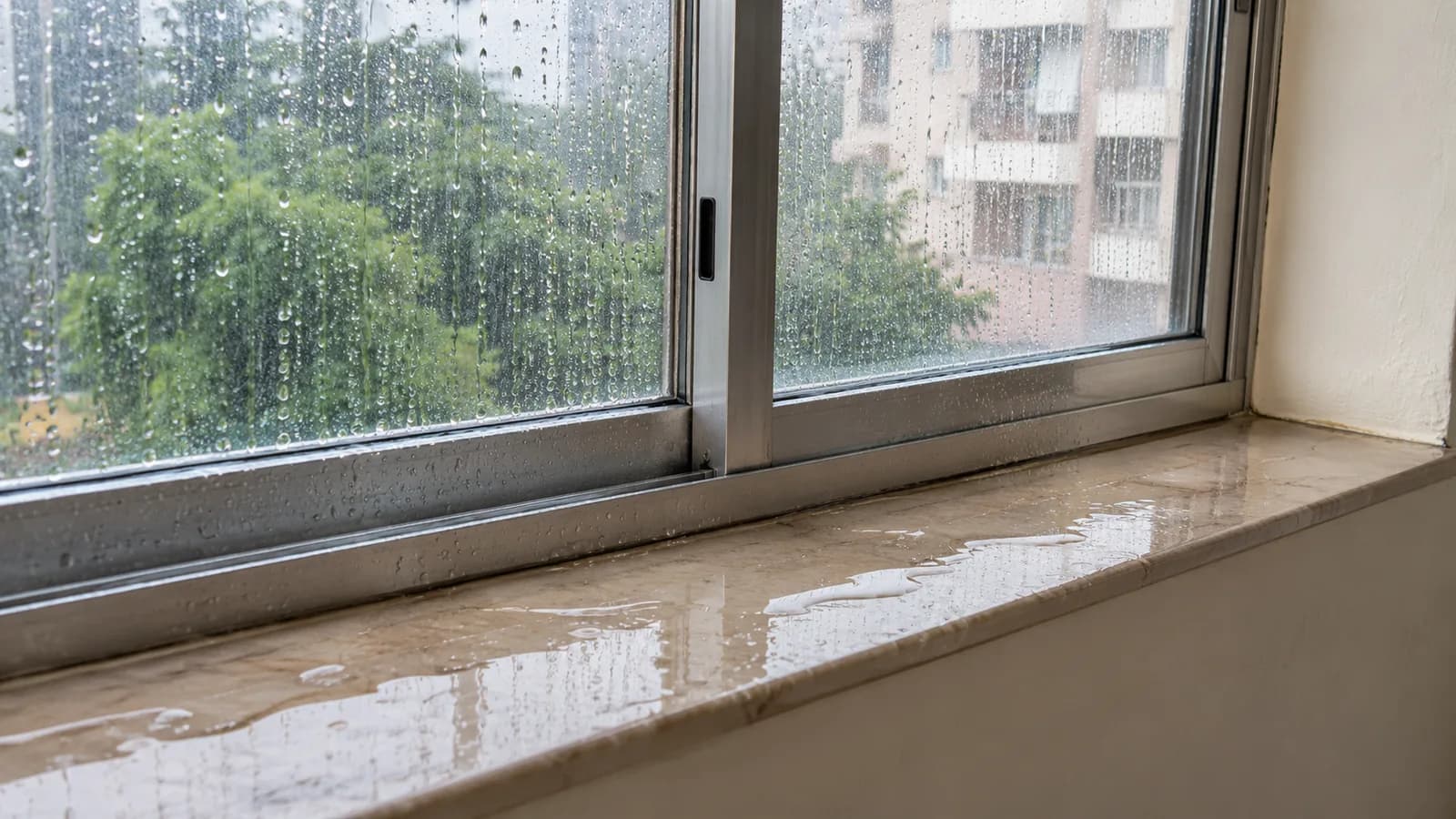
Rain almost never comes through the glass. It comes through one of five places. They are the drain slots, the track, the seals, the joint between frame and wall, and the sill. To stop rain water from a window, find which of the five places lets it in, then fix that place properly.
Start with the two you can check yourself, the track and the drain slots. If the window still leaks after that, the seals or the wall joint are usually the cause, and those are repairs. This guide goes through all five in order.
It also says where to stop. Some checks are safe from inside the room. Anything on the outside of an upper floor is not a home job, however simple it looks.
Five places rain water gets in at a window
| Where | What you see | Who fixes it |
|---|---|---|
| Drain slots blocked | Water stands in the track, then spills over the inner edge | You, from inside; or a repair visit |
| Track packed with dirt or damaged | Muddy water in the track, shutter hard to slide | You can clean it; damage is a repair |
| Seals worn | Water blown in at the edges or the middle in wind | A repair: new seals |
| Joint between frame and wall open | Damp patch beside or below the frame, drips at the top | A repair: sealing from the correct side |
| Sill or wall above the window | Water runs back along the sill; stains above or below | A mason or a waterproofing firm |
The first three belong to the window. The fourth is where the window meets the building. The fifth is the building itself. A good repair starts by working out which one you have. Our page on a window leaking rain water covers that diagnosis for aluminium and uPVC windows.
Rain water coming from sliding windows: drain slots and the track
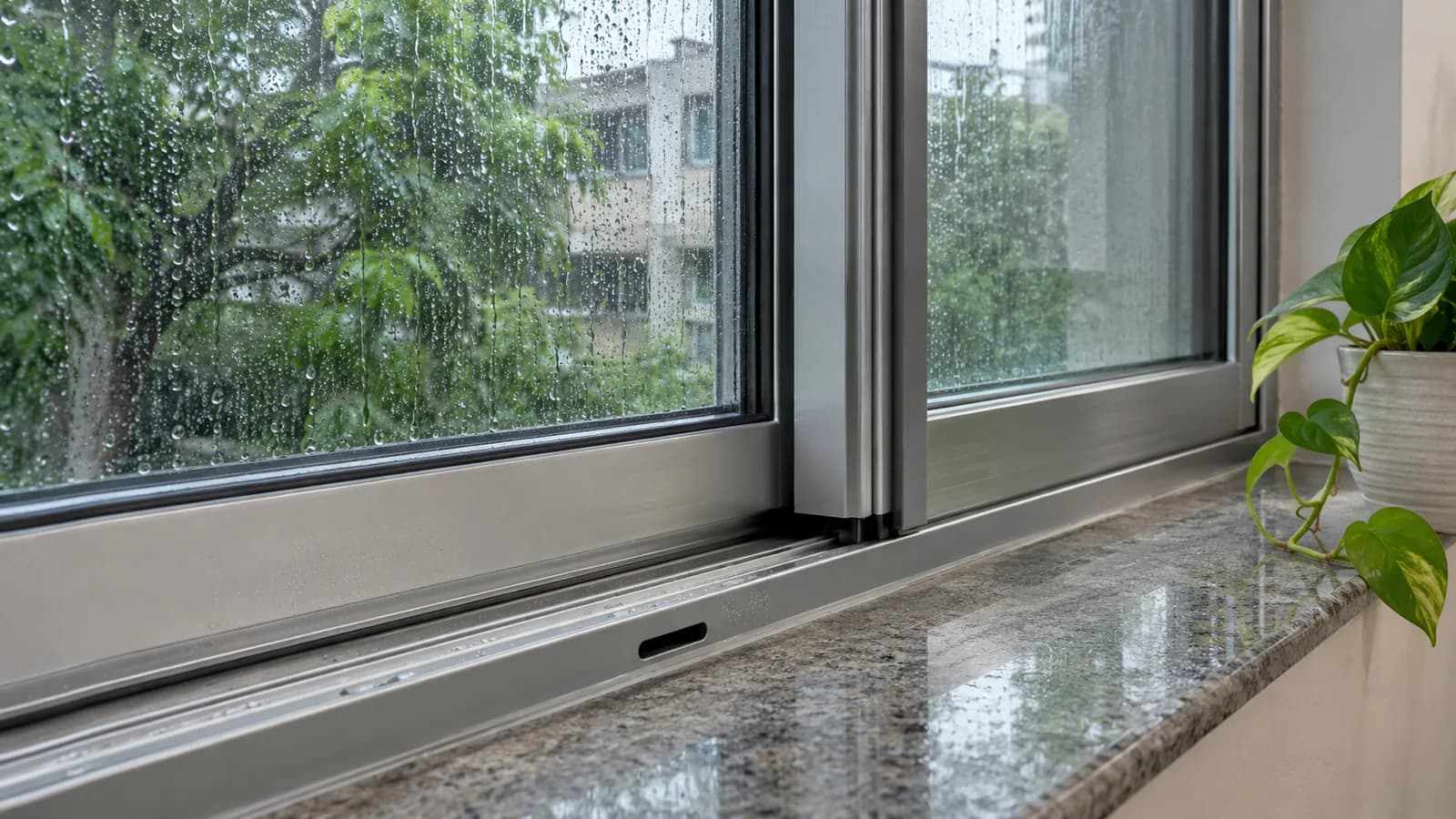
A sliding window is not meant to be watertight at the track. The track is a channel. It catches the rain that runs down the glass and lets it out through drain slots. These are small openings at the bottom of the frame, also called weep holes. On many frames the inner edge of the track stands a little higher than the outer edge. Water then leaves towards the outside.
The system fails when the slots block. Dust, dead insects and paint fill them. Then the track fills like a tray and spills into the room. A sliding window usually leaks because the water in its track cannot get out, not because too much is getting in.
- Wait for a dry hourDo this before the monsoon if you can. Open the window and slide the shutter fully to one side.
- Remove the dirt from the trackBrush or vacuum the loose dirt out first. Wipe the grooves with a damp cloth. Our quiet, cool and dry home guide has the full track-cleaning routine.
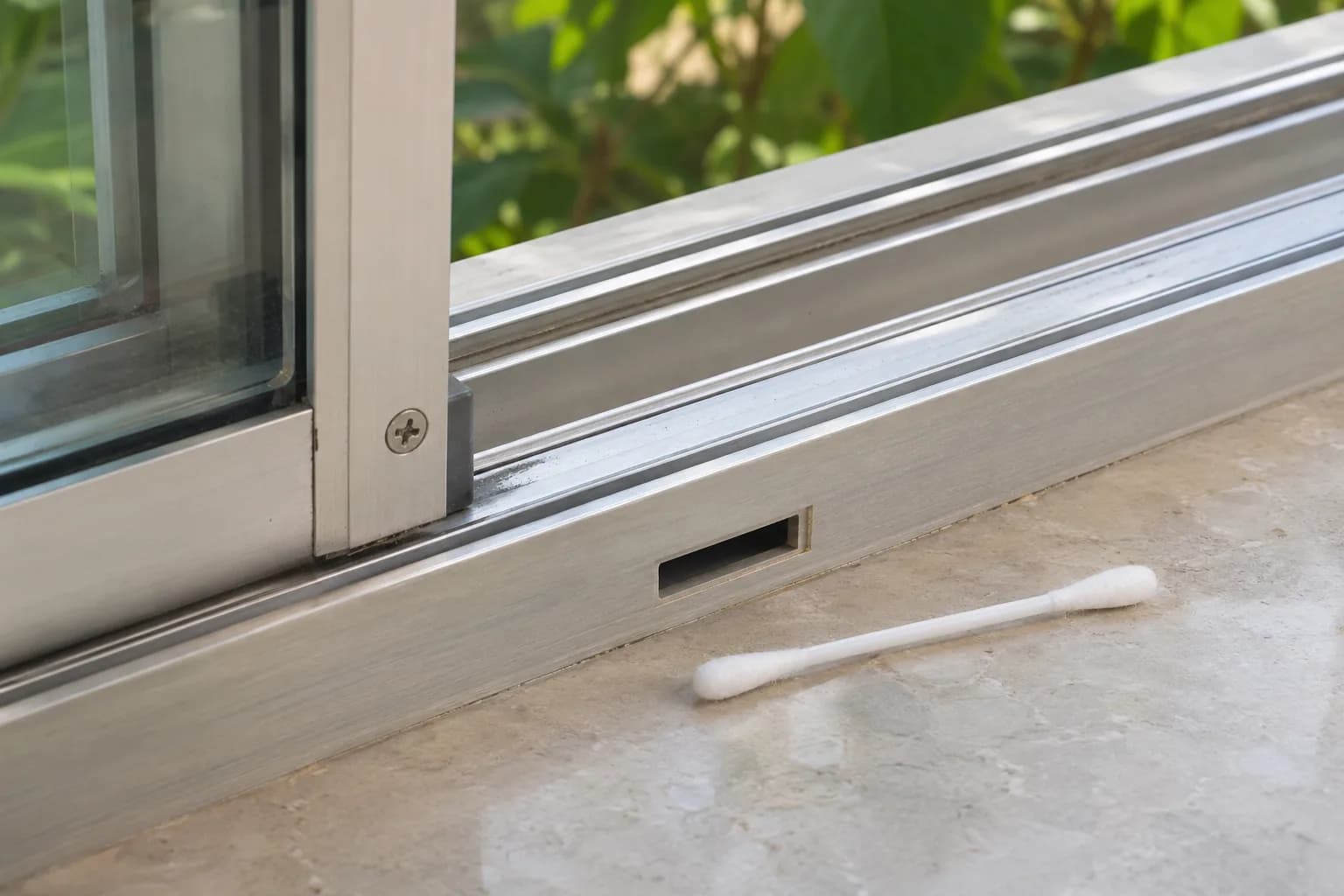
- Find the drain slotsLook along the bottom of the track for small slots or holes. Most windows have one near each end. Some frames hide them under small plastic caps on the outside face.
- Clear them gentlyUse a cotton bud, a wooden toothpick or a thin cable tie. Push the dirt through, working from inside the room. Do not use a drill or a screwdriver, which can damage the frame.
- Test with a cup of waterPour a little water into the track near each slot. It should run away to the outside. If it stands, the slot is still blocked.
If the track is clean and the slots are open but water still stands, read water in sliding window track. On uPVC frames the slots are easy to miss, and uPVC window leaking shows where to look.
How to prevent rain water on window tracks in a storm
Some water on the track in heavy rain is normal. The aim is that it drains away and never climbs over the inner edge. A few habits help.
- Lock the window, do not just push it shut. The lock pulls the shutter against its seals. A shutter left a finger-width open lets wind drive rain straight in.
- Clean before the monsoon, and once during it. Slots that are clear in May can be blocked again by August.
- Keep the mesh shutter's track clean too. The mosquito mesh usually runs on its own track on the same frame, and dirt from it washes into the main one.
- Do not store things on the sill. Pots and bottles on the track or sill stop the shutter closing and block the path of the water.
- Use a towel only as a stopgap. A rolled towel in the track buys you one storm. It is not a fix.
On a high floor that faces the wind, even a healthy track can be overwhelmed for a minute in a strong gust. If the water drains away as soon as the gust passes, the window is working. If it stands or spills in ordinary rain, something is blocked or worn.
Worn window seals and rain blown in by wind
Seals are the brush and rubber strips around the moving shutter. They close the gap the shutter needs in order to slide. After years of use they flatten or fall out. Then wind-driven rain passes at the sides and in the middle, where the two shutters overlap.
- Flat or missing strips around the shutter. Window seal replacement fits new ones.
- Shrunken rubber around the glass. Water gets between the glass and its frame. See aluminium window seal replacement.
- A shutter that has dropped. Worn rollers let the shutter sink, so the seals no longer meet. That needs new rollers, on aluminium or uPVC windows.
- A lock that does not pull tight. If the catch is worn, the shutter rattles and the seals never press. See window not locking properly.
You can look at the seals yourself. Close the window and look at the edges from inside in daylight. A line of light, or a strip that is hard, cracked or missing, tells you the seal has gone. Changing it is a repair, because the shutter has to come out of the frame.
Leakage from the window frame joint, the wall and the sill
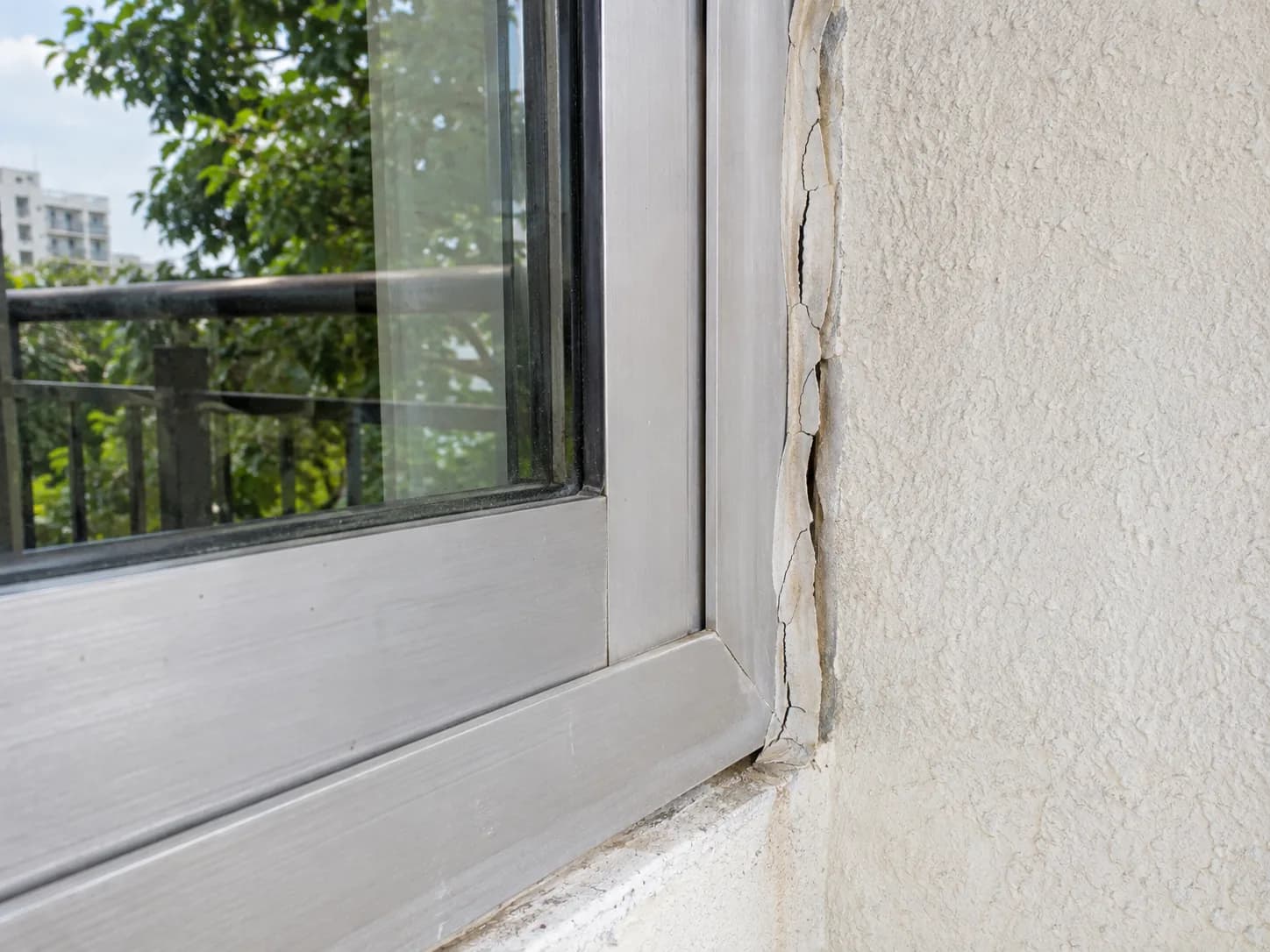
The frame is fixed into an opening in the wall, and the joint between them is filled with sealant. Sun and heat make the frame move a little every day. Old sealant cracks and lets go. Rain then runs into the joint and behind the frame. It can appear at the top corner, beside the frame, or as a damp patch below the window.
This leak is the one people most often seal wrongly. A line of silicone on the inside face hides the damp for a season. The water is still entering from outside and now stays in the wall. The lasting repair removes the old filling, packs the gap and seals it again, including the weather side. The drain slots are left open. Our page on a gap between window frame and wall explains how that is done, and window gap sealing is the service.
The sill is the ledge under the window. It should slope away from the frame so water runs off. A flat sill, or one that slopes towards the room, feeds water into the bottom joint all through the monsoon. Cracked plaster above the window does the same from the top. A missing chajja, the small concrete shade over a window, leaves the whole frame exposed. Changing a sill slope, repairing plaster and waterproofing a wall are a mason's work. We do not do them, and no sealant makes up for a sill that slopes the wrong way.
Rain water coming from a wooden window
A wooden window has no track and no drain slots. It leaks for its own reasons.
- Wood moves with the weather. It swells when wet and shrinks when dry. Gaps open between the shutter and the frame, and joints in the shutter loosen.
- The putty or beading fails. Old wooden windows hold the glass with putty or a thin wooden strip. When that cracks, water runs in behind the glass.
- Paint or polish has worn off. Bare wood soaks up water, and the bottom rail of the shutter usually suffers first.
- There is no seal where the shutter closes. Many wooden shutters close wood against wood, so wind pushes rain through the joint.
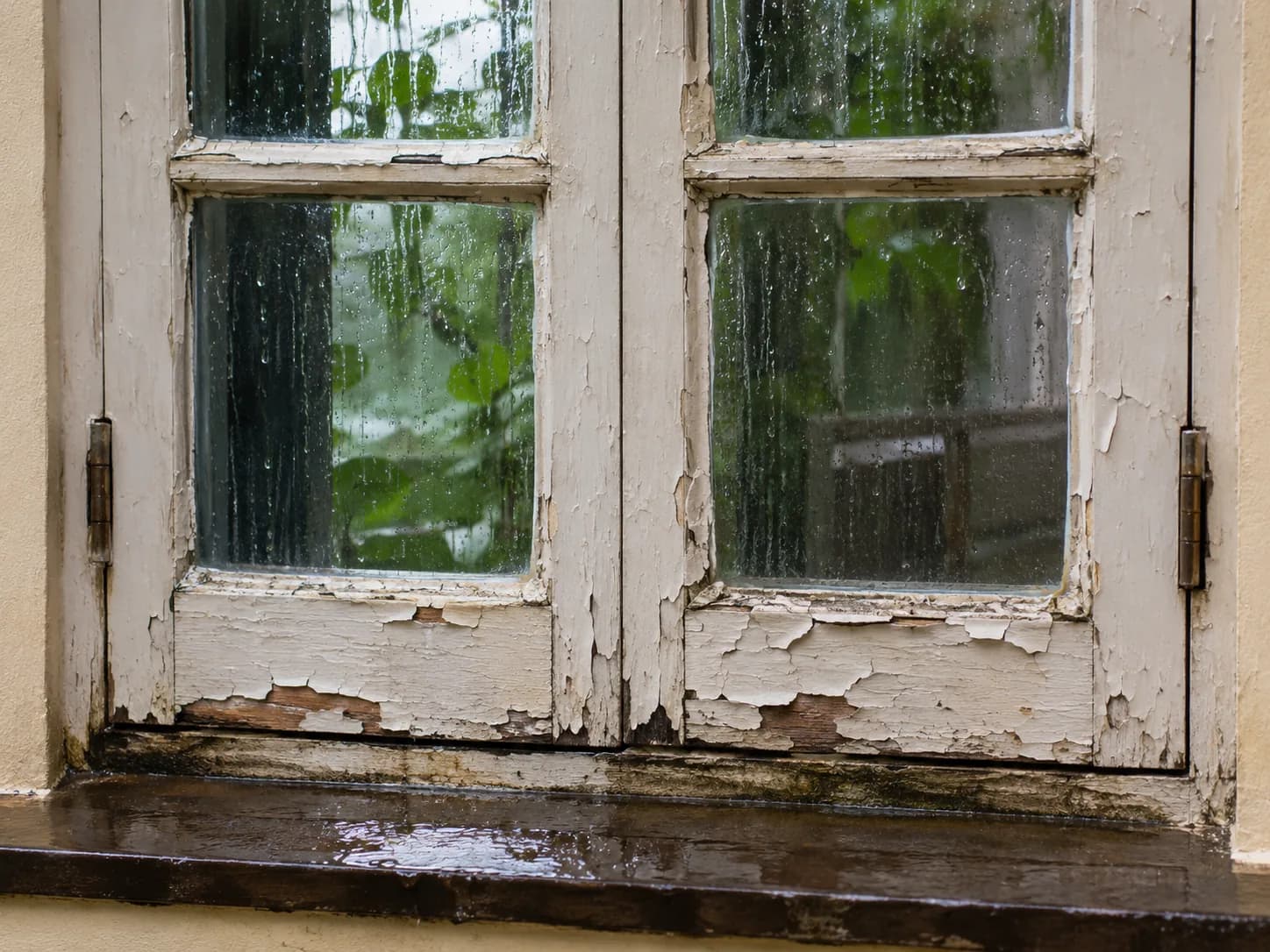
The fixes are a carpenter's and a painter's work. Repaint or repolish before the monsoon. Renew the putty. Add a drip moulding, a small sloped strip along the bottom of the shutter that throws water clear of the frame. A stick-on rubber strip where the shutter meets the frame helps a little, and you can fit that yourself. Do not fill the joints of a wooden shutter with silicone. It stops the window opening, and it can trap damp in the wood.
Fabrockers does not do carpentry or painting. If the wood is past saving, we replace wooden windows with uPVC or aluminium windows in Bengaluru. Our comparison of uPVC and wooden windows helps with that decision. If you are not sure whose job yours is, describe the fault on the repairs page and add a photo.
Window leak checks that are safe to do yourself, and those that are not
A leak is easiest to find while it is raining. These checks are safe from inside the room.
- Watch where the first drop appears. Is it the track, a side, the top corner or the wall below? Take a photo or a short video.
- Check the track. Is water standing in it, or draining?
- Touch the wall around the frame. A damp wall beside or above the frame points to the joint or the plaster, not the track.
- Dry everything, then watch again. The place that gets wet first is nearest to the entry point.
- Note the wind. A leak that only happens with wind from one side usually means seals or the joint on that side.
When a leaking window needs a repair visit
Book a visit when the track is clean, the slots are open and the window still leaks. Book one at once if the wall is getting damp, because water inside a wall damages plaster and paint over time. Our team traces the entry point before sealing anything. Sealing the wrong joint only moves the leak.
Window water leakage repair is available in Bengaluru and across Delhi NCR. The service page shows the live rate. What moves the cost is the number of windows, which part has failed, and how the outer face can be reached. For uPVC frames, see uPVC window repair. For parts, the repair cost guide lists seals and rollers.
Balcony doors leak in the same ways, with a bigger track. See sliding door leaking water and door water leakage repair. If the rain is coming into the balcony itself, that is a different job. Our guide on how to cover a balcony from rain covers it.
Book a visit. We trace where the rain is getting in, and quote in writing before we seal anything.
Water near a window that is not a window leak
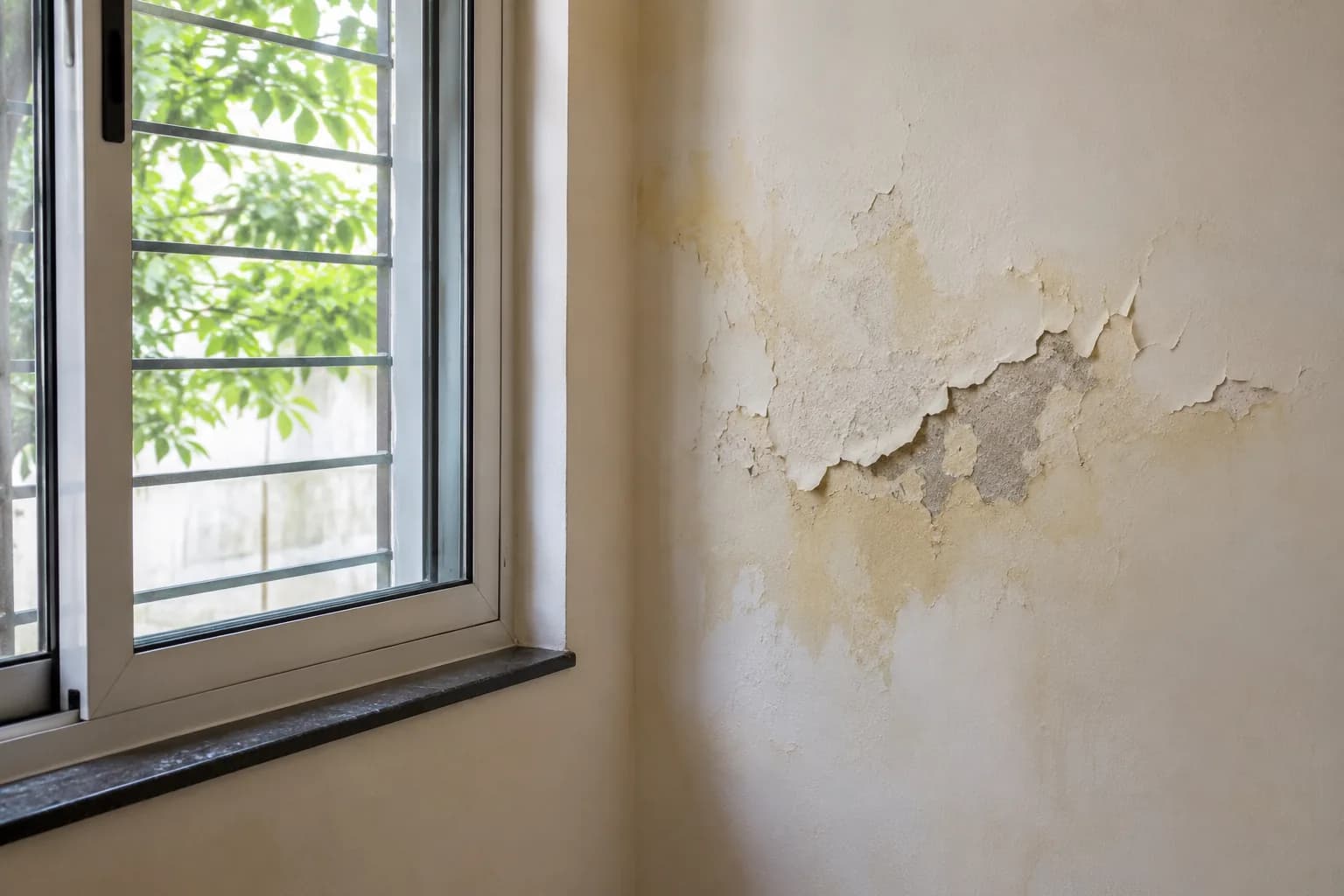
- Seepage through the wall. A damp patch far from the frame usually comes through the wall or from the floor above. So does a patch that grows days after the rain. That is waterproofing work.
- The AC drain pipe. A dripping or blocked AC drain can wet the wall beside a window in any season.
- Condensation. On cold winter mornings in Delhi NCR, drops form on the inside of the glass. That is moisture from the room air, and it wipes off.
- A leak from the balcony or terrace above. Water can travel along a slab and come out at the top of your window.
If the wet patch appears when it has not rained, the window is probably not the cause.
A pre-monsoon checklist for windows and window tracks
- Clean every track. Brush, vacuum and wipe each one.
- Open every drain slot. Test each with a little water.
- Look at the seals. Note any strip that is flat, hard, cracked or missing.
- Lock each window. A lock that does not catch is a leak waiting for wind.
- Look at the frame joints from inside. Note cracks between the frame and the plaster.
- Check wooden windows. Look for bare wood, cracked putty and loose joints, and call the carpenter early.
- Book repairs before the rain. Sealant needs a dry surface, so sealing work goes better in dry weather.
A little time on this list before the first shower saves a lot of mopping later.
Common questions
Why is rain water coming in through my sliding window?
Usually because the water in the track cannot drain. The small drain slots at the bottom of the frame get blocked with dust and insects. The track then fills and spills inside. Worn seals between the shutters and a cracked joint between the frame and the wall are the next causes. Clean the track and slots first, then check the seals.
Can I use silicone to stop rain water leaking from a window?
Only in the right place. Sealant belongs in the joint between the frame and the wall, applied on the weather side over a clean, dry surface. Never put it over the drain slots or along the track, because that traps water inside. A line of silicone on the inside face usually hides a leak without stopping it.
How do I stop rain water coming in from a wooden window?
Repaint or repolish the wood before the monsoon and renew cracked putty around the glass. Ask a carpenter to add a drip moulding to the bottom of the shutter. A stick-on rubber strip where the shutter closes helps against wind. These are carpentry and painting jobs, which we do not do.
Is water in the window track during heavy rain normal?
Yes, a little is normal. The track of a sliding window is made to catch rain and let it out through drain slots. It is a problem only when the water stands, rises and spills over the inner edge. That usually means the slots are blocked.
Who should I call for water leakage from a window, a mason or a window repair team?
It depends on where the water enters. Blocked slots, worn seals, dropped shutters and the sealant joint around the frame are window repairs. A sill that slopes inward, cracked plaster and a damp wall are a mason's or a waterproofing firm's work. A photo taken during the rain usually settles it.
How do I stop rain water leaking from a window from inside the room?
From inside you can clean the track, clear the drain slots, lock the shutter and check the seals. Those steps fix many sliding window leaks. A leak at the joint between frame and wall needs sealing on the outer side. That is not safe to do yourself on an upper floor.
Have a question this guide did not answer? Call us or send a photo on WhatsApp and we will tell you what it needs.
