
In this guide
- Why noise, heat, rain, dust and insects all use the same openings
- The home comfort ladder: cheapest fix first
- How to reduce dust in the house: where it really comes from
- How to prevent dust in the house from coming back
- How to clean window tracks easily, without making mud
- A quieter home: what works against outside noise
- A cooler home: stopping summer heat at the window
- A drier home: keeping monsoon rain out of windows and doors
- An insect-free home: mesh, gaps and standing water
- Home comfort work we do, and work that belongs to other trades
- A season-by-season home comfort checklist
Key takeaways
- Noise, heat, rain, dust and insects use the same openings. Windows, doors and the balcony are where all five come in.
- Start with gaps, not with new windows. Seals, the frame joint and the gap under the door are the cheapest fixes, and they help with all five.
- Dust is a gap problem and a cleaning problem. Close the paths in, then mop wet and keep tracks and meshes clean.
- Glass is the last step, not the first. Double glazing helps with noise and heat through the pane, after the gaps are closed.
- Mesh stops insects, not dust or rain. Each problem has its own fix, and this guide puts them in order of cost.
Why noise, heat, rain, dust and insects all use the same openings
Most comfort problems in an Indian flat have one thing in common. Traffic noise, afternoon heat, monsoon rain, road dust and mosquitoes all enter through the same few openings. Those openings are your windows, your doors and your balcony. Fix the gaps around your windows and doors first, because that one job helps with noise, heat, rain, dust and insects together.
This guide is the overview. It explains what works for each problem, with the cheapest fix first. Four longer guides go deeper into soundproofing, heat, rain water and mosquitoes, and each is linked in its section below. Dust has no guide of its own, so it gets the most space here.
We are Fabrockers. Our own teams fit and repair glass, aluminium and uPVC in Bengaluru, Mumbai, Pune and Delhi NCR. Some fixes in this guide are our work, and some belong to other trades. We say which is which, so you can plan honestly.
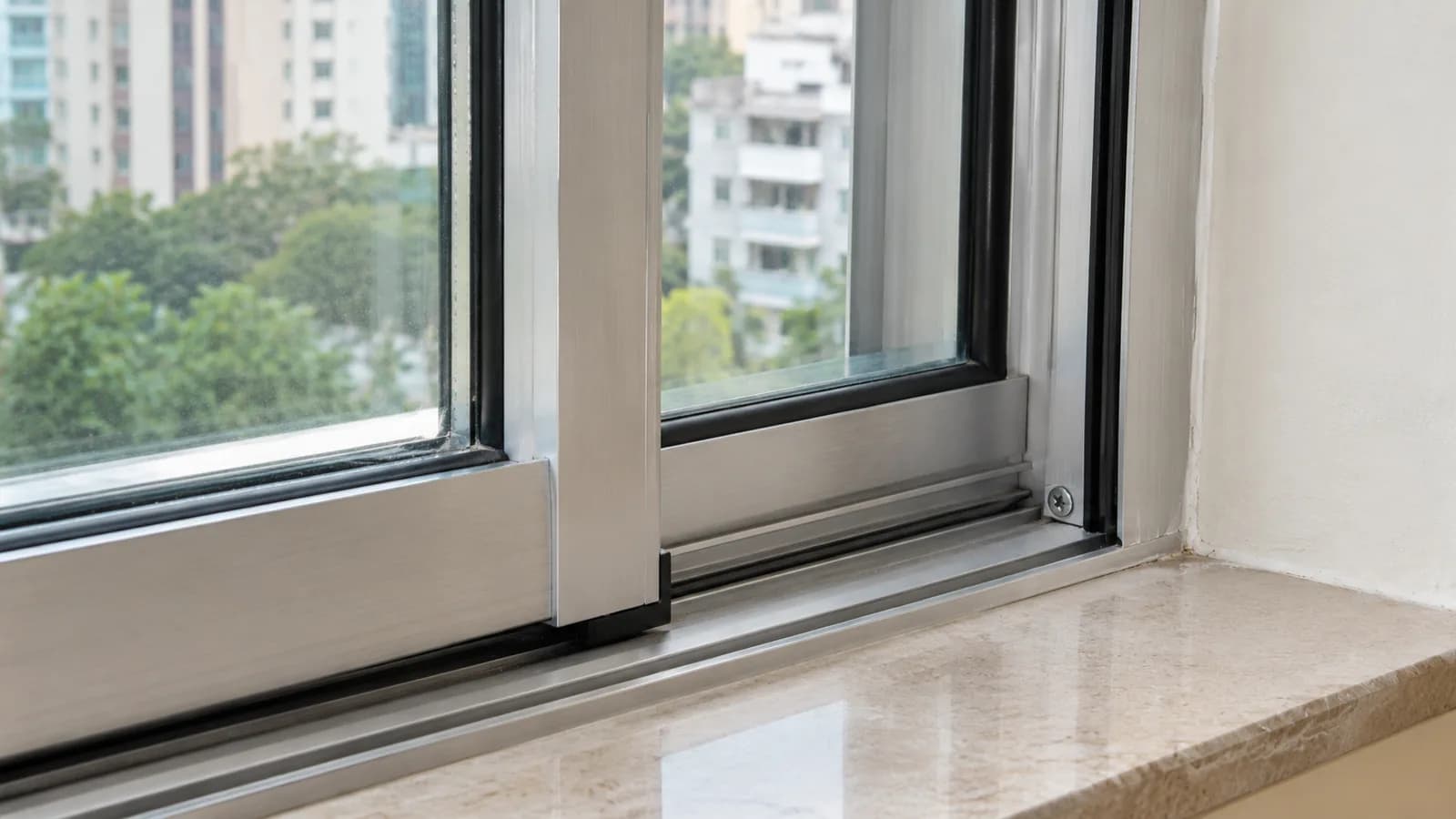
The home comfort ladder: cheapest fix first
Think of the fixes as a ladder. Each step costs more than the one below it. Most homes get most of the benefit on the first three steps, and many never need the last one.
- Step 1: Change a habitClose the road-side windows at peak traffic hours. Draw the curtains before the afternoon sun arrives. Lock sliding windows fully, because the lock pulls the shutter tight against its seals. These cost nothing.
- Step 2: Clean what is already thereClear the window tracks and their drain slots. Wash the mosquito mesh. A blocked track holds rain water, and a dusty mesh sheds dust into the room.
- Step 3: Close the gapsRenew worn seals, reseal the joint between frame and wall, and fit a seal under each door. This is the step that helps all five problems at once.
- Step 4: Add a screen or a coverFit mosquito mesh where windows stay open. Shade the glass that takes direct sun. Cover a balcony that floods or fills with dust.
- Step 5: Change the glass or the windowDouble glazing and new frames come last. They deal with noise and heat passing through the pane itself, which no seal can change.
| The problem | Usual way in | Try first | If that is not enough |
|---|---|---|---|
| Outside noise | Gaps around the frame, flat seals, then the glass | Window gap sealing and new seals | Double glazed windows, which we fit in Bengaluru |
| Summer heat | Direct sun on the glass, hot air through gaps | Shade the glass, then seal the air leaks | Double glazing with a sun-control outer pane |
| Monsoon rain | Blocked drain slots, worn seals, a cracked wall joint | Clean the track and open the slots | Window water leakage repair |
| Dust | Open windows, frame gaps, the gap under doors | Wet mopping and closed road-side windows | Door gap sealing and new window seals |
| Mosquitoes | Open windows and balcony doors with no mesh | Remove standing water, repair torn mesh | Mosquito mesh on each opening |
How to reduce dust in the house: where it really comes from
People ask how to reduce dust in the house as if dust were one thing. It is two. Some dust comes from outside: road dust, construction dust and dry soil. Some is made inside: fibres from clothes and bedding, hair, cooking residue and incense ash. The two need different answers.
Outside dust needs a path in. It comes through open windows, through gaps around frames and under doors. Inside dust needs removing before it is stirred up again. To reduce dust, close the paths it enters by, then clean with a damp cloth instead of a dry broom.
- Mop wet, do not sweep dry. A dry broom throws fine dust back into the air. It settles again within hours.
- Dust from the top down. Wipe fans, shelves and sills with a damp cloth first. Do the floor last.
- Stop dust at the door. Keep one mat outside and one inside. Leave outdoor shoes at the entrance.
- Wash the fabrics. Curtains, bedsheets and sofa covers hold dust and release it. Wash them regularly, and shake rugs outside.
- Clean the filters. AC filters and exhaust fan grilles collect dust. A clogged filter blows it around the room.
- Time your windows. Keep road-side windows shut during peak traffic and while the street is being swept.
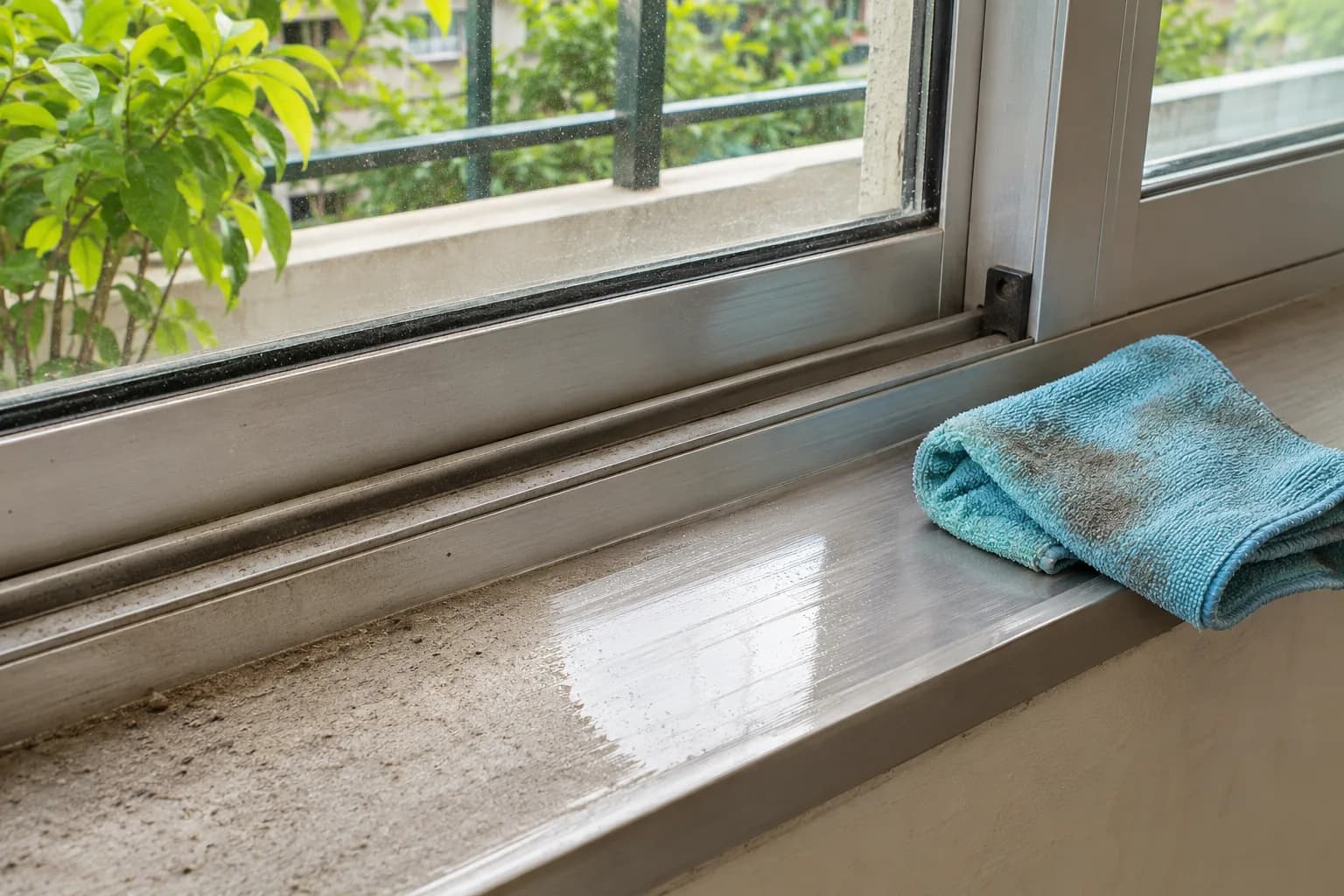
How to prevent dust in the house from coming back
To prevent dust in the house for good, look at the building as well as the cleaning. A window can be shut and still leak dust. The usual paths are small and easy to miss.
- The joint between frame and wall. Old sealant cracks in the sun. The crack is thin, but it runs all round the window. Window gap sealing closes it. Our page on a gap between window frame and wall explains the causes.
- Worn seals on the moving shutter. The shutter is the part of the window that moves. Its brush and rubber strips flatten with years of sliding. Window seal replacement brings back a tight close. If you can see daylight at a closed window, read gap in window when closed.
- The gap under the door. Most doors are hung with a gap so they clear the floor. A seal on the bottom edge closes it. See the gap under door page for the choices.
- The space beside a window AC. The packing beside the unit shrinks and lets in dust and hot air. See gap around window AC.
- The open balcony. A balcony open on one side fills with dust, and the dust travels into the room. Our page on too much dust in balcony explains what helps.
For a balcony, the fix that keeps dust out is sliding glass from the railing up to the ceiling. We fit a balcony glass cover and enclosure in Bengaluru and across Delhi NCR. It changes how the building looks, so ask your society first. A net or a mesh will not do this job, because dust passes through both.
How to clean window tracks easily, without making mud
Window tracks collect dust, dead insects, hair and grit. Add rain and it becomes mud. The mud blocks the drain slots, which are the small openings that let water out of the track. Then the track floods in the monsoon and the rollers grind all year. Cleaning the track is the easiest home job with the biggest return.
- Take out the dry dirt firstSlide the shutter to one side. Use a vacuum cleaner with a narrow nozzle, or a dry paintbrush and a dustpan. Remove everything loose before any water touches the track.
- Loosen the corners with an old toothbrushScrub the corners and the grooves while they are still dry. Vacuum again. Most of the dirt comes out at this stage.
- Wipe with a damp clothWrap a damp cloth around a blunt butter knife or a ruler. Run it along each groove. Use a little mild soapy water for sticky dirt.
- Open the drain slotsFind the small slots at the bottom of the frame. Clear them gently with a cotton bud or a wooden toothpick. Work from inside the room only.
- Test with a cup of waterPour a little water into the track. It should run away to the outside. If it stands, the slots are still blocked.
- Do the other halfSlide the shutter across and repeat on the other side. Dry the track with a cloth at the end.
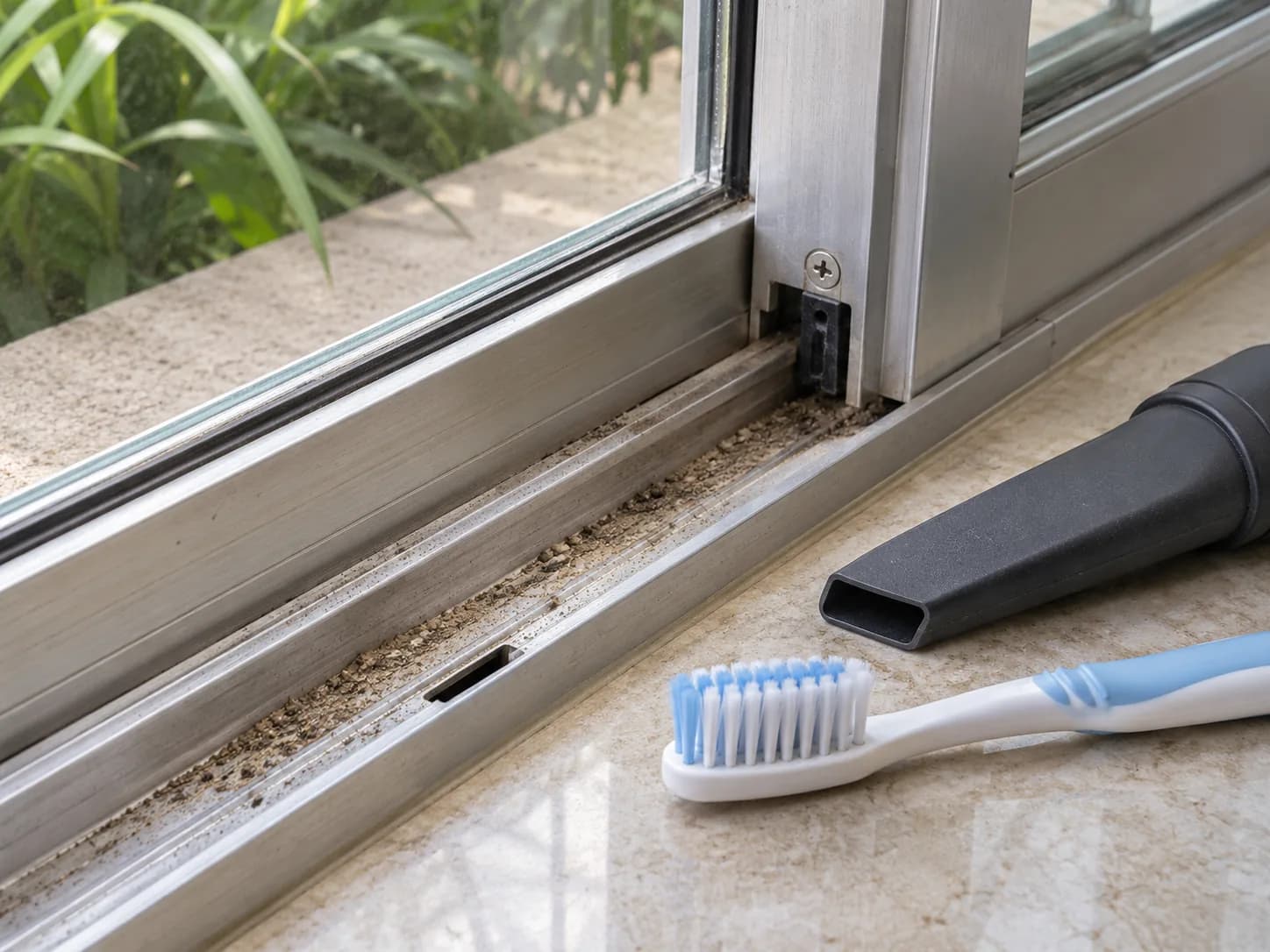
Clean the tracks before the monsoon and again after it. Near a main road or a construction site, do it more often. If water still stands in a clean track, read water in sliding window track.
A quieter home: what works against outside noise
Noise travels on air. Where air can pass, sound passes too. That is why a window with flat seals lets in traffic noise even when it is shut. The first step for a quieter room is the same gap work that keeps out dust.
After the gaps, the glass is the limit. A single pane lets sound through, however well it is sealed. Double glazing or laminated glass is the next step, and it costs much more. No window makes a room silent. Sealed gaps and the right glass can still make a loud road far easier to live with. We fit soundproof double glazed windows in Bengaluru. Sealing work is available in Bengaluru and across Delhi NCR.
Our guide on how to soundproof windows goes from free fixes to new glass. It covers flats, rentals and what you can do without replacing the window. For the diagnosis of your own window, see traffic noise coming through windows.
A cooler home: stopping summer heat at the window
Heat enters at a window in two main ways. The sun shines through the glass and warms everything it touches. Hot outside air also leaks in through gaps, while your cooled air leaks out. These two need different fixes, and people often buy the wrong one.
For direct sun, shade is the answer. Shade outside the glass works better than shade inside it, because the heat is stopped before it enters. Curtains, blinds and window film all help in their own ways, and we do not fit any of the three. For leaking air, the answer is sealing. If the AC runs all evening and the room stays warm, the window is a likely place to look.
The full order of fixes is in how to reduce heat from windows. The problem page on heat coming through windows helps you tell sun heat from leaking air.

A drier home: keeping monsoon rain out of windows and doors
Rain rarely comes through the glass. It comes through the track, the seals or the joint with the wall. A sliding window is built to catch some rain in its track and drain it outside. When the drain slots block, the track fills and spills into the room.
So the first fix is cleaning, which you can do yourself from inside. The second is new seals. The third is the joint between the frame and the wall, which needs proper sealant and a careful hand. Work on the outside of an upper floor is never a home job. Our team traces the entry point before sealing anything. For balcony doors, see door water leakage repair.
The step-by-step version is how to stop rain water from windows. It covers sliding windows, wooden windows and wet tracks. For a quick diagnosis, read window leaking rain water.
An insect-free home: mesh, gaps and standing water
Mosquitoes fly in through open windows and open balcony doors. They also come through torn mesh and the gap under a door. The building-side answer is simple. Put mesh on every opening you like to keep open, and close the small gaps.
Mesh comes in several types. Framed mesh suits most windows. Magnetic mesh suits rentals, because it usually needs no drilling. Pleated mesh and sliding mesh doors suit wide balcony openings. The mosquito net price guide explains what moves the cost. We fit mesh in Bengaluru and across Delhi NCR.
Mesh is half the job. The other half is water. Mosquitoes breed in still water, so empty plant saucers, buckets and cooler tanks regularly. Our guide on how to stop mosquitoes entering the house covers both halves. We do not do pest control, and the guide makes no claims about sprays or repellents.

Book a visit. We check the seals, the tracks and the frame joints, and quote in writing before any work.
Home comfort work we do, and work that belongs to other trades
An honest guide names its limits. Here is what our teams do, and what belongs to somebody else.
| Job | Our work? | Where, or who to ask |
|---|---|---|
| Sealing gaps around windows and doors | Yes | Bengaluru, Mumbai, Pune and Delhi NCR |
| New seals, rollers, handles and locks | Yes | Bengaluru, Mumbai, Pune and Delhi NCR |
| Tracing and sealing a rain leak at a window or door | Yes | Bengaluru, Mumbai, Pune and Delhi NCR |
| Mosquito mesh for windows, doors and balconies | Yes | Bengaluru, Mumbai, Pune and Delhi NCR |
| Double glazed windows, new uPVC and aluminium windows | Yes | Bengaluru |
| Sliding glass balcony cover | Yes | Bengaluru, Mumbai, Pune and Delhi NCR |
| Curtains, blinds and window film | No | A furnishing shop or a film supplier |
| Wall waterproofing, plaster cracks and plumbing | No | A mason, a waterproofing firm or a plumber |
| Pest control, fogging and repellents | No | A pest control company |
| Carpentry on wooden windows and doors | No | A carpenter |
Most of our part is repair work on the windows and doors you already have. See the full range under repairs and installations, or check where we work.
A season-by-season home comfort checklist
- Before summer: check the seals on sun-facing windows. Plan shade for west-facing glass. Clean the AC filters.
- Before the monsoon: clean every track and open every drain slot. Look for cracked sealant around frames. Repair torn mesh before the mosquito season.
- During the monsoon: note exactly where water appears, and when. A photo taken during the rain helps a repair team later. Empty standing water on the balcony every week.
- After the monsoon: clean the tracks again. Check wooden frames for swelling. Wash the mesh.
- In winter: in Delhi NCR, feel for cold draughts at closed windows. A winter draught is the same gap that leaks cool air in summer. See cold air coming through window.
- At any time: if a window is hard to slide or will not lock, fix that first. A window that does not close fully cannot keep anything out.
Start with one room, usually the bedroom on the road side. Do the free steps, then the gaps. Decide on new glass only after you have lived with the sealed window for a few weeks.
Common questions
How do I reduce dust in my house if I live near a main road?
Keep the road-side windows closed at peak traffic hours and mop with a wet cloth instead of a dry broom. Then close the paths dust uses: worn window seals, the joint between frame and wall, and the gap under the door. Wash mosquito mesh and AC filters often, because both collect dust.
Why is my house so dusty even with the windows closed?
A closed window can still leak. Dust comes through flat seals, cracked sealant around the frame, the gap under doors and the space beside a window AC. Some dust is also made inside the house, from fabrics, hair and cooking. Sealing the gaps and wet cleaning deal with both.
What is the easiest way to clean sliding window tracks?
Clean them dry first. Vacuum the loose dirt, scrub the corners with an old toothbrush and vacuum again. Then wipe with a damp cloth wrapped around a ruler, and clear the drain slots with a cotton bud. Do not oil the track afterwards.
Does mosquito mesh stop dust from coming into the house?
No. Mesh is made to let air through, so fine dust passes through it too. It stops insects, leaves and larger fluff. For dust, close the gaps around windows and doors, and on a balcony consider sliding glass instead.
Which should I fix first at home: noise, heat, rain or dust?
Fix the gaps first, because they are part of all four. New seals, a sealed frame joint and a seal under the door reduce noise, dust and leaking air together. A rain leak comes next if you have one, because water damages the wall. Glass and shading decisions can wait.
Do I need new windows to make my flat quieter and cooler?
Usually not as the first step. If the frame is sound, new seals and gap sealing often make a clear difference for much less money. New double glazed windows help when noise or heat is coming through the glass itself. We fit those in Bengaluru.
Have a question this guide did not answer? Call us or send a photo on WhatsApp and we will tell you what it needs.
